

TL;DR
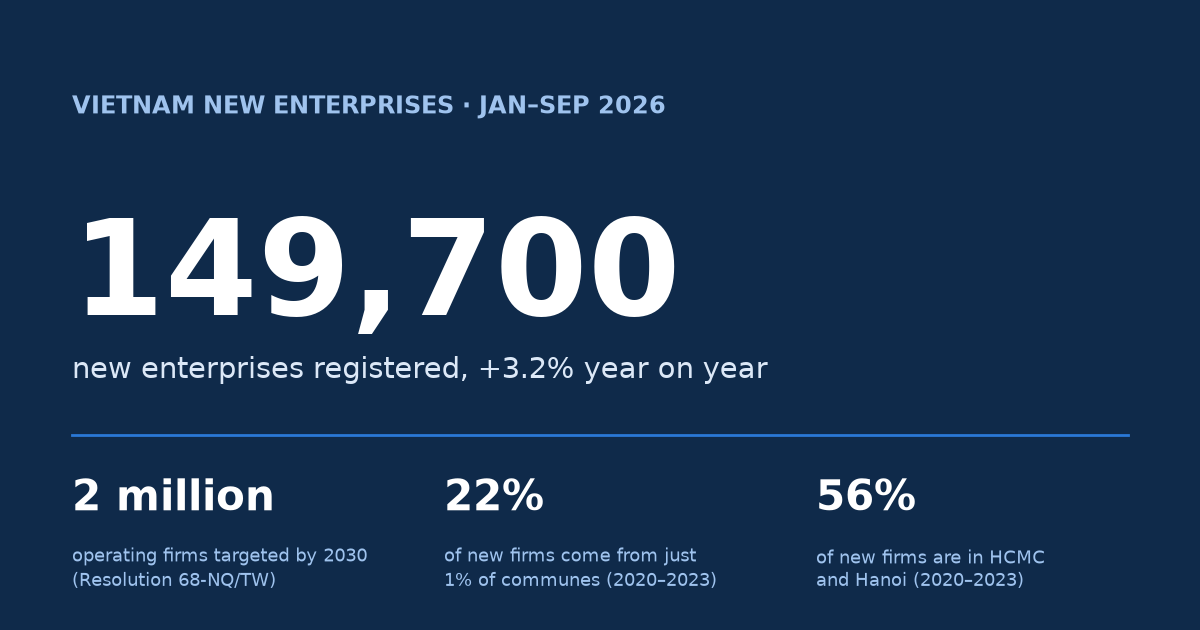
- Vietnam's new enterprise 2026 data are still growing, but more slowly. About 149,700 new enterprises registered in January–September 2026, up 3.2% year on year, while registered capital rose 32.7% (NSO, Oct 2026).
- Vietnam has set a target of 2 million operating enterprises by 2030. Resolution 68-NQ/TW (4 May 2025) also aims for 20 enterprises per 1,000 people, up from just over 940,000 enterprises when it was issued.
- 2025 was a record year for entry, with 195,100 new enterprises and 297,500 including firms that resumed operations (NSO, Jan 2026). Exits also rose: 35,900 enterprises completed dissolution in 2025, up 66.1%.
- New companies are born in very few places. On the new 2025 map, 1% of Vietnam's 3,319 communes and wards produced 22% of all new enterprises in 2020–2023, and the bottom half produced just 3% (DataCore calculation).
- Five data signals will show whether the 2030 target is on track. They are set out in Section 7.
1. What do the Vietnam new enterprises 2026 figures show?
The Vietnam new enterprises 2026 figures extend two years of historic highs, in line with the strong growth described in our analysis of Vietnam GDP Q3 2026. In 2025, 195,100 new enterprises registered with combined registered capital of VND 1.92 quadrillion. Counting the 102,300 firms that resumed operations, 297,500 businesses entered or returned to the market, up 27.4% (NSO, Jan 2026).
2026 has continued at a slower pace. Nine-month registrations reached about 149,700 (+3.2%). Registered capital grew ten times faster (+32.7%), so the average new firm is now registered with about VND 12.6 billion, up 28.5%. The number of firms resuming operations fell 14%, and September registrations dropped 31.1% year on year (NSO, Oct 2026). That monthly drop is measured against an exceptional September 2025, when about 16,800 firms registered, up 49.8% (NSO, Oct 2025).
| Indicator | Period | Value | Change y/y | Source |
| New enterprises | Jan–Sep 2026 | ~149,700 | +3.2% | NSO, Oct 2026 |
| Registered capital of new firms | Jan–Sep 2026 | VND 1.88 quadrillion | +32.7% | NSO, Oct 2026 |
| Average capital per new firm | Jan–Sep 2026 | ~VND 12.6 bn | +28.5% | NSO, Oct 2026 |
| Firms resuming operations | Jan–Sep 2026 | ~74,300 | −14% | NSO, Oct 2026 |
| New enterprises | Sep 2026 | ~11,600 | −31.1% | NSO, Oct 2026 |
| New enterprises | Sep 2025 | ~16,800 | +49.8% | NSO, Oct 2025 |
| New enterprises | Jan–Sep 2025 | 144,984 | +18.9% | NSO, Oct 2025 |
| New construction firms | Jan–Sep 2026 | ~15,000 | +33% | NSO, Oct 2026 |
| New enterprises | 2025 | 195,100 | +24.1% | NSO, Jan 2026 |
| New + resumed enterprises | 2025 | 297,500 | +27.4% | NSO, Jan 2026 |
| Completed dissolutions | 2025 | 35,900 | +66.1% | NSO, Jan 2026 |
Table 1: Vietnam new enterprises 2026 and 2025 – key indicators
Source: NSO socio-economic reports for Q3 and 9 months of 2026 (Oct 2026), Q3 and 9 months of 2025 (Oct 2025), and Q4 and full year 2025 (Jan 2026).
2. Why do new enterprises matter for Vietnam's policy in 2026?
Three policy changes since 2025 make Vietnam new enterprises 2026 data worth watching closely
- A target of 2 million enterprises. Resolution 68-NQ/TW of the Politburo on private economic development (4 May 2025) sets 2030 targets of 2 million operating enterprises and 20 operating enterprises per 1,000 people, plus at least 20 large enterprises in global value chains. The private sector is expected to grow 10–12% a year and contribute 55–58% of GDP. When the resolution was issued, Vietnam had just over 940,000 enterprises and more than 5 million household businesses.
- The end of lump-sum tax for household businesses. Resolution 198/2025/QH15 of the National Assembly (17 May 2025), which puts Resolution 68 into law, states that household and individual businesses stop using the lump-sum tax method from 1 January 2026 (Article 10, Clause 6) and must declare and pay tax under the Law on Tax Administration. The business license fee was also abolished from the same date. Once households have to keep books and declare actual revenue anyway, the extra step of registering as a company becomes smaller, which is the route Resolution 68 encourages.
- A new administrative map. Since July 2025, Vietnam has 34 provinces and 3,319 commune-level units, down from 63 provinces and over 10,000 communes. Regional statistics published before 2025 use the old boundaries.
3. Where are Vietnam's new enterprises born on the 2025 map?
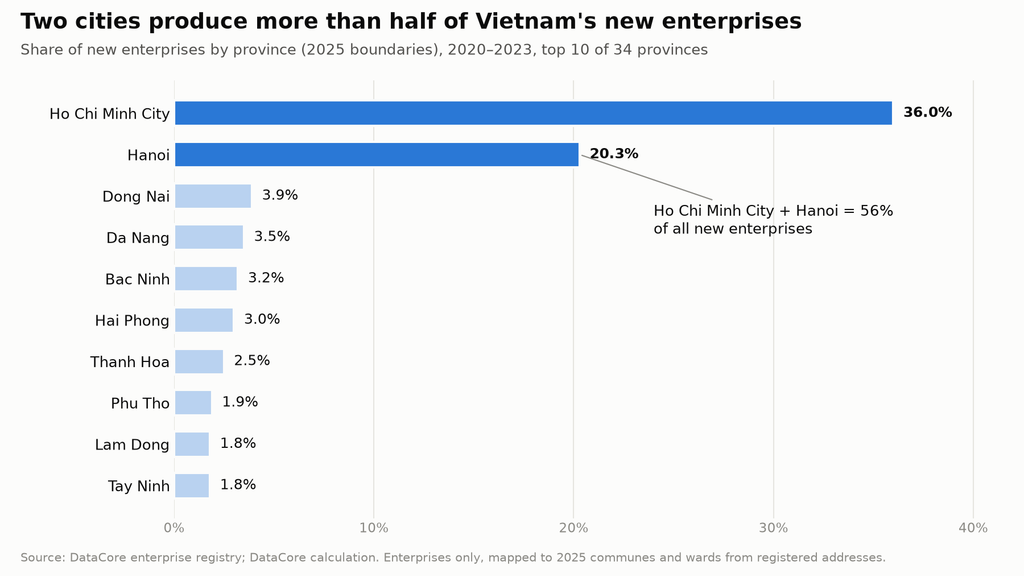
DataCore placed about 551,000 new enterprises registered in 2020–2023 into their 2025 commune or ward, 98.6% of the total. Their distribution is extremely uneven.
Chart 1: Share of new enterprises by province (2025 boundaries), 2020–2023
| Province (2025) | New enterprises 2020–2023 | Share | Average per year |
| Ho Chi Minh City | 198,539 | 36.0% | ~49,600 |
| Hanoi | 111,950 | 20.3% | ~28,000 |
| Dong Nai | 21,511 | 3.9% | ~5,400 |
| Da Nang | 19,382 | 3.5% | ~4,800 |
| Bac Ninh | 17,746 | 3.2% | ~4,400 |
| Hai Phong | 16,431 | 3.0% | ~4,100 |
| Thanh Hoa | 13,717 | 2.5% | ~3,400 |
| Phu Tho | 10,660 | 1.9% | ~2,700 |
| Lam Dong | 10,079 | 1.8% | ~2,500 |
| Tay Ninh | 9,791 | 1.8% | ~2,400 |
Source: DataCore enterprise registry; DataCore calculation. Enterprises only (10-digit tax code; excludes branches, cooperatives and household businesses), mapped to 2025 communes and wards from registered addresses.
Chart takeaway: the new Ho Chi Minh City (merged with Binh Duong and Ba Ria–Vung Tau) and Hanoi together produce more than half of all new companies, and no other province reaches 4%.
The commune level shows even more concentration:
- The top 33 communes and wards (1% of the total) produced 22% of new enterprises.
- The top 100 produced 45%.
- The bottom half (about 1,660 communes) produced just 3.3%.
- 216 communes registered no new enterprise at all in four years. The median commune registered about 7–8 per year.
- The busiest wards were Nghia Do and Yen Hoa in Hanoi and Sai Gon and An Khanh in Ho Chi Minh City, each with about 1,500–1,700 new firms per year.
- Urban wards make up 21% of commune-level units but registered 75% of new firms. Rural communes registered 24%.
For the 2030 target, this means most of Vietnam's communes contribute almost nothing to company formation. Raising the number of firms per 1,000 people outside the big urban wards is where the most growth is still available.
4. What kind of new enterprises is Vietnam creating?
Vietnam's new companies are overwhelmingly limited liability companies (LLCs).
| Legal form | Share of new enterprises, 2020–2023 |
| Limited liability company (LLC) | 82.8% |
| Joint stock company (JSC) | 16.3% |
| Private enterprise | 0.9% |
| Partnership and other | 0.1% |
Source: DataCore enterprise registry; DataCore calculation, with legal form identified from the registered company name.
Fewer than 1 in 100 new firms is a private enterprise (doanh nghiệp tư nhân), the single-owner form that is closest to a household business. This matters in 2026. Resolution 68 counts on household businesses converting into enterprises, and the tax reform gives them a reason to. If conversions are large, the private-enterprise share should rise from this low base, or converting households will go straight to single-member LLCs. Either outcome will show up in company-level registry data well before it appears in annual reports.
Firms are also getting bigger on paper. The NSO's figure of about VND 12.6 billion in average registered capital in 2026 (+28.5%) suggests that the growth in 2026 comes more from larger firms than from more firms.
5. What does the 2020–2023 shock tell us about today?
The COVID years are the most recent case of a sharp drop in registrations followed by a recovery. The official series:
| Year | New enterprises (official) | Change y/y |
| 2019 | 138,139 | — |
| 2020 | 134,941 | −2.3% |
| 2021 | 116,839 | −13.4% |
| 2022 | 148,533 | +27.1% |
| 2023 | 159,294 | +7.2% |
| 2024 | 157,240 | −1.3% |
| 2025 | 195,100 | +24.1% |
Source: Business Registration Management Agency (2019–2024); NSO (2025). Growth rates are our calculation from these official figures.
Two lessons apply to 2026. First, registrations recover quickly once the shock passes: the 2021 drop was fully reversed within a year. Second, one weak month means little on its own. The September 2026 drop of 31.1% is measured against September 2025, which was itself up 49.8% on the year before, with about 16,800 new firms. At about 11,600, September 2026 is closer to a normal month than a collapse. The fourth-quarter figures will show whether it's a trend.
DataCore's registry tracks the official series closely for these years, within ±1.3% each year from 2020 to 2023, so the regional and legal-form patterns above can be read alongside the national figures with confidence.
6. Can Vietnam reach 2 million firms by 2030?
Here is a simple calculation comparing the Vietnam new enterprises 2026 pace with the 2030 target:
| Item | Value |
| Target, 2030 (Resolution 68-NQ/TW) | 2,000,000 operating enterprises |
| Enterprises when Resolution 68 was issued (2025) | just over 940,000 |
| Gap | ~1,060,000 |
| Net addition needed per year, 2026–2030 | ~210,000 |
| New enterprises, 2025 (gross) | 195,100 |
| Completed dissolutions, 2025 | 35,900 |
Even 2025's record entry is below the required net addition, before subtracting any exits. Two levers can close the gap: keeping more new firms alive and converting household businesses. Both work at local level, in particular communes and particular sectors. That is why the 2030 target needs to be monitored at company and commune level, not only nationally.
7. Five data signals to watch through 2030
Signal 1: Do household-business conversions appear in 2026 registrations?
The end of lump-sum tax on 1 January 2026 (Resolution 198/2025/QH15) is the biggest potential source of new companies this decade. Watch for very small, low-capital firms in 2026–2027, and for the private-enterprise share rising from its 0.9% base in 2020–2023. If average capital keeps rising and private enterprises stay rare, conversions are not yet happening at scale.
Signal 2: Is company creation spreading beyond the two big cities?
In 2020–2023, Ho Chi Minh City and Hanoi produced 56% of new enterprises, and rural communes produced 24%. These are the baselines. If the merged industrial provinces (Dong Nai, Bac Ninh, Hai Phong) and rural communes increase their share, the 2025 reorganization is spreading economic activity as intended.
Signal 3: Is rising average capital a sign of quality or of fewer small entrants?
Capital grew ten times faster than firm numbers in 2026. Larger firms may survive longer, but this could also mean small founders are holding back. Compare the change in firm count with the change in median capital, not just the average.
Signal 4: Are exits growing faster than entries?
Completed dissolutions rose 66% in 2025. For the 2030 target, net entry is what counts. Tracking entry and exit at company level, by sector and region, is what DataCore's company data is designed for.
8. Why does enterprise-level data matter?
National totals show how many companies Vietnam creates. They don't show which companies, where or in what sector, and those details are what decisions depend on. All of the analysis in this post comes from counting individual firms, and the same detail is useful well beyond a blog post.
- For policymakers: measuring whether a policy is working. Resolutions 68-NQ/TW and 198/2025/QH15 set measurable goals, such as 2 million operating enterprises, 20 per 1,000 people and household businesses converting into companies. Enterprise-level data can serve as one of the measures of whether these policies succeed. Counting new registrations, exits and changes in legal form before and after 1 January 2026 shows whether the end of lump-sum tax actually moved household businesses into the enterprise sector. Comparing communes and provinces shows where policies are taking hold and where they are not. Since the 2025 reorganization, these comparisons need baselines on the new boundaries, which national reports do not provide.
- For banks and lenders: finding SME demand. New firms need accounts, credit and payment services. Knowing where firms are being created, how much capital they register and which sectors they are in helps lenders size markets, place branches and prioritize outreach, including to household businesses as they convert.
- For businesses: choosing where to sell and expand. B2B suppliers, accounting and software providers, and industrial-park developers all depend on the number of firms in an area. A ward with 1,500 new companies a year is a very different market from a commune with fewer than one.
- For investors and researchers: reading the economy early. Registrations by sector are a leading indicator. The 33% jump in new construction firms in 2026 says something about expected public investment months before the output data shows it.
- For risk and compliance teams: knowing who you deal with. Company-level records (legal form, registration date, address, sector) are the basis for verifying partners and suppliers.
Each of the five signals in Section 7 can only be tracked with this level of detail. DataCore's company data provides it by company, commune, province, sector and legal form, matching official national counts within ±1.3% for 2020–2023.
Vietnam new enterprises 2026 figures show companies being created at a record pace, but in very few places and increasingly as larger firms. Reaching 2 million firms by 2030 depends on whether entry spreads beyond the big urban wards and whether household businesses convert, and company-level data will show both first.
9. FAQ
What does Resolution 68-NQ/TW aim for?
Issued by the Politburo on 4 May 2025, it sets 2030 targets of 2 million operating enterprises, 20 enterprises per 1,000 people and private-sector growth of 10–12% a year, and calls the private sector the most important driver of the economy.
How many new companies does Vietnam need each year to reach the target?
About 210,000 net additions a year from 2026 to 2030, more than the 195,100 gross registrations in the record year of 2025.
How many new enterprises did Vietnam register in 2026?
Vietnam new enterprises 2026: about 149,700 registered in January–September, up 3.2% year on year, with registered capital up 32.7% (NSO, Oct 2026).
10. References
Policy documents
- Politburo, Resolution No. 68-NQ/TW on private economic development (Nghị quyết số 68-NQ/TW của Bộ Chính trị về phát triển kinh tế tư nhân), 4 May 2025.
- National Assembly, Resolution No. 198/2025/QH15 on special mechanisms and policies for private economic development (Nghị quyết số 198/2025/QH15 về một số cơ chế, chính sách đặc biệt phát triển kinh tế tư nhân), 17 May 2025, Article 10, Clause 6.
Official statistics
- National Statistics Office (NSO), Ministry of Finance, “Báo cáo tình hình kinh tế - xã hội quý III và 9 tháng năm 2026” (Socio-economic report for Q3 and 9 months of 2026), Oct 2026. https://www.nso.gov.vn/bai-top/2026/10/bao-cao-tinh-hinh-kinh-te-xa-hoi-quy-iii-va-9-thang-nam-2026/
- NSO, “Báo cáo tình hình kinh tế - xã hội quý IV và năm 2025” (Socio-economic report for Q4 and full year 2025), 5 Jan 2026. https://www.nso.gov.vn/bao-cao-tinh-hinh-kinh-te-xa-hoi-hang-thang/
- NSO, “Báo cáo tình hình kinh tế - xã hội quý III và 9 tháng năm 2025” (Socio-economic report for Q3 and 9 months of 2025), 6 Oct 2025. https://www.nso.gov.vn/bao-cao-tinh-hinh-kinh-te-xa-hoi-hang-thang/
- NSO, “Tình hình doanh nghiệp gia nhập và tái gia nhập thị trường năm 2024” (Business entry and re-entry in 2024), Jan 2025. https://www.nso.gov.vn/du-lieu-va-so-lieu-thong-ke/2025/01/tinh-hinh-doanh-nghiep-gia-nhap-va-tai-gia-nhap-thi-truong-nam-2024/
- Business Registration Management Agency, Ministry of Finance, annual new-enterprise statistics, 2019–2024.
How Vietnamese Fintechs Are Re-Wiring KYB Onboarding Around a Single Resolver CallHow Vietnam’s 2025 Commune Merger Quietly Broke Bank Customer-Address Tables (And the Cleanup Pattern That Works)How Vietnamese Fintechs Are Re-Wiring KYB Onboarding Around a Single Resolver CallHow Vietnam’s 2025 Commune Merger Quietly Broke Bank Customer-Address Tables (And the Cleanup Pattern That Works)How Vietnamese Fintechs Are Re-Wiring KYB Onboarding Around a Single Resolver CallHow Vietnam’s 2025 Commune Merger Quietly Broke Bank Customer-Address Tables (And the Cleanup Pattern That Works)






Để lại một bình luận
You must be logged in to post a comment.