
TL;DR
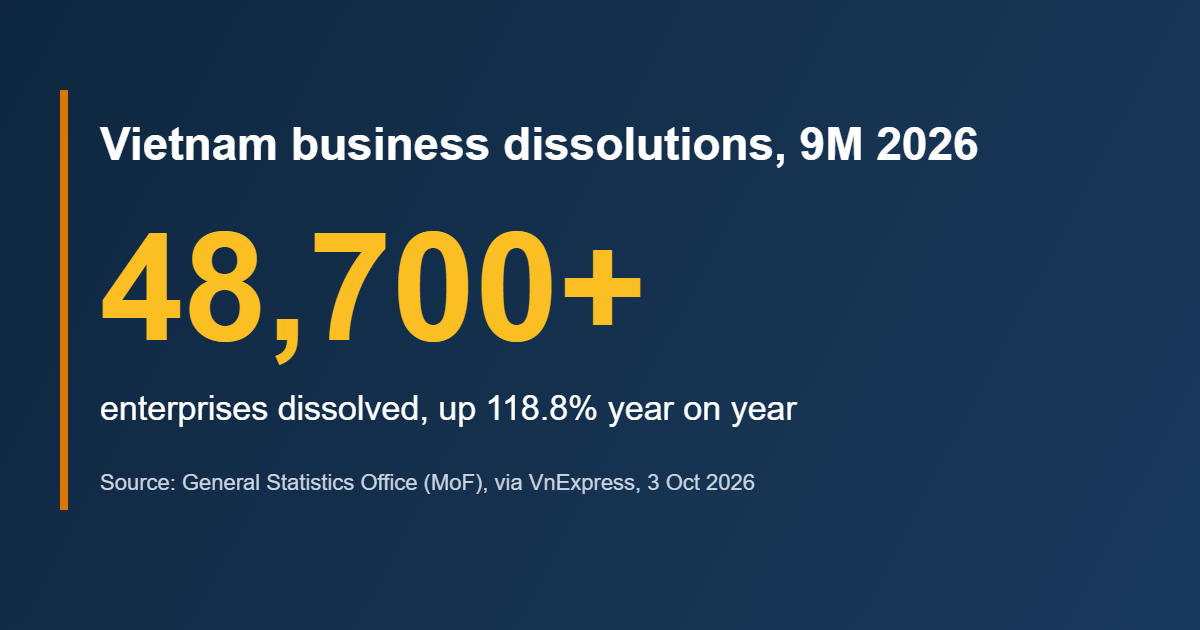
- Vietnam business dissolutions reached more than 48,700 enterprises in the first nine months of 2026, up 118.8% year on year, according to the General Statistics Office under the Ministry of Finance, as reported by VnExpress on 3 October 2026.
- Total market exits (dissolutions, temporary suspensions and enterprises stopped while awaiting dissolution) averaged about 19,100 per month over January to September 2026 (VnExpress, 3 October 2026).
- New registrations held up: nearly 149,700 new enterprises, up 3.2%, with registered capital of about VND 1.88 quadrillion, up 32.7% (VnExpress, 3 October 2026).
- Wholesale, retail and motor vehicle repair led Vietnam business dissolutions with 18,579 enterprises, up 129% (VnExpress, 3 October 2026).
- For lenders, suppliers and B2B sales teams, the practical lesson is simple: a company record that was correct in January may be wrong by October. Five data checks below help keep counterparty files current.
Table of contents
- What do the 9-month 2026 figures on Vietnam business dissolutions show?
- Which sectors are driving Vietnam business dissolutions in 2026?
- Who is exiting: what does the capital size of dissolved firms tell us?
- Why do Vietnam business dissolutions matter for counterparty data?
- What are the 5 critical data checks to run now?
- How should lenders, suppliers and B2B teams adjust their workflows?
- What do the figures not tell us yet?
- FAQ
- Sources
What do the 9-month 2026 figures on Vietnam business dissolutions show?
Vietnam business dissolutions more than doubled in the first nine months of 2026. The General Statistics Office (GSO, Cục Thống kê), the statistics agency under the Ministry of Finance (MoF), reported that more than 48,700 enterprises completed dissolution procedures from January to September 2026, an increase of 118.8% over the same period of 2025 (VnExpress, Phương Dung, 3 October 2026).
In the data on Vietnam business dissolutions, dissolution is only one of three exit routes that the GSO tracks. Nearly 89,800 enterprises suspended business for a fixed period, down 9.7%, and about 33,500 stopped operating while waiting to complete dissolution procedures, down 37% (VnExpress, 3 October 2026). Across all three routes, an average of 19,100 enterprises left the market each month.
On the entry side, the picture is steadier. Nearly 149,700 enterprises were newly established in the nine months, up 3.2%, with total registered capital of about VND 1.88 quadrillion, up 32.7%. Nearly 74,300 enterprises returned to operation, down 14%. In total, more than 223,900 enterprises entered or re-entered the market, down 3.2% (VnExpress, 3 October 2026).
| Indicator, 9M 2026 (Jan to Sep) | Value | Change vs 9M 2025 |
|---|---|---|
| Enterprises completing dissolution | 48,700+ | +118.8% |
| Enterprises suspending business for a fixed period | about 89,800 | -9.7% |
| Enterprises stopped, awaiting dissolution | about 33,500 | -37% |
| Average market exits per month (all three routes) | about 19,100 | n/a |
| Newly established enterprises | about 149,700 | +3.2% |
| Registered capital of new enterprises | about VND 1.88 quadrillion | +32.7% |
| Enterprises returning to operation | about 74,300 | -14% |
| Total entering or re-entering the market | 223,900+ | -3.2% |
Source: GSO (Ministry of Finance), via VnExpress, 3 October 2026.
A simple calculation from these GSO figures puts total exits across the three routes at roughly 172,000 enterprises in nine months (48,700 + 89,800 + 33,500). That is DataCore's arithmetic on the published numbers, not a GSO statistic. It is consistent with the reported average of 19,100 exits per month.
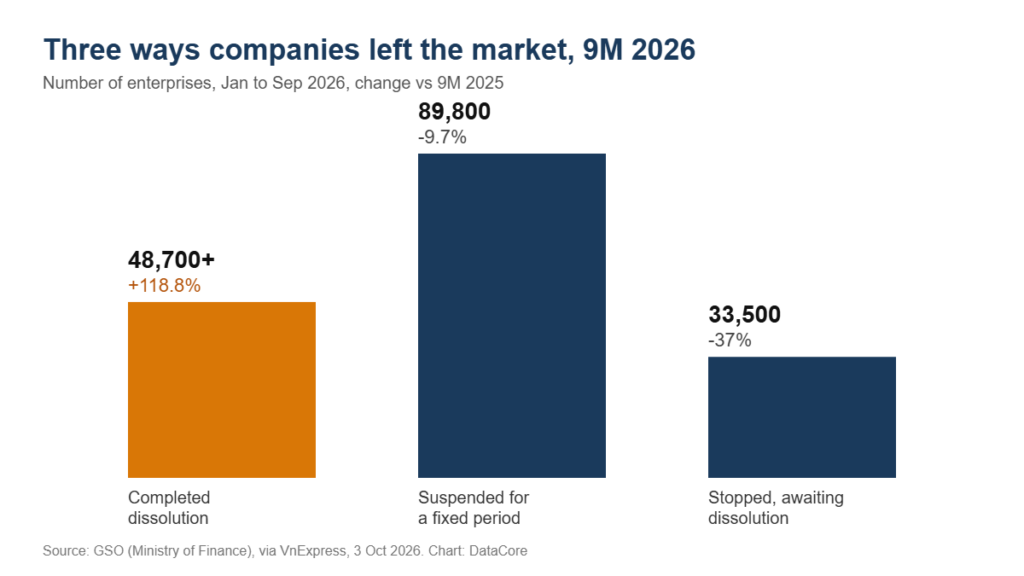
The chart's takeaway in one sentence: dissolutions are the smallest of the three exit routes in absolute terms, but they are the only one that grew, and they grew fast.
Which sectors are driving Vietnam business dissolutions in 2026?
Vietnam business dissolutions are concentrated in trade and services. Wholesale, retail and motor vehicle and motorcycle repair accounted for 18,579 dissolved enterprises in nine months, up 129% (VnExpress, 3 October 2026). Thanh Nien, citing the same GSO release, put that sector at 48.9% of all dissolutions (Thanh Nien, Lê Hiệp, 3 October 2026).
Other sectors with large increases, all for 9M 2026 versus 9M 2025 (VnExpress, 3 October 2026):
- Manufacturing and processing: 5,253 dissolved enterprises, up 114.8%.
- Construction: 3,646 dissolved enterprises, up 128.2%.
- Real estate: 2,813 dissolved enterprises, up 123.3%.
By broad sector, services made up 77.8% of Vietnam business dissolutions, or 37,923 enterprises (Thanh Nien, 3 October 2026).
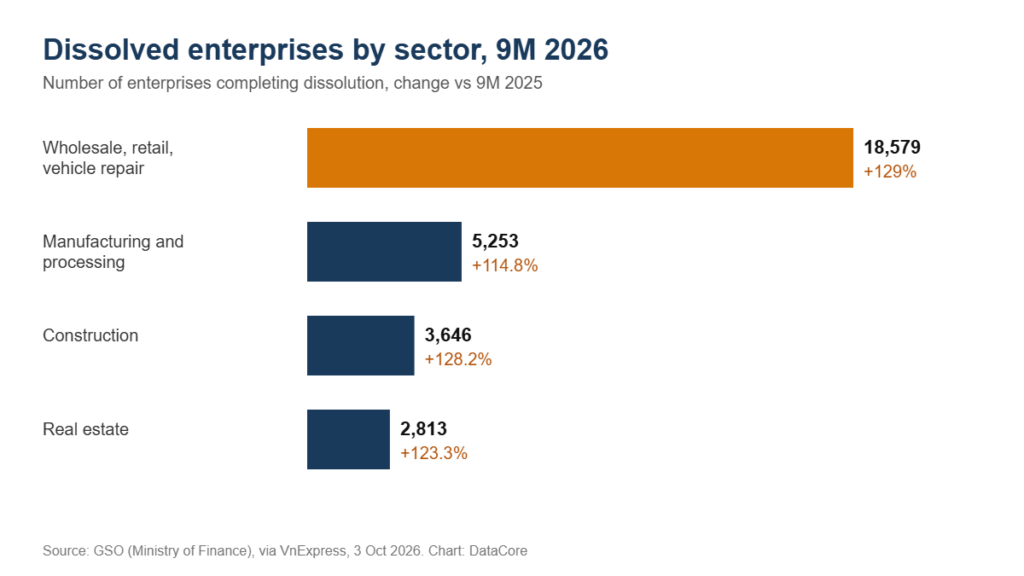
For data teams, the sector split matters because these are the sectors with the most counterparties per customer. A distributor, a bank's SME desk or a B2B marketplace typically holds far more trading and retail counterparties than manufacturing ones. When Vietnam business dissolutions cluster in trade, the share of stale records in a typical supplier or customer file rises fastest.
Construction and real estate deserve their own attention. Both sectors run long contracts, subcontractor chains and progress payments. A dissolved subcontractor can leave warranty obligations, unpaid invoices or unclear liability, which is why contract owners should know about the change early rather than at the next payment run.
Who is exiting: what does the capital size of dissolved firms tell us?
Most Vietnam business dissolutions involve small companies. According to the GSO data cited by Thanh Nien, 90.3% of dissolved enterprises had registered capital below VND 10 billion (Thanh Nien, 3 October 2026).
At the same time, new companies are getting larger on paper. The average registered capital of a newly established enterprise reached VND 12.6 billion in 9M 2026, up 28.5% (VnExpress, 3 October 2026). In September alone, the average was VND 15.2 billion across nearly 11,600 new enterprises (Thanh Nien, 3 October 2026).
Behind Vietnam business dissolutions, two patterns therefore run side by side. Small firms are leaving in larger numbers, while the firms that register are, on average, bigger. For anyone scoring SMEs, that combination changes the base population. A model calibrated on 2025 data may see a different mix of company sizes in late 2026, and that is worth testing before it shows up in loss rates.
Small counterparties are also the ones with the thinnest public footprint. A large listed company that dissolves makes headlines. A trading company with VND 2 billion in charter capital that dissolves usually does not, and the only reliable signal may be the change in its legal status on the national registry. Our earlier guide to common Vietnamese company lookup mistakes covers why manual checks miss these changes.
Why do Vietnam business dissolutions matter for counterparty data?
Vietnam business dissolutions matter because every company record has a shelf life. A tax code, a registered address, a legal representative and a legal status are all true at a point in time. When exits accelerate, the share of records that have quietly expired grows with them.
Consider the three exit routes from a data point of view:
- Dissolved enterprises have completed the legal process. Contracts with them need to be closed, receivables collected or written off, and any open credit lines stopped.
- Suspended enterprises may come back. Nearly 74,300 enterprises returned to operation in 9M 2026 (VnExpress, 3 October 2026), so a suspension is a warning flag, not an end state.
- Awaiting dissolution enterprises have stopped operating but have not finished the paperwork. This is the riskiest grey zone, because the company still looks alive on paper while its ability to perform is uncertain.
Each route calls for a different action. Treating them as one "inactive" bucket hides that difference. A credit team may cut a suspended customer that would have returned in two months, while a procurement team may keep paying a supplier that is already waiting to dissolve.
There is also a timing problem. Vietnam business dissolutions are recorded when the legal procedure is complete, which can be weeks or months after the company actually stopped trading. Teams that only check status at onboarding will see the change late, if at all.
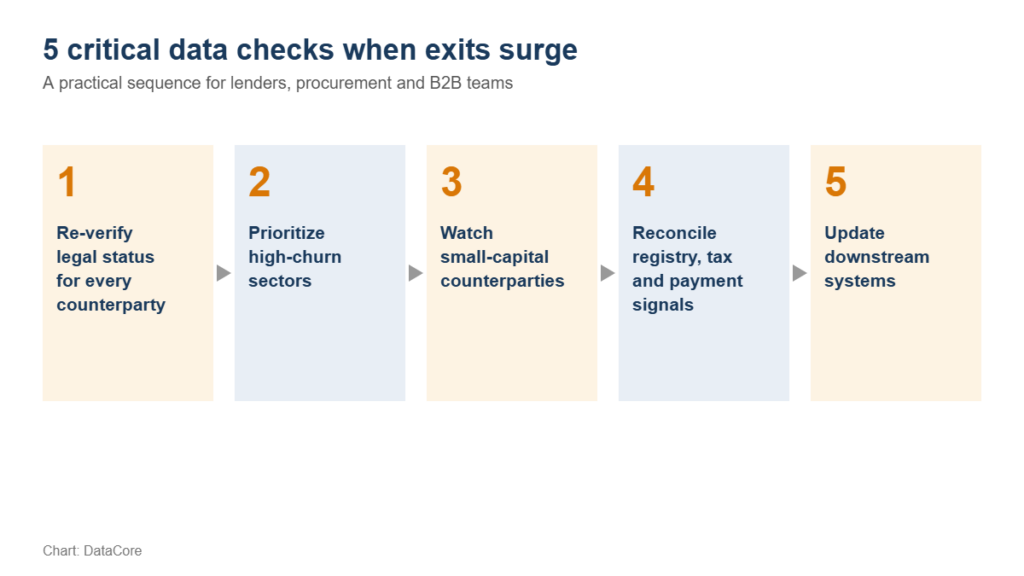
What are the 5 critical data checks to run now?
The checks below are practical responses to Vietnam business dissolutions that any team can run against its own counterparty list. None depends on a specific vendor, though a structured company data source makes them faster.
Check 1: Re-verify legal status for every active counterparty
Start with a full status refresh across customers, suppliers and borrowers. Compare each tax code against its current status on the national business registry and flag anything not shown as operating. Given the pace of Vietnam business dissolutions in 2026, a quarterly refresh is a sensible minimum for most portfolios, and monthly for high-exposure accounts.
Distinguish the three exit states in your data model: dissolved, suspended for a fixed period, and stopped while awaiting dissolution. Our article on KYB onboarding around a single resolver call explains how to structure a status lookup so it returns a clean, auditable answer.
Check 2: Prioritize high-churn sectors first
Not all records carry the same risk. Sort your counterparty file by industry code and refresh wholesale and retail, construction and real estate counterparties first, since these sectors saw Vietnam business dissolutions rise between 123.3% and 129% in 9M 2026 (VnExpress, 3 October 2026).
This is a triage step for tracking Vietnam business dissolutions, not a judgment on any individual company. Many companies in these sectors are healthy. The point is that, statistically, a stale record is more likely to sit in these buckets.
Check 3: Watch small-capital counterparties more closely
Since 90.3% of dissolved enterprises had capital under VND 10 billion (Thanh Nien, 3 October 2026), charter capital is a reasonable second sorting key. Small-capital counterparties with recent changes, such as a new legal representative, a moved registered address or a reduced charter capital, deserve a closer look.
A single change is rarely a problem on its own. A cluster of changes in a short window, followed by a suspension, is a pattern worth an alert.
Check 4: Reconcile registry status with tax and payment signals
Registry status is one signal. Tax status and payment behavior are others. Vietnam's tax authority uses codes for taxpayers who are not operating at their registered address, and banks are starting to use tax data in credit reviews. Our post on how banks use tax data in credit scoring through CIC describes that new data layer.
When registry status, tax status and your own payment history disagree, treat the disagreement itself as the finding. A company shown as operating on the registry but with a tax-address flag and 60 days of late payments is a very different risk from one that is clean on all three.
Check 5: Close the loop in downstream systems
A status change is only useful if it reaches the systems that act on it. Map where counterparty records live: the CRM, the ERP vendor master, the loan origination system, the e-invoicing setup. Then decide who gets told when a counterparty becomes dissolved, suspended or awaiting dissolution.
Typical actions include blocking new purchase orders, stopping automated invoicing, moving receivables to collections, and removing dissolved companies from marketing lists. For a broader view of why record quality drives everything downstream, see our piece on data quality as the foundation for AI in Vietnam.
How should lenders, suppliers and B2B teams adjust their workflows?
Different teams feel Vietnam business dissolutions in different ways. A short view by function:
Banks and lenders. SME credit desks should add status monitoring to the life of every loan, not just onboarding. The rise in dissolutions among small firms overlaps with the segment that already struggles to borrow, as our article on SME credit access in Vietnam discusses. Better monitoring can support more lending, because lenders can price risk they can see.
Procurement and supply chain. Vendor masters are often the least maintained data set in a company. A quarterly status refresh, plus an alert for suppliers in high-churn sectors, lowers the chance of prepaying a supplier that is already exiting.
Sales and marketing. B2B prospect lists decay. When Vietnam business dissolutions double, outbound teams waste more effort on companies that no longer exist, and bounce rates rise. Removing dissolved and awaiting-dissolution companies from target lists is a quick win.
Investors and analysts. Sector-level exit data is a useful complement to output and credit data. The sharp rise in trade-sector dissolutions sits alongside steady new registrations and much larger average registered capital. Watching both sides of the flow, not just one, gives a more balanced view of business dynamics.
Compliance teams. Know-your-business (KYB) files need a refresh trigger. A legal-status change should prompt a review, especially where the counterparty is also a payment recipient.
For teams that want to automate these steps, DataCore's company data services provide structured Vietnamese company records, and you can test lookups in the company data trial.
What do the figures not tell us yet?
The GSO release, as reported, gives totals and sector splits. It does not, in the coverage reviewed for this article, explain why Vietnam business dissolutions more than doubled. It would be easy to guess at causes, but the published figures do not support a single explanation, so this article does not offer one.
Three other limits are worth keeping in mind:
- Recording lag. Dissolutions are counted when procedures are completed. Some of the 2026 rise may reflect companies that stopped trading earlier and only finished paperwork this year. The figures alone cannot separate the two.
- Direction of the other exit routes. Suspensions fell 9.7% and stopped-awaiting-dissolution fell 37% (VnExpress, 3 October 2026). A shift between exit routes, rather than only more exits, may be part of the story.
- Entry quality. New registrations rose 3.2%, but the total entering or re-entering the market fell 3.2% because fewer companies returned from suspension (VnExpress, 3 October 2026).
Sentiment data adds some context to Vietnam business dissolutions. In the GSO's Q3 2026 survey of manufacturing firms, 34.2% reported better conditions than the previous quarter, 45.7% reported stable conditions and 20.1% reported more difficulty, while 39.2% expected improvement in Q4 (Thanh Nien, 3 October 2026). That does not look like a broad collapse in manufacturing confidence, which suggests the dissolution surge should be read sector by sector.
Overall GDP growth for the first nine months of 2026 was reported at 9.01% year on year (Znews, Liên Phạm, 3 October 2026). Strong headline growth and a doubling of Vietnam business dissolutions can both be true at once. Growth can be concentrated in larger firms and certain sectors while many small trading companies close.
FAQ
How many businesses were dissolved in Vietnam in 2026?
More than 48,700 enterprises completed dissolution procedures in the first nine months of 2026, up 118.8% year on year, according to the GSO under the Ministry of Finance (VnExpress, 3 October 2026). Full-year 2026 figures were not yet published as of 4 October 2026.
Which sector has the most Vietnam business dissolutions?
Wholesale, retail and motor vehicle and motorcycle repair, with 18,579 dissolved enterprises in 9M 2026, up 129% (VnExpress, 3 October 2026). That is 48.9% of all dissolutions (Thanh Nien, 3 October 2026).
Are more companies being created than closed in Vietnam?
Yes, on the GSO figures. More than 223,900 enterprises entered or re-entered the market in 9M 2026, while exits across all three routes total roughly 172,000 by DataCore's calculation from the same release. New registrations rose 3.2% to about 149,700.
What is the difference between dissolved and suspended companies?
A dissolved company has completed the legal procedure to end its existence. A suspended company has paused business for a fixed period and may return; about 74,300 companies returned to operation in 9M 2026 (VnExpress, 3 October 2026). Companies "awaiting dissolution" have stopped operating but not yet finished the procedure.
How often should I check the status of Vietnamese counterparties?
At onboarding and then on a schedule that matches exposure. With Vietnam business dissolutions more than doubling in 2026, a quarterly refresh is a sensible minimum, with monthly checks for large or high-risk accounts and for high-churn sectors.
How can I check a Vietnamese company's legal status quickly?
Look up its tax code on the national business registry and tax portals, or use a structured company data service. DataCore's company data trial lets you test lookups by tax code or name.
Sources
- VnExpress (Phương Dung): Hơn 48.700 doanh nghiệp giải thể trong 9 tháng, 3 Oct 2026
- Thanh Nien (Lê Hiệp): Hơn 48.700 doanh nghiệp rút lui, tăng 118,8%, 3 Oct 2026
- Znews (Liên Phạm): Gần 150.000 doanh nghiệp thành lập mới trong 9 tháng, 3 Oct 2026
- Underlying data: General Statistics Office (Cục Thống kê), Ministry of Finance, socio-economic report for Q3 and 9M 2026, as cited by the three outlets above.






Để lại một bình luận
You must be logged in to post a comment.