
TL;DR: Many Vietnamese enterprises are investing in artificial intelligence (AI) to optimize operations, personalize customer experiences, and accelerate decision-making. Yet AI performance depends directly on trusted data. To enable AI to create real business value, enterprises need to start by building trusted data infrastructure capable of connecting, standardizing, validating, and generating reliable insights. This article explains what trusted data means, how it works as a mechanism inside an enterprise, and what changes for leaders, finance teams, marketing teams, and data teams.

Why Is Trusted Data Now the Foundation for Vietnamese Enterprises to Grow with AI?
For many years, enterprises have typically been evaluated based on traditional factors such as:
- Revenue scale.
- Production capacity.
- Market share.
- Physical assets.
- Brand value.
However, in the digital economy, a new factor is increasingly determining an enterprise's competitiveness: its ability to own and leverage valuable, trusted data.
At CRIF Forum Vietnam 2026, organized by CRIF Vietnam under the theme "Empowering Growth with Trusted Data," experts emphasized that transparent and verifiable data is becoming a foundation for improving decision-making, managing risk, and strengthening trust among investors and financial institutions.
This reflects an important shift: data is no longer merely a resource supporting internal operations. Trusted data is increasingly becoming a form of "trust asset" that enables enterprises to demonstrate their capabilities in the market.
At the same time, Vietnamese enterprises are facing a paradox:
- Data is growing exponentially.
- Technology is becoming increasingly powerful.
- AI is becoming increasingly widespread.
However, the ability to turn data into business decisions remains limited. The issue is not how much data an enterprise has. The real question is: how much can an enterprise trust its own data? That question is the starting point for every trusted data strategy.
What Did CRIF Forum Vietnam 2026 Signal About Trusted Data for Vietnamese Enterprises?
Trusted data is becoming a foundation of business trust. In an increasingly complex business environment, enterprises compete not only through products or costs. They must also demonstrate:
- Governance capabilities.
- Transparency.
- Risk management capabilities.
- The ability to adapt to emerging technologies.
At CRIF Forum Vietnam 2026, one important message was emphasized: standardized and structured data helps enterprises, investors, and financial institutions assess risks, identify opportunities, and make more confident decisions. This is particularly important for:
- Credit assessment.
- Corporate investment.
- Supply chain expansion.
- Business partnerships.
- Entering international markets.
An enterprise with transparent, trusted data can more easily demonstrate its capabilities to banks, investors, partners, and major customers.
For banks and investors: Transparent financial and operational data serves as the most credible "identity card" for an enterprise to demonstrate its governance capabilities and actual financial health.
When indicators such as revenue, cash flow, costs, and capital efficiency are accurately and clearly digitized, supervisory boards and investors can quickly assess risk levels, profitability, and growth potential. This helps reduce concerns over "inflated" figures, strengthen strategic trust, shorten due diligence processes, and make it easier for enterprises to access preferential financing or successfully raise capital at higher valuations.
For partners and major customers: Transparency in operational data, such as production capacity, quality-control processes, on-time delivery rates, and customer service history, is compelling evidence of execution capabilities.
Global corporations and partners always seek to minimize supply chain risks. They do not simply choose organizations that make strong commitments; they choose organizations that can provide trusted data proving those commitments. Clear and consistent data demonstrates professionalism, stability, and accountability, helping enterprises build a competitive advantage, win contracts, and establish long-term strategic partnerships.
However, data today still exists in the form of "data silos." One of the biggest challenges enterprises face is that data is fragmented across multiple systems. For example, a retail enterprise may have:
| Data Source | Managing Department |
|---|---|
| Customer information | Marketing |
| Orders | Sales |
| Payments | Finance |
| Website behavior | Digital |
| Inventory | Operations |
Takeaway: each department owns important data, but if these data sources are not connected, the enterprise lacks a comprehensive view of its customers and business operations. This is precisely the gap between having data and having trusted data capabilities.
Why Can't AI Reach Its Full Potential Without Trusted Data?
Reliable data does not necessarily mean large amounts of data. An enterprise may have millions of customer records. But if:
- Data is duplicated.
- Information is inaccurate.
- Data sources are unclear.
- Data is not updated.
- Data cannot be connected.
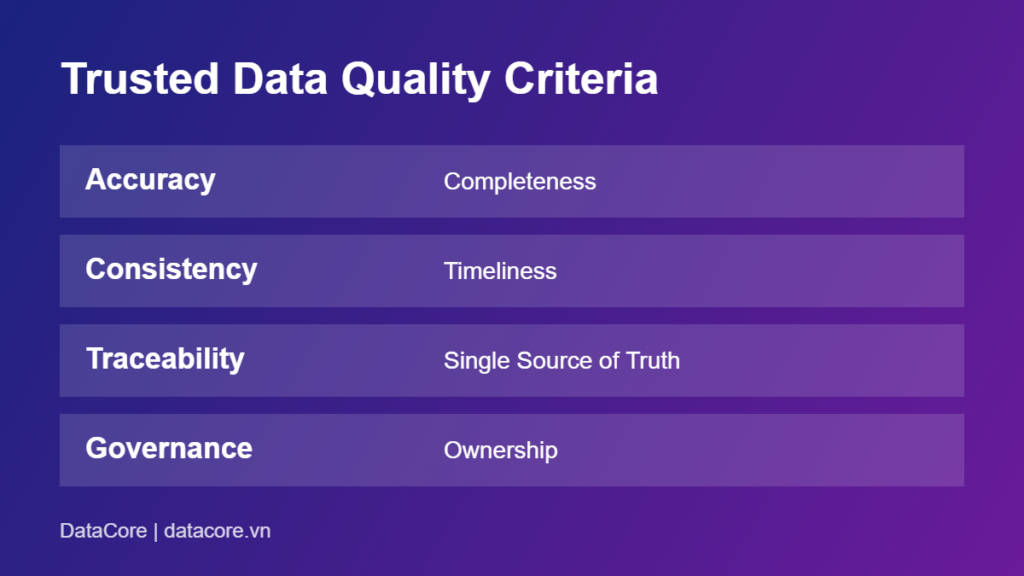
Then a large volume of data does not necessarily create value. A valuable, trusted data system needs to ensure:
| Criterion | Meaning |
|---|---|
| Accuracy | Data is accurate |
| Completeness | Data is complete |
| Consistency | Data is consistent |
| Timeliness | Data is updated in a timely manner |
| Traceability | Data can be traced back to its source |
Takeaway: trusted data is defined by these five criteria together, not by volume. A dataset that fails any one of them cannot be fully trusted by an AI model or by a board.
What Kind of Data Does AI Need?
Many enterprises begin their AI journey by asking: "Which AI model should we deploy?" However, a more important question is: "Is our data ready for AI?"
An AI system typically goes through the following process: Raw Data → Data Standardization → Data Analysis → AI Model Training → Insights and Business Decisions. Trusted data has to exist before the second arrow, or every later step inherits the error.
If the input data is inaccurate, AI may:
- Incorrectly forecast demand.
- Misclassify customers.
- Provide inappropriate recommendations.
- Increase operational risks.
Therefore, AI does not replace the data foundation. AI amplifies the value of a strong, trusted data foundation. It also amplifies the cost of a weak one, because a model trained on flawed records repeats the same flaw at scale and at speed.
How Does Trusted Data Actually Work Inside an Enterprise?
Trusted data is not a single tool or a single database. It is a mechanism made of a few connected parts that together let people and machines rely on the same numbers. Understanding the mechanism helps leaders see why buying an AI tool alone rarely closes the gap.
1. A shared definition of each business entity
Every enterprise has a small set of core entities: customers, products, suppliers, contracts, and transactions. Trusted data starts when every department agrees on how each entity is identified and described. Without that agreement, the same customer appears under an email in one system, a phone number in another, and an internal ID in a third.
2. Identity resolution and deduplication
Once definitions exist, records from different systems are matched to the same real-world entity. Matching rules compare names, tax codes, addresses, phone numbers, and other attributes, then merge duplicates into one "golden record." This step is where most of the practical value of trusted data is created.
3. Validation rules at the point of entry
Trusted data is cheaper to protect than to repair. Validation rules check formats, required fields, and allowed values when data is first captured, so errors are stopped before they spread into reports and models.
4. Lineage and traceability
Every important figure should be traceable back to its source system and the transformations applied to it. Lineage lets an auditor, a bank, or an AI engineer answer the question "where did this number come from?" in minutes rather than weeks.
5. Ownership and governance
Finally, each dataset needs a named owner who is accountable for its quality, plus a governance routine that reviews issues on a regular schedule. Governance is what keeps trusted data trusted after the first cleanup project ends.
Why Are Enterprises Investing in AI but Not Yet Generating Growth From Trusted Data?
1. Enterprises focus on technology before addressing data
The AI trend is creating numerous opportunities:
- AI assistants.
- Process automation.
- Predictive analytics.
- Personalized customer experiences.
However, many AI projects fail not because the technology is weak. The underlying problems often include:
- Insufficiently clean data.
- Lack of a trusted data strategy.
- Lack of data governance processes.
2. Data across departments does not speak the same language
For example, the Marketing department identifies a customer using an email address. Sales identifies the same customer using a phone number. Accounting identifies the customer using a customer ID. When these records are fed into an AI system, AI may interpret them as three different customers.
The consequences include inaccurate behavioral analysis, inaccurate reporting, and ineffective personalization. When data across departments does not share a common language, the direct consequence is significant distortion in AI models and management reports.
AI may generate inaccurate behavioral forecasts, miscalculate customer lifetime value, and overstate the actual number of customers in executive dashboards. This can lead management to make strategic decisions based on "artificial" data while increasing personnel costs due to the need for continuous manual reconciliation and data cleansing.
Beyond operational losses, customer experience and brand reputation can also deteriorate significantly. The absence of a centralized data governance system not only wastes Marketing and advertising budgets on duplicated customer datasets, but also disrupts operational processes and weakens the enterprise's competitive advantage in the digital transformation era.
3. Lack of a "single source of truth"
A modern enterprise needs a unified source of trusted data to answer questions such as:
- What is the actual revenue?
- Which customer segments generate the most value?
- Which products have the greatest growth potential?
- What risks are emerging?
If each department uses a different version of the data, decision-making speed can decrease significantly.
What Happens When Enterprises Lack Trusted Data Infrastructure?
1. Business decisions based on uncertain data
Managers may have numerous dashboards. But if the underlying data is not accurate or relevant enough, those reports only reflect "what the system has recorded" rather than necessarily reflecting "what is actually happening."
2. Difficulty scaling AI applications
AI can be applied across many areas of an enterprise:
- Marketing: forecast customer behavior, personalize content, optimize campaigns.
- Finance: risk analysis, anomaly detection, investment decision support.
- Operations: demand forecasting, supply chain optimization, process automation.
However, all of these applications require a unified and highly reliable trusted data platform.
3. Reduced competitiveness in international markets
As enterprises participate in global supply chains, requirements related to data transparency, traceability, risk management, and Environmental, Social and Governance (ESG) reporting are becoming increasingly important. At this point, data is no longer used only for internal operations. Trusted data becomes evidence of an enterprise's capabilities.
How Do Fragmented Data and Trusted Data Compare?
The table below contrasts the two operating states described in this article. It is a qualitative comparison based on the mechanisms above, not a measured benchmark.
| Dimension | Fragmented data | Trusted data |
|---|---|---|
| Customer view | Same customer counted several times across systems | One golden record per customer |
| Reporting | Each department reports its own numbers | One single source of truth for all reports |
| AI readiness | Models trained on duplicated or stale records | Models trained on validated, current records |
| Bank and investor review | Long due diligence and manual reconciliation | Figures traceable to source, faster review |
| Partner and export readiness | Hard to prove traceability or ESG claims | Evidence available on request |
| Cost of change | Every new AI use case restarts data cleanup | New use cases reuse the same trusted data layer |
Takeaway: the difference between fragmented data and trusted data is not the volume of records but whether every team, model, and external reviewer can rely on the same numbers.
How Does the 4-Layer Model Turn Trusted Data Into Competitive Advantage?
To turn data into a competitive advantage, enterprises need to build their architecture in layers. Each layer depends on the one below it, which is why skipping straight to AI rarely works.
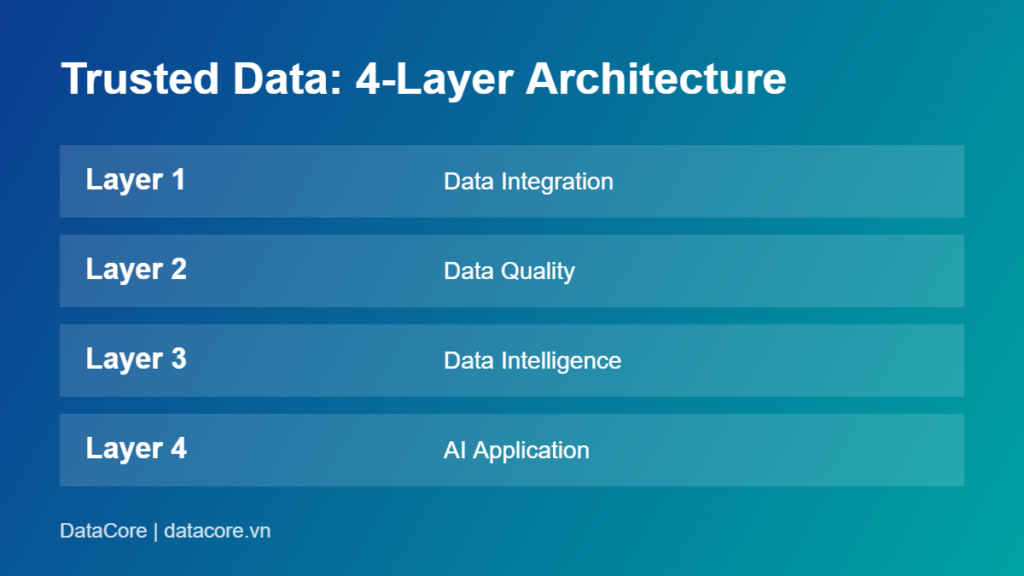
Layer 1: Data Integration, connecting data
Objectives: collect data from multiple sources, eliminate isolated data systems, and create continuous data flows. For example: ERP (Enterprise Resource Planning) + CRM (Customer Relationship Management) + Website + IoT (Internet of Things) + Financial Systems.
Layer 2: Data Quality, ensuring data quality
This includes data cleansing, format standardization, duplicate data removal, and data lifecycle management. This is the step that creates the Trusted Data Layer, the shared foundation every later layer reads from.
Layer 3: Data Intelligence, turning data into insights
Enterprises can build management dashboards, analytical reports, predictive models, and decision-support systems. Because they all read from the same trusted data layer, their numbers agree with each other.
Layer 4: AI Application, creating business value
Once data is ready, enterprises can deploy AI agents, machine learning, generative AI, and HPC (High Performance Computing) for large-scale computational problems. At this layer, trusted data is what turns an AI pilot into a repeatable business capability.
What Does a Trusted Data Program Look Like in Practice? An Illustrative Example
The following example is illustrative only. The company, the steps, and the outcomes are hypothetical and are included to show the mechanism. No part of this example is reported fact, and it does not describe any real enterprise.
Imagine a mid-sized Vietnamese retail chain that wants to use AI to recommend products to its loyalty members. Its first attempt produces poor recommendations, and the team discovers that the same shopper exists as separate records in the loyalty app, the point-of-sale system, and the e-commerce site.
In step one, the chain agrees on a single customer definition and chooses which attributes identify a customer. In step two, it runs identity resolution across the three systems and merges duplicates into golden records. In step three, it adds validation rules to its sign-up forms so new duplicates are blocked at entry.
In step four, it documents lineage for its key metrics, such as active members and repeat purchase rate, so every dashboard reads from the same trusted data layer. Only then does it retrain the recommendation model. In this hypothetical, the improvement comes from the data work, not from a new model, which is the central point of this article.
What Changes for Whom When an Enterprise Builds Trusted Data?
Trusted data affects several audiences inside and around an enterprise in different ways.
- CEOs and boards: strategic decisions rest on figures that reflect what is actually happening, and the board can ask one question and get one answer.
- CFOs and finance teams: less time on manual reconciliation, cleaner audit trails, and stronger evidence when approaching banks or investors for financing.
- Marketing and sales teams: one customer view, less budget wasted on duplicated audiences, and personalization that actually matches the customer.
- Data, IT and AI teams: new AI use cases reuse the trusted data layer instead of restarting cleanup for every project.
- Banks, investors and partners: faster, more confident assessment of risk, governance, and execution capability, as discussed at CRIF Forum Vietnam 2026.
For related reading on how external lenders use structured data, see our analysis of bank credit scoring with tax data in Vietnam, and our overview of Vietnam's data market opportunities for businesses.

Why Will Future Enterprises Be Built on Trusted Data?
The development of AI is opening a new chapter for Vietnamese enterprises, as discussed in DataCore's Vietnam AI Strategy 2030. But AI is not the starting point. Data is.
Enterprises that can effectively leverage trusted data will gain advantages in faster decision-making, better risk management, deeper customer understanding, and more effective AI adoption.
In the future, competitive advantage will not belong to the enterprise with the most data. It will belong to the enterprise that has the most trusted data and knows how to turn data into action.
If you want to see how structured company data looks in practice, you can explore DataCore services or try the DataCore company data trial.
Frequently Asked Questions About Trusted Data
What is trusted data?
Trusted data is data that is accurate, complete, consistent, timely, and traceable to its source, so that people, AI models, and external reviewers such as banks can rely on it without manual re-checking.
Why does AI need trusted data?
AI learns patterns from the data it is given. If records are duplicated, stale, or inconsistent, the model learns those errors and repeats them at scale. Trusted data is what lets AI forecasts and recommendations reflect what is actually happening.
Is more data the same as trusted data?
No. An enterprise may hold millions of records and still lack trusted data if those records are duplicated, unverified, or disconnected. Quality and connection matter more than volume.
What is a single source of truth?
It is one agreed, governed version of key business data that every department and every report reads from, so the enterprise answers questions like "what is our actual revenue?" with one number.
Where should an enterprise start building trusted data?
Start with integration and quality: connect the main systems, agree on how core entities such as customers are identified, remove duplicates, and add validation rules at the point of entry. Then assign clear data owners and a governance routine.
How does trusted data help with banks and investors?
Transparent, traceable financial and operational data lets banks and investors assess risk, profitability, and governance faster, which can shorten due diligence and support access to financing, as discussed at CRIF Forum Vietnam 2026.
References
- CRIF Vietnam, CRIF Forum Vietnam 2026: Empowering Growth with Trusted Data, 2026. CRIF Vietnam event page
- Vietnam Chamber of Commerce and Industry (VCCI), Trusted Data Becomes a "Trust Asset" for Enterprises, 2026. VCCI article
- Vietnam Government News (Báo Chính phủ), Trusted Data Expands Growth Opportunities for Vietnamese Enterprises, 2026. Government News article






Để lại một bình luận
You must be logged in to post a comment.