
TL;DR: A landmark study, "ImageNet-trained CNNs are Biased Towards Texture; Increasing Shape Bias Improves Accuracy and Robustness" (Geirhos et al., 2018), showed that standard image models recognise objects mainly by texture, while humans rely on shape. This texture bias explains many failures in computer vision, and the paper offers a practical fix: retrain networks on a stylized dataset that strips texture cues, which shifts the model toward a human like shape bias and improves both accuracy and robustness. This article explains what texture bias is, how it was measured, why it matters for reliable AI, and how teams can reduce it.

What is texture bias in a convolutional neural network?
A convolutional neural network (CNN) is a deep learning model that learns visual features from images through stacked layers of filters. The common assumption was that a CNN builds understanding hierarchically, from edges and colours up to complex shapes such as a car or a dog. Texture bias is the finding that contradicts this picture. It describes the tendency of an ImageNet-trained CNN to base its decision on local texture, the fine surface pattern of an object, rather than on its global shape.
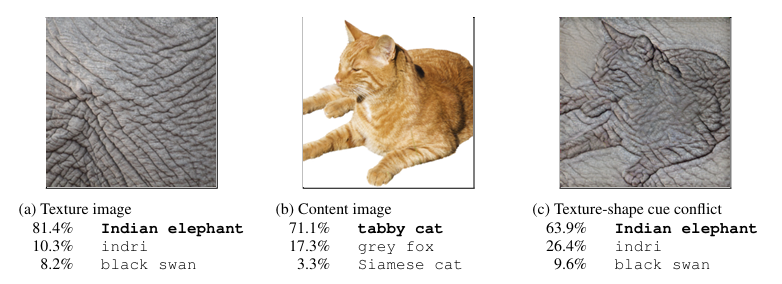
The distinction matters because texture and shape usually agree. An elephant has elephant shaped outlines and wrinkled grey skin, so a model can be right for the wrong reason. Texture bias only becomes visible when the two cues are put in conflict, and that is exactly what the researchers engineered to expose how the network really decides.
How did researchers measure texture bias?
To quantify texture bias, the team used cue conflict images created with style transfer. They took the shape of one object, for example a cat, and painted it with the texture of another, for example elephant skin. A human looking at this image still reports a cat, because people classify by shape. A standard ImageNet-trained CNN, by contrast, tends to answer elephant, revealing that texture, not shape, is driving the prediction.
Across many such images and several well known architectures, including versions of ResNet, VGG, GoogLeNet and AlexNet, the pattern was consistent. Human observers made shape based decisions the large majority of the time, while the networks made texture based decisions the large majority of the time. Texture bias was therefore not a quirk of one model but a general property of how these networks learned from ImageNet.
Why does texture bias matter for reliable AI?
Texture bias is not just an academic curiosity. A model that leans on texture is fragile in the real world. Change the surface statistics of an image, through noise, blur, weather, compression or a change in style, and a texture reliant network can misclassify an object whose shape is perfectly intact. Humans barely notice these changes because shape is preserved.
This connects texture bias directly to robustness. Many documented failures of computer vision systems, from misreading distorted photos to breaking under small perturbations, are consistent with a model that has learned texture shortcuts instead of object structure. For safety critical uses such as medical imaging, autonomous driving or industrial inspection, a shape aware model is far more trustworthy than a texture reliant one.
How can you reduce texture bias in a model?
The paper's most useful contribution is a remedy. The authors built a new training set called Stylized-ImageNet, produced by applying style transfer to every ImageNet image so that the original texture is replaced with random artistic styles. Because texture is randomised, it stops being a reliable cue, so a network trained on Stylized-ImageNet is forced to rely on shape to identify objects.
The results were striking. A ResNet-50 trained on Stylized-ImageNet developed a much stronger shape bias, closer to human perception. It also became more robust to a wide range of image distortions and corruptions that were never seen during training, and it even improved object detection performance when used as a backbone. Reducing texture bias, in other words, did not cost accuracy; it added resilience.
For practitioners, the takeaway is a concrete toolkit. Data augmentation that varies texture and style, training on stylized or texture randomised data, and evaluation on cue conflict and corruption benchmarks all help surface and reduce texture bias. The broader lesson is that what a model learns depends heavily on what the training data makes easy, so shaping the data is often more powerful than tweaking the architecture.
What does texture bias teach us about data quality?
The deepest lesson of texture bias is about data, not models. A network is an efficient shortcut finder. If the training data lets texture solve the task, the model will use texture, even when we hoped it would learn shape. Texture bias is a specific case of shortcut learning, where a model latches onto whatever superficial signal correlates with the label rather than the concept we actually care about.
That is why curated, well characterised and deliberately varied datasets matter so much. Understanding the distribution of a dataset, its biases and its blind spots is a prerequisite for building models that generalise. Teams that treat data as a first class asset, with clear documentation and structured metadata, are far better placed to detect problems like texture bias before they reach production.
This is where DataCore focuses. By building clean, well documented and structured datasets, and by making the properties of that data transparent, the platform helps teams train models on signals that reflect the real concept rather than convenient shortcuts. You may also find our coverage of the Vietnam AI data center boom useful, and you can explore the wider DataCore data platform for structured, machine readable datasets.

Texture bias: frequently asked questions
What is texture bias in simple terms?
Texture bias is the tendency of an image model to identify objects by their surface pattern rather than their overall shape. When shape and texture disagree, a texture biased model follows the texture, whereas a human follows the shape.
Do all CNNs have texture bias?
The study found strong texture bias across several standard architectures trained on ImageNet, so it is a general property of typical training rather than one specific model. The degree of texture bias can be changed by changing the training data.
How do you fix texture bias?
Train on data where texture is not a reliable cue, such as Stylized-ImageNet, and use style and texture varying augmentation. This pushes the network toward shape based recognition and improves robustness to distortions.
Where can I read the original research?
The findings come from Geirhos and colleagues, "ImageNet-trained CNNs are Biased Towards Texture; Increasing Shape Bias Improves Accuracy and Robustness", available on arXiv.
This article summarises published deep learning research for educational purposes. Findings are attributed to the original authors cited above.
Shape, texture and how humans really see
To appreciate the result, it helps to recall how human vision works. Decades of perceptual research suggest that people recognise objects largely through global form and the spatial arrangement of parts. A child can identify a chair drawn as a plain outline, with no colour and no surface detail, because the shape alone carries the identity. Surface pattern helps, but it is secondary to structure.
Before this study, many researchers assumed that deep networks were converging on something similar. The intuition was that early layers detect edges, middle layers assemble parts, and later layers represent whole objects, a progression that sounds shape driven. The cue conflict experiments punctured that intuition. When the easy path to a correct label runs through texture, the network takes it, and the elegant hierarchy we imagined does not guarantee the shape understanding we assumed.
This reframes a network as an optimiser of whatever works on the training set, not as a system that shares our priorities. It is a humbling and useful correction. It tells us that impressive benchmark accuracy can coexist with a representation that is quite unlike human perception, and that we must test models on the specific behaviours we care about rather than trusting a single accuracy number.
Shortcut learning and the wider pattern
The texture finding is one example of a broader phenomenon called shortcut learning. In case after case, models discover superficial correlations that happen to predict the label on the training distribution but fail when that correlation breaks. A pneumonia classifier that keys on the hospital scanner type, an animal detector that keys on the typical background, a text model that keys on dataset artefacts, all follow the same logic as a network that keys on texture.
Seeing these cases as one family is clarifying. The problem is rarely that the model is broken; the problem is that the data offered an easier route to the answer than the concept we intended. That reframing points to the solution. If we want a model to learn the concept, we must build data and evaluations where the shortcut does not work, forcing the network onto the harder but more general signal.
Stylized training is the concrete instance of that principle for vision. By destroying the texture shortcut, it leaves shape as the only reliable route to the label. The same mindset generalises: randomise or balance the spurious cue, and the model is pushed toward the feature you actually want it to use. This is why practitioners increasingly treat robustness as a data design problem first and an architecture problem second.
A practical workflow for teams
Turning the research into practice follows a clear sequence. First, probe for the bias: run cue conflict tests and evaluate on corrupted or out of distribution images to see whether performance collapses when surface statistics change. Second, if it does, intervene on the data with style and texture augmentation or stylized training, so the shortcut stops paying off during learning.
Third, re evaluate on the same stress tests and confirm that robustness improved without sacrificing clean accuracy. Fourth, document the dataset and the tests so the next team inherits the knowledge rather than rediscovering the problem. Throughout, the recurring theme is measurement: you cannot manage a bias you never test for, and a single in distribution accuracy number will happily hide it.
None of this requires exotic tooling. It requires treating data quality, documentation and targeted evaluation as core parts of the model building loop. That discipline, more than any single trick, is what turns a fragile pattern matcher into a dependable system, and it is the practical inheritance of the shape and texture research for anyone shipping computer vision today.
Limitations and what came next
Like any study, this one has boundaries worth stating. The cue conflict method uses artificial images, and real world scenes rarely pit shape against texture so cleanly, so the exact numbers describe a controlled probe rather than everyday performance. The work also focused on convolutional networks trained on ImageNet, so its conclusions apply most directly to that setting rather than to every model or task.
Even so, the direction of the finding has held up well and influenced a great deal of later research. Follow up work explored how newer architectures, including vision transformers, balance shape and texture, and how different training recipes, augmentations and objectives move that balance. The specific measurements vary from study to study, but the central message is durable: the inductive biases of a vision model are shaped strongly by the data and the training procedure, and they can be steered on purpose.
That steering ability is the optimistic side of the story. If a harmful reliance on surface statistics can be reduced by redesigning the data, then robustness is within a team's control rather than being a fixed property of neural networks. Stylized training, richer augmentation and targeted evaluation are all levers that engineers can pull, and each one nudges the model toward representations that behave more like human perception under stress.
Why this still matters for modern AI systems
As AI moves into higher stakes settings, the gap between benchmark accuracy and real world reliability is the central engineering challenge, and this research is an early, clear illustration of that gap. A model can score well on a familiar test set and still fail when conditions shift, because it learned a cue that was only incidentally correct. Recognising that failure mode early saves teams from deploying systems that look strong in the lab and disappoint in the field.
The same reasoning applies well beyond image classification. Any model that learns from data can pick up a convenient signal that does not match the concept its builders intended, whether the domain is vision, language, audio or structured business data. The defence is always similar: understand the data deeply, test for the specific behaviours that matter, and redesign the inputs when a shortcut is found. That is a data centric view of machine learning, and it is increasingly the mainstream one.
For organisations building on top of data, the practical implication is that investment in clean, well documented and representative datasets pays off directly in model reliability. The story of shape and texture is ultimately encouraging. It shows that a surprising weakness in powerful models can be understood, measured and corrected, and that the correction begins not with a cleverer network but with better data and better tests.
That is the enduring lesson for anyone shipping AI today: treat the dataset as the primary lever on behaviour, keep a standing suite of stress tests that reflect real conditions, and remember that a single headline accuracy figure can conceal as much as it reveals. Teams that internalise those habits build systems that hold up when the world stops looking like the training set.
Key takeaways for building dependable vision models
Pulling the threads together, a few principles stand out for anyone building or buying computer vision. When it comes to texture bias, benchmark accuracy is necessary but not sufficient, because a high score can hide a reliance on cues that will not survive a change in conditions. The only way to know how a model behaves is to test it deliberately on the situations that matter, including distorted, stylised and out of distribution inputs that separate genuine understanding from surface pattern matching.
Equally, the fix for texture bias usually lives in the data. When a model leans on the wrong cue, the most durable remedy is to redesign the training set so that cue no longer solves the task, rather than to keep adding parameters. This is why leading teams invest in data curation, documentation and stress testing as first class engineering activities, not afterthoughts. The shape and texture story is a clean, memorable case study in that data centric philosophy.
Finally, the result is a reminder to stay curious about what our models actually learn. The networks that showed texture bias in this study were not defective; they were doing exactly what the data rewarded. Treating surprising failures as information about the data, rather than as random noise, is the habit that steadily turns fragile prototypes into systems people can trust in the real world.
In short, texture bias is best understood not as a flaw to be embarrassed about but as a lens on how learning systems work. It shows that a network will always exploit the easiest path a dataset offers, and that path is not always the one aligned with human meaning. Naming texture bias, measuring it and engineering data that removes the shortcut is a repeatable recipe, and the same recipe transfers to any place where a model might be learning the wrong thing for the right score.
Curious how the latest AI models actually compare? Check DataCore's AI Leaderboard, a free, real time ranking of frontier AI models updated continuously.






Để lại một bình luận
You must be logged in to post a comment.