
TL;DR: PNJ, Vietnam's largest jewelry retailer, saw its share price and market capitalization fall sharply after a diamond smuggling investigation drew public attention in 2026. PNJ stated the smuggled diamonds never entered its retail distribution system and that it was cooperating fully with authorities. The episode shows that markets price in uncertainty long before any legal conclusion, and that trust, once damaged, is far harder to rebuild than a balance sheet. For risk teams, the PNJ case is a live example of why continuous, data-driven Fraud Intelligence matters more than backward-looking financial statements alone.
Corporate fraud is often associated with poorly managed companies, opaque financial reporting, or organizations operating in the gray areas of the economy. In reality, however, some of the most valuable lessons come from companies with strong governance, established brands, and long-standing public trust. Their experiences remind us that no organization, regardless of its reputation, is completely insulated from risk.
The recent developments surrounding PNJ illustrate this point clearly, and they offer a useful case study for anyone who evaluates companies through data rather than headlines alone.
What happened in the PNJ diamond smuggling case?
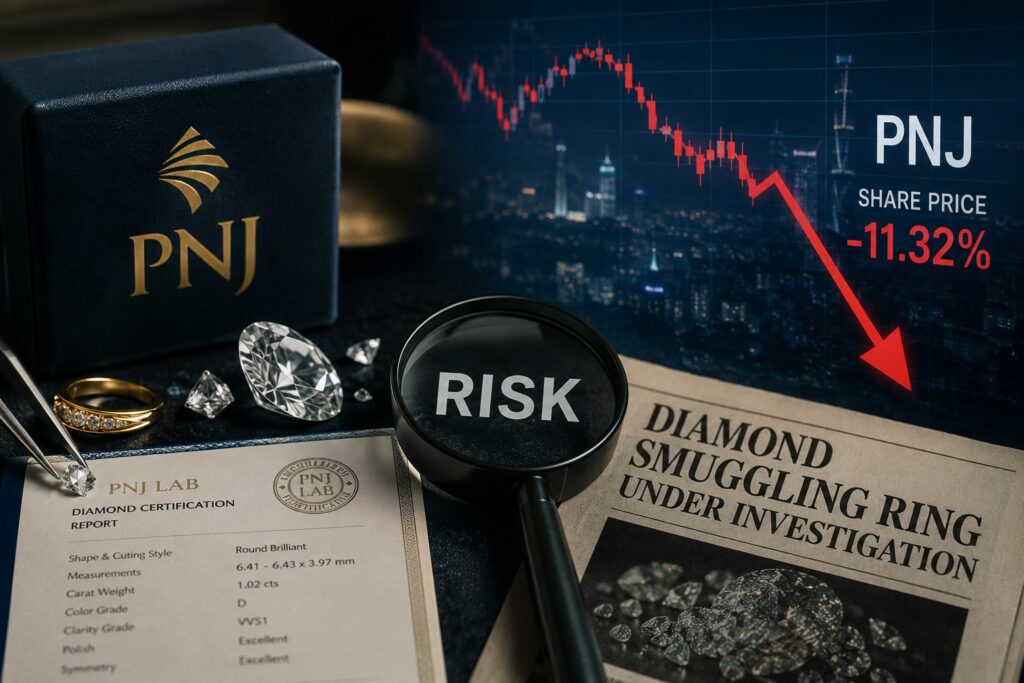
PNJ, Vietnam's largest jewelry retailer, became the center of public attention after a diamond smuggling investigation surfaced in the domestic press. PNJ responded by stating that the smuggled diamonds had never entered its retail distribution system and that the company was fully cooperating with the authorities throughout the investigation. Nevertheless, the market reacted almost immediately.
The company's share price declined sharply, its market capitalization fell significantly, and investors began reassessing the potential implications. At the same time, public discussion expanded beyond PNJ itself to broader questions about transparency, traceability and trust across Vietnam's diamond market.
Why do markets react before a legal case is resolved?
This reaction highlights an important characteristic of financial markets: they rarely wait for a final legal conclusion. Instead, markets price in uncertainty. Investors evaluate not only what is already known, but also what remains unknown - the possibility of legal exposure, operational disruption, reputational damage, and changes in relationships with external partners. A single breakdown in one part of the organization can expose the entire business to financial losses, legal challenges and reputational consequences.
In many cases, the most significant damage is not a regulatory penalty or a legal settlement but the gradual erosion of trust among customers, investors and business partners. Unlike financial assets, trust cannot be restored overnight. Once confidence begins to weaken, rebuilding it often requires years of consistent transparency and performance.
The market's response to the PNJ incident demonstrated how quickly this process can unfold. Reports indicated that many customers sought to sell back their diamonds shortly after the investigation became public. Although PNJ maintained that its products were unrelated to the alleged smuggling case, the volume of negative headlines was sufficient to influence customer behavior in the short term.
What does the PNJ incident reveal about corporate risk?
For investors, the case reinforces the importance of evaluating companies through the lens of risk as well as financial performance. For businesses, it underscores the value of strong internal controls, effective supply chain governance and transparent crisis communication. For data professionals, it demonstrates that the greatest value of data lies not in explaining what has already happened but in identifying the earliest signals before they develop into a full-scale corporate crisis.
A brand as established as PNJ built decades of consumer trust in Vietnam's diamond and jewelry market. That trust is precisely what came under pressure once the smuggling investigation became public, which is why the PNJ case is a useful reference point whenever an analyst or risk officer needs to explain why reputation should be tracked as a quantifiable input, not treated as an intangible afterthought.

How is Fraud Intelligence different from traditional Fraud Detection?
Modern Fraud Intelligence systems are not designed to determine whether a company is guilty or innocent - that responsibility belongs to investigators and the courts. Instead, they continuously monitor changes in publicly available information, including:
- the volume and trajectory of negative news coverage
- the types of fraud or regulatory issues being reported
- the relationships between companies, individuals, and related entities and emerging patterns that may indicate increasing operational, legal or reputational risk
Traditional Fraud Detection tends to be transactional and retrospective: it flags a single suspicious transaction or a single anomalous entry after the fact. Fraud Intelligence, in contrast, is relationship-aware and forward-looking. It links entities, tracks sentiment shifts across news and public filings, and surfaces early warning patterns across an entire network of counterparties, not just one account or one transaction.
The objective is not to replace legal judgment but to provide organizations with earlier visibility into risks that traditional financial indicators often reveal only after the damage is already visible in the share price. For investors, the case reinforces the importance of evaluating companies through the lens of risk as well as financial performance. For businesses, it underscores the value of strong internal controls, effective supply chain governance and transparent crisis communication. For data professionals, it demonstrates that the greatest value of data lies not in explaining what has already happened but in identifying the earliest signals before they develop into a full-scale corporate crisis.
What role does entity resolution play in tracking corporate risk?
One of the hardest practical problems in monitoring a case like this is simply keeping track of which entities are actually connected. A large retailer typically has subsidiaries, related parties, key suppliers, distribution partners and individual executives, all of which may appear under slightly different names across different public records. Entity resolution is the process of matching these different mentions back to a single underlying entity so that an analyst, or an automated system, can see the full picture rather than a fragmented set of unconnected records.
Without reliable entity resolution, a company's risk exposure can be understated simply because a supplier is registered under three different legal names across three different filings. With it, a single change in one part of a network, such as a supplier facing a new investigation, can be surfaced as a relevant signal for every connected entity, including a retailer several steps removed from the original event. This is one of the core capabilities that separates a modern risk intelligence platform from a simple news-monitoring feed.
How does sentiment tracking help detect early warning signs?
News sentiment on its own is a noisy signal. A single negative article rarely means much, and coverage volume can spike for reasons unrelated to fraud, such as a product launch or a routine regulatory filing. What matters more is the trajectory: is negative coverage increasing week over week, is it spreading from a single outlet to multiple independent sources, and is the tone shifting from speculative to confirmed. Systems designed to track these patterns over time can distinguish a short-lived news cycle from a genuine deterioration in a company's risk profile.
In the PNJ case, the pattern was visible in real time: initial reports of the investigation were followed by a rapid escalation in coverage volume, a broadening of the discussion from the specific investigation to the wider diamond market, and a corresponding movement in the share price. None of these signals required access to non-public information. They were all derivable from publicly available news and market data, tracked continuously rather than reviewed only after the fact.
This is also where the distinction between a static compliance check and a continuous monitoring program becomes important. A one-time due diligence review, performed when a relationship with a supplier or partner is first established, captures only a snapshot. Trust and risk are not static, and a company that looked clean at onboarding can develop new exposure months or years later. Continuous monitoring closes that gap by re-evaluating the same questions on an ongoing basis rather than only once.
What should risk and compliance teams do differently after the PNJ case?
The practical takeaway for risk and compliance teams in Vietnam is not that any specific company is at fault, but that the PNJ episode is a clear illustration of how quickly public sentiment can move markets long before any legal process concludes. Teams that already had a systematic way of tracking sentiment shifts and entity relationships around PNJ and its supply chain would have had earlier visibility into the shift in narrative, even without any inside information.
Three practical steps follow from this. First, treat reputational and governance risk as a tracked, quantifiable input alongside standard financial due diligence, rather than an intangible factor considered only after a crisis breaks. Second, build continuous rather than point-in-time monitoring into vendor and partner relationships, particularly in sectors like jewelry, gold and luxury retail where provenance and traceability are central to consumer trust. Third, make sure crisis communication capabilities are in place before they are needed, since the speed and clarity of a company's public response measurably affects how quickly trust stabilizes after a negative event.
For a deeper look at how tightening data governance expectations in Vietnam are reshaping this landscape, see DataCore's coverage of the proposed data security penalty framework, which shows regulators are increasingly willing to attach direct financial consequences to governance failures, not just reputational ones.
How does the PNJ case compare with other trust-driven market events?
The pattern seen in the PNJ case is not unique to Vietnam or to the jewelry sector. Across many markets, the sharpest share price reactions to corporate scandals tend to occur in the first days after a story breaks, well before regulators or courts have reached any conclusion. What varies from case to case is how quickly the company communicates, how clearly it separates confirmed facts from speculation, and how well it can demonstrate that the issue is contained rather than systemic.
Companies that recover fastest from this kind of shock typically share a few characteristics: they had already built a reputation for transparency before the incident, they respond quickly with specific, verifiable statements rather than generic reassurances, and they can point to independent verification, audits or certifications that support their position. PNJ's public statements about product traceability and its own certification processes are an example of the kind of evidence that can help rebuild confidence, provided they are matched by consistent follow-through over time.

For Vietnam's broader gold and diamond retail sector, the PNJ case is likely to accelerate demand for stronger traceability standards, clearer chain-of-custody documentation, and independent certification of sourcing practices. Retailers that can demonstrate these standards proactively, rather than only after a competitor faces public scrutiny, are better positioned to retain customer trust when the next sector-wide incident occurs, as it eventually will in any market built on high-value, difficult-to-verify goods.
What comes next for PNJ and Vietnam's diamond market?
The investigation into the PNJ smuggling allegations will ultimately be resolved through the ordinary legal process, and any final findings will matter far more for the historical record than the initial market reaction did. But the initial reaction is exactly what makes this case instructive for anyone building or buying risk intelligence tools in Vietnam. Markets, customers and counterparties all moved before the facts were settled, based on incomplete information filtered through news coverage and public sentiment.
That is precisely the environment in which structured, continuously updated data adds the most value: not in confirming what is already known, but in helping decision makers act faster and more rationally while a situation is still unfolding. Whether the immediate business is jewelry retail, banking, manufacturing or any other sector exposed to supply chain and counterparty risk, the underlying lesson from PNJ holds - trust is measurable, it moves faster than legal processes, and the organizations that track it systematically are the ones best prepared for the next incident.
How can Vietnamese companies monitor trust and reputational risk?
The PNJ episode is not an isolated warning. Vietnam's regulators have been tightening disclosure and data-handling requirements across sectors, a trend also visible in the proposed data security penalty framework for Vietnamese businesses, which signals that compliance and governance failures increasingly carry direct financial consequences, not just reputational ones. Companies that treat governance, traceability and transparent communication as ongoing operational disciplines, rather than reactive public-relations exercises, are better positioned when an incident like this becomes public.
In practice, this means building a continuous monitoring layer around three questions: who are the entities connected to a given supplier or partner, what is the current sentiment trajectory in public reporting about them, and how quickly is that sentiment changing. None of these questions require inside information. They rely entirely on structured, publicly available data, which is exactly the kind of dataset a Fraud Intelligence platform is built to organize and track at scale.
What is the lasting lesson from the PNJ case for investors and data teams?
In many cases, the most significant damage is not a regulatory penalty or a legal settlement but the gradual erosion of trust among customers, investors and business partners. Unlike financial assets, trust cannot be restored overnight. Once confidence begins to weaken, rebuilding it often requires years of consistent transparency and performance.
The market's response to the PNJ incident demonstrated how quickly this process can unfold, and it is a reminder that reputational capital behaves like any other asset on a balance sheet: it can be built slowly and lost quickly. For investors, the case reinforces the importance of evaluating companies through the lens of risk as well as financial performance. For businesses, it underscores the value of strong internal controls, effective supply chain governance and transparent crisis communication. For data professionals, it demonstrates that the greatest value of data lies not in explaining what has already happened but in identifying the earliest signals before they develop into a full-scale corporate crisis.
Public reporting on the case, including coverage from Vietstock and FireAnt, tracked the share price movement and disclosure timeline in real time, illustrating how quickly market data and news sentiment moved together once the investigation became public.
FAQ: PNJ, trust risk and Vietnam's diamond market
What is PNJ?
PNJ (Phu Nhuan Jewelry) is Vietnam's largest jewelry retailer, publicly listed and long regarded as one of the country's most trusted consumer brands in gold and diamond retail.
What triggered the PNJ trust and share price decline in 2026?
A diamond smuggling investigation drew public attention to PNJ. The company stated the smuggled diamonds never entered its retail distribution system and that it was cooperating fully with authorities, but the share price and market capitalization still fell sharply as investors priced in uncertainty.
Did PNJ do anything wrong?
As of this writing, PNJ maintains its products were unrelated to the alleged smuggling case and the investigation remains with the authorities. This article does not make a determination of guilt; it examines how markets and public trust respond while a case is unresolved.
Why did the market react before any legal conclusion?
Markets price in uncertainty, not just confirmed facts. Investors weigh the probability of legal exposure, operational disruption and reputational damage well before a case is resolved, which is why share prices can move quickly on unconfirmed allegations.
What is Fraud Intelligence and how does it differ from Fraud Detection?
Fraud Detection is typically transactional and retrospective, flagging a single suspicious event after it happens. Fraud Intelligence is relationship-aware and forward-looking, continuously tracking entity networks, news sentiment and disclosure patterns to surface early warning signals before a crisis fully develops.
How can companies protect themselves from trust-driven risk like the PNJ case?
Strong internal controls, transparent supply chain governance and clear, timely crisis communication all reduce the speed and severity of reputational damage when an incident becomes public.
Want data like this on your own watchlist? DataCore's Company Intelligence Service gives you verified financial, ownership, and registry data on over 2.3 million Vietnamese companies, one click away.






Để lại một bình luận
You must be logged in to post a comment.