
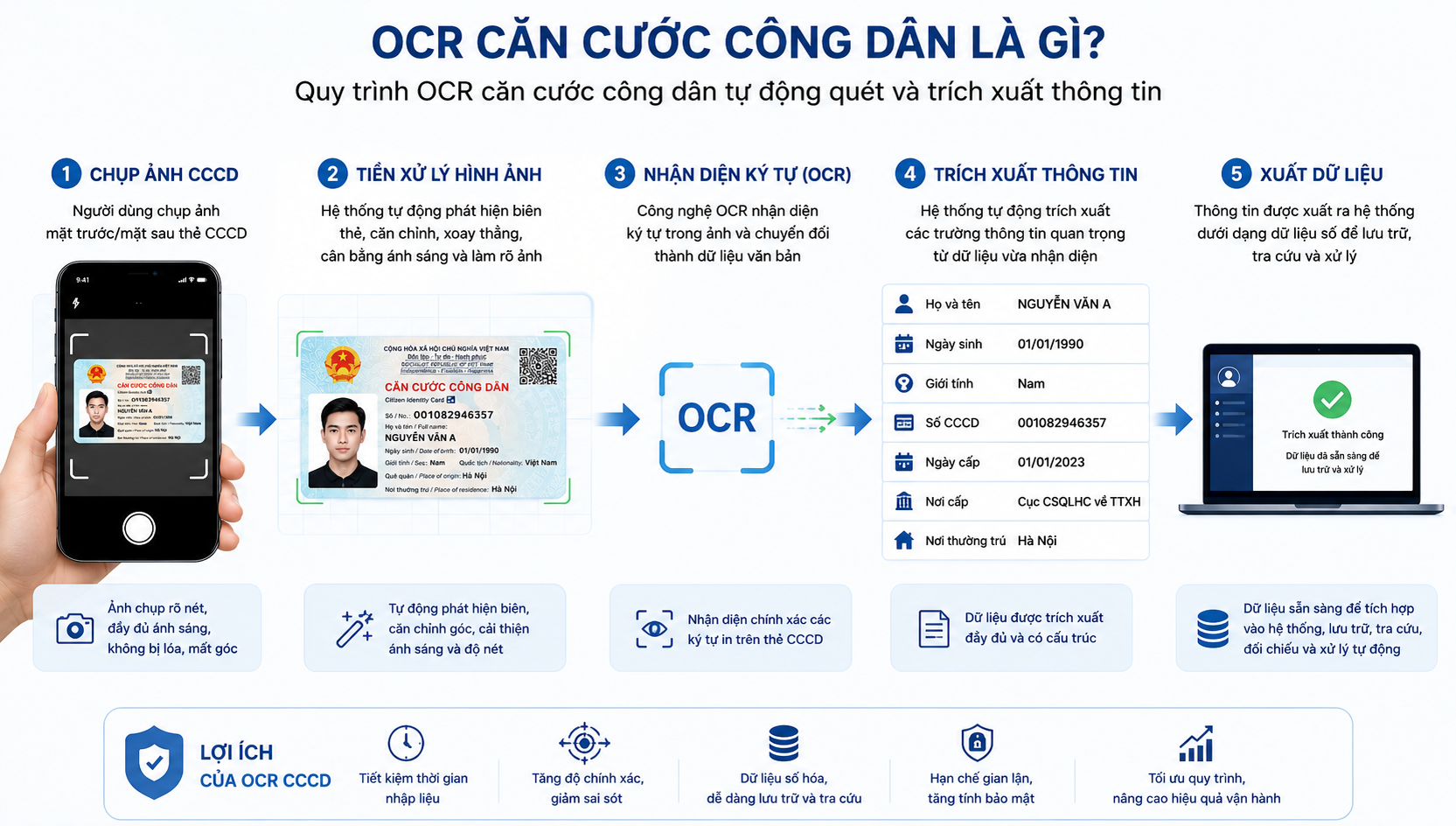
TL;DR: OCR CCCD is the technology that automatically scans and extracts data from Vietnam's national ID card, Can Cuoc Cong Dan (CCCD), in 1-3 seconds at 98-99% accuracy, versus 2-3 minutes per record and frequent typos with manual entry. Businesses use OCR CCCD to cut onboarding time from 10-15 minutes to under 1 minute, support compliance with Decree 13/2023/ND-CP on personal data protection, and lay the technical foundation for electronic know-your-customer (eKYC) verification. Successful rollouts follow five steps: define scope, pick a Vietnamese-language-capable OCR engine, control image quality, keep a human-in-the-loop review step, and pilot before scaling.
What Is OCR for Can Cuoc Cong Dan (CCCD)?
As digital transformation accelerates across every industry in Vietnam, the need to process information from identity documents keeps growing. OCR for Can Cuoc Cong Dan (CCCD) - Vietnam's national ID card, sometimes still called the "citizen identity card" - is the technology answering that need.
OCR for CCCD is the application of Optical Character Recognition (OCR) to automatically scan, recognize, and extract the information printed on a citizen ID card. In plain terms, the technology converts a photo of a physical CCCD card into structured, searchable digital data.
Instead of a staff member manually keying in every field - full name, date of birth, gender, place of origin, ID number, issue date, permanent address, and more - an OCR system automatically "reads" the photo of the card. The extracted information is then output as structured digital data, ready to store, search, and process further.

Today, OCR for CCCD is commonly paired with artificial intelligence (AI) and deep learning inside electronic know-your-customer (eKYC) identity verification solutions. This combination lets a system do more than extract text: it can also detect forged images, cross-check a photo against a live face, and validate whether the card itself is genuine.
As a result, OCR for CCCD serves a wide range of sectors effectively, including finance, banking, telecommunications, and public administrative services.
Beyond the newer chip-based CCCD, OCR technology also recognizes older identity document formats still in circulation in Vietnam: the 9-digit CMND (Chung Minh Nhan Dan, the predecessor identity card), the 12-digit CMND, and the barcode-based CCCD. This ensures full coverage of the identity documents Vietnamese businesses actually encounter.
Why Does OCR for CCCD Matter to Vietnamese Businesses?
As the Vietnamese government pushes forward Project 06 - the national program to expand the use of population and identity data - OCR for CCCD plays an important role for businesses in several respects. Sectors that handle a high volume of paperwork tied to identity verification, such as banking, insurance, telecommunications, and public services, are typically the first to feel the impact, since every new customer or citizen interaction starts with capturing the same handful of identity fields from a CCCD card.
Speeding Up Document Digitization
OCR for CCCD converts large volumes of physical paperwork into digital data in a short amount of time. This is the first, and most important, step toward building a centralized customer or employee data management system. Without a reliable way to turn paper and photo IDs into structured records, every downstream system - CRM, core banking, HR - ends up working from inconsistent, manually re-typed data instead of a single clean source.
Improving the Customer Experience
In banking, insurance, and telecommunications, customers no longer have to wait long to complete a sign-up process. A single photo of the CCCD card lets the system auto-fill all the required fields - cutting onboarding time from 10-15 minutes down to under 1 minute. That difference matters most at the exact moment a business is trying hardest to keep a new customer engaged - the first few minutes of a sign-up flow, when a slow or clunky form is the easiest place to lose them.
Supporting Legal Compliance
Decree 13/2023/ND-CP on personal data protection requires businesses to manage customer information in a systematic, transparent way. OCR for CCCD helps standardize the data collection process, creating a foundation for controlling and tracing how personal data is handled. Because every record enters the system through the same automated, logged pipeline, businesses have a much easier time demonstrating exactly how, when, and from where a piece of personal data was collected if a regulator or customer ever asks.
Building a Competitive Advantage
Businesses that adopt OCR early in their operating workflows save significantly on labor cost and processing time. That, in turn, frees up resources to focus on core business activities instead of manual paperwork. Early adopters also build up institutional experience with tuning the technology to real Vietnamese documents and edge cases well before slower-moving competitors, which becomes its own advantage once OCR-based onboarding is simply what customers expect.

This same push toward digitization is reshaping public-sector operations too - see our coverage of Vietnam's digital transformation platforms rollout across 1,400 local governments for the broader national context OCR for CCCD fits into.
A Practical Rollout Scenario: OCR CCCD in Retail Banking Onboarding
Consider how a typical mid-size retail bank or fintech in Vietnam approaches an OCR CCCD rollout, based on the common pattern seen across the market. Before OCR, a new-account application requires a teller or agent to manually key in full name, date of birth, CCCD number, place of origin, and place of residence from a physical card, a process that takes 10-15 minutes per customer and carries a meaningful error rate on Vietnamese diacritics and long administrative addresses.
With OCR CCCD integrated into the mobile or in-branch onboarding app, the front-line flow changes shape. The customer or agent captures a photo of the front and back of the CCCD, the OCR engine extracts and auto-fills the identity fields in 1-3 seconds, and the same image feeds a face-matching and liveness check as the next stage of the eKYC pipeline. The staff member's role shifts from typing to verifying: confirming the auto-filled fields match the physical card and resolving the small share of low-confidence extractions that OCR flags for human review.
The operational effect compounds across three areas at once. Onboarding time per customer drops from the 10-15 minute manual baseline to under 1 minute of active handling. Data entry error correction, previously a recurring back-office task, falls sharply because the source of truth is the OCR read rather than a manually typed field. And the audit trail required under Decree 13/2023/ND-CP becomes a byproduct of the process rather than an added step, since every scan already carries a timestamp and a purpose code by design.
What Practical Benefits Does OCR for CCCD Deliver?
Applying OCR for CCCD delivers real value to organizations and businesses of many different sizes. Below are the most notable benefits.
Superior Processing Speed, Fewer Errors
Each CCCD card holds more than 10 fields of information that need to be extracted. Entered by hand, a staff member needs 2-3 minutes per record and typos are unavoidable.
With OCR, the entire process finishes in 1-3 seconds at 98-99% accuracy. This eliminates nearly all of the errors caused by manual human entry.
Lower Operating Costs
An average data-entry staff member processes 150-200 records per day. An OCR system, by contrast, can process thousands of records in the same window of time.
For businesses handling large volumes of paperwork, OCR meaningfully cuts staffing and office-supply costs.
A Foundation for Electronic KYC (eKYC)
OCR for CCCD is the first link in the eKYC chain - from extracting the card's information, to matching it against a live portrait photo, to verifying identity through a liveness check.
Without OCR, the entire eKYC process would depend on manual data entry - both slower and easier to forge.
Stronger Security and Fraud Prevention
Combined with AI, an OCR system can detect unusual signals on a card - an edited photo, a mismatched font, or logically inconsistent information, for example.
The system then raises an early warning on suspected document forgery, protecting the safety of online transactions.
As a result, both end users and the operations team get a seamless, consistent experience.

How Should a Business Implement OCR for CCCD Successfully?
To bring OCR for CCCD into real-world operation smoothly, a business needs a methodical rollout plan. Here are the concrete steps.
Step 1: Define Clear Goals and Scope
First, the organization needs to answer: what will OCR serve? Digitizing archived records, supporting eKYC, or automating the customer onboarding process?
Alongside that, define the rollout scale - a single department, one branch, or the entire organization. Clarifying this up front helps you pick the right solution and avoid wasting resources.
Step 2: Choose an OCR Solution That Fits Real Requirements
Not every OCR solution is equal. Businesses should prioritize technology with strong recognition for Vietnamese text (including diacritics and special characters), the ability to process lower-quality images (blurry, tilted, poorly lit), and support for the various identity document formats in circulation.
It's also worth evaluating API integration capability, documentation, and the vendor's technical support policy - a factor closely tied to broader data-vendor due diligence; see our related piece on Vietnam's data laws and the legal risk of foreign SaaS and cloud tools for the compliance angle vendors need to satisfy.
Step 3: Ensure Input Image Quality
Image quality is one of the biggest factors affecting OCR accuracy. Businesses should therefore set clear photo-capture guidance for end users.
At the same time, integrate supporting features such as automatic card-edge detection, tilt correction, lighting adjustment, and image-quality checks before the photo is sent to the server for processing.

Step 4: Design a Controlled Process
Even though OCR reaches very high accuracy, businesses should still build a "human-in-the-loop" process. Specifically, set up a manual review step for cases where the system returns a low-confidence result.
This matters especially for financial transactions or legal procedures that demand absolute accuracy.
Step 5: Pilot Before Scaling
Run a small-scale pilot over roughly 2-4 weeks. During this phase, measure key metrics such as processing speed, accuracy rate, and error rate.
Only once the pilot results meet requirements should the business decide to scale it across the whole organization.
How Does OCR CCCD Support Decree 13/2023/ND-CP and Project 06?
Vietnam's data protection landscape gives OCR CCCD adoption a compliance dimension, not just an efficiency one. Decree 13/2023/ND-CP on personal data protection, issued by the Government of Vietnam and effective from July 1, 2023, requires organizations that collect and process personal data - including identity document data captured through OCR CCCD - to do so lawfully, transparently, and with a documented basis for collection. A business running OCR CCCD as part of onboarding needs to be able to show what identity fields it captured, when, and why.
In parallel, Project 06 (Decision 06/QD-TTg), the national program on population data, digital identity, and electronic authentication, has driven the rollout of the chip-based CCCD and the VNeID digital identity app across ministries, localities, and state-owned enterprises. As more public services and bank branches connect to the national population database under Project 06, businesses that already run OCR CCCD as their intake layer are better positioned to plug into upcoming government-backed verification channels without re-architecting their onboarding flow.
Three compliance habits make OCR CCCD deployments hold up under Decree 13/2023/ND-CP: log a timestamp and purpose code every time a CCCD is scanned, store the extracted fields separately from the source image with clear retention limits, and give the data subject a simple way to ask what was captured from their card. None of this slows down the 1-3 second scan step; it just wraps the scan in an audit trail regulators and customers can both see.
Closing Thoughts
OCR for Can Cuoc Cong Dan is fast becoming a de facto standard in the operating workflows of modern Vietnamese businesses. From banking, insurance, and telecommunications to public administrative agencies, the technology has proven its practical value.
With the ability to extract information quickly, accurately, and integrate flexibly, OCR for CCCD does more than save time and cost. It is also a solid foundation for eKYC identity-verification solutions and comprehensive digital transformation.
To implement it effectively, a business needs to define clear goals, choose a solution suited to the characteristics of Vietnamese text, ensure input quality, and build a tight control process. Investing correctly from the start helps an organization make the most of the technology and build a durable competitive advantage in the digital era.
FAQ: OCR for Can Cuoc Cong Dan (CCCD)
What is Can Cuoc Cong Dan (CCCD)?
Can Cuoc Cong Dan (CCCD) is Vietnam's national citizen identity card, the current chip-based identity document issued to Vietnamese citizens. It succeeded earlier formats such as the 9-digit and 12-digit Chung Minh Nhan Dan (CMND) and the barcode-based CCCD.
How accurate is OCR for CCCD?
A well-implemented OCR system can process a CCCD card in 1-3 seconds at 98-99% accuracy, compared with 2-3 minutes per record and a higher error rate for manual data entry.
How is OCR for CCCD different from eKYC?
OCR for CCCD is the step that extracts structured data from the ID card image. eKYC (electronic know-your-customer) is the broader identity-verification process, which uses OCR as its first stage before adding face matching and a liveness check to confirm the person is real and present.
Does OCR for CCCD help with Vietnam's personal data protection rules?
Yes. Decree 13/2023/ND-CP requires businesses to manage customer personal data systematically and transparently. Standardizing data intake through OCR supports that requirement by making the collection process traceable and auditable from the point of capture.
How long does it take to roll out OCR for CCCD?
Most businesses run a pilot of about 2-4 weeks on a limited scope before deciding whether to scale the solution across the full organization, based on measured processing speed, accuracy, and error rate.
What identity document formats can OCR for CCCD read?
Beyond the current chip-based CCCD, a well-built OCR system also recognizes the older 9-digit CMND, the 12-digit CMND, and the barcode-based CCCD, so businesses do not need a separate process for customers who have not yet switched to the newest card.
Does OCR replace human review entirely?
No. Even at 98-99% accuracy, businesses should keep a human-in-the-loop step for low-confidence results, particularly for financial transactions or legal procedures where accuracy has to be absolute.
What is Project 06 and how does it relate to OCR CCCD?
Project 06 (Decision 06/QD-TTg) is Vietnam's national program for developing population data, digital identity, and electronic authentication applications. It underpins the chip-based CCCD and the VNeID app. OCR CCCD is the private-sector intake layer that reads the same chip-based card, so businesses that adopt OCR CCCD now are aligned with the identity infrastructure Project 06 continues to expand.
Does OCR CCCD work for both individual and business customer onboarding?
Yes. Individual customer onboarding uses OCR CCCD to capture the account holder's own identity fields directly. Business customer onboarding typically uses OCR CCCD to verify the identity of the authorized representative or beneficial owner signing on behalf of the company, alongside separate business registration checks.
What happens if OCR CCCD misreads a field?
A well-designed OCR CCCD workflow flags any field below a confidence threshold for human review rather than auto-accepting it. The staff member sees the extracted value next to the original image, confirms or corrects it, and the corrected value becomes the record of truth. This keeps the speed benefit of OCR while keeping a human accountable for low-confidence results, particularly for financial transactions or legal procedures where accuracy has to be absolute.
Sources
- Decree 13/2023/ND-CP on personal data protection, Government of Vietnam.
- Project 06 (De An 06), national program on population data application and digital identity, Government of Vietnam.
Published: 2026-07-30.
Want data like this on your own watchlist? DataCore's Company Intelligence Service gives you verified financial, ownership, and registry data on over 2.3 million Vietnamese companies, one click away.






Để lại một bình luận
You must be logged in to post a comment.