
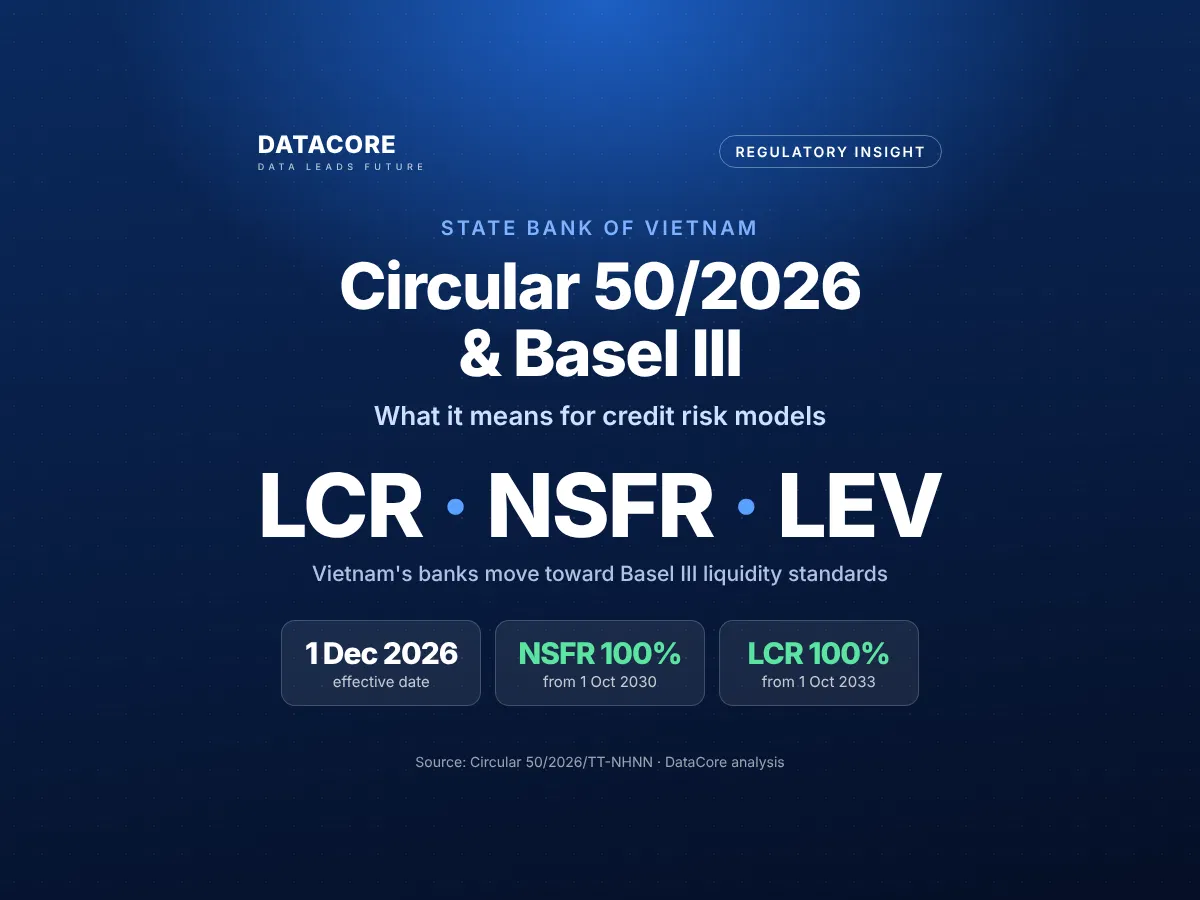
Comparison with Circular 22/2019 • Key ratios and implementation timeline • Implications for credit scoring, IRB and early-warning models
30 October 2026 | Regulatory and technology perspective | For banking and data professionals
KEY TAKEAWAY Circular 50/2026 advances liquidity risk management through LCR and NSFR and introduces a leverage-ratio (LEV) framework. It does not mandate AI or machine learning for credit scoring. Some tools used solely to monitor legacy ratios may become less central as banks migrate to the new framework.
Circular 50/2026/TT-NHNN was issued by the State Bank of Vietnam (SBV) on 30 September 2026. Its general effective date is 1 December 2026, while the phased implementation of the Liquidity Coverage Ratio (LCR) and Net Stable Funding Ratio (NSFR) starts on 1 October 2028. The circular materially updates the prudential limits and safety ratios applicable to commercial banks and foreign bank branches [1].
Its implications for risk models need to be considered on two levels: (i) regulatory obligations imposed on banks, and (ii) banks’ discretionary use of analytical models to help meet those obligations. The two are not identical.
01 What changes under Circular 50/2026 compared with Circular 22/2019?
The numbers: which changes matter most?
| Metric | Circular 22/2019 (as amended) | Circular 50/2026 |
| LDR – loans to deposits | Maximum 85% | Nominal ceiling 95% under Article 12, subject to Article 13 |
| Short-term funding for medium-/long-term lending | Maximum 40% from 1 July 2026 (Circular 25/2026); previously 30% | Transition regime retained; legacy compliance obligation decreases after migration to LCR/NSFR |
| Liquidity reserve ratio | Minimum 10% | Continues during transition; requirement changes under Article 13(5) |
| 30-day payment capacity | Previous thresholds: 50% VND and 10% foreign currencies for commercial banks | Transition toward LCR based on HQLA and stressed cash flows |
| NSFR | No Basel III NSFR metric under this framework | 90% in 2028; 95% in 2029; 100% from 2030 |
| LEV – leverage ratio | No equivalent LEV mechanism | Formula added; minimum set by SBV decision for the relevant period |
Note: the 40% limit reflects Circular 25/2026, effective 1 July 2026, which amended Circular 22; 30% was the earlier limit. Old and new ratios differ in definition and scope and should not be compared one for one. Sources: [1], [2], [2a].
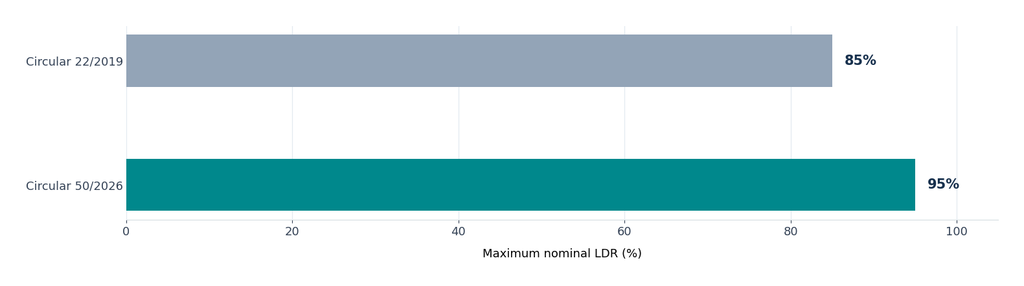
Figure 1. Circular 50/2026 vs Circular 22: LDR ceiling rises from 85% to 95%
The nominal LDR ceiling increases from 85% to 95%, but Article 13 is essential to interpreting the change. Prior to the LCR/NSFR transition, banks remain subject to the legacy ratios and reporting requirements. Following transition, the new LDR rule applies unless a bank has reached the 100% minimum for both LCR and NSFR. In that case, it is no longer required to comply with the new LDR ceiling, although it must continue reporting the ratio [1].
The new roadmap: LCR, NSFR and convergence towards Basel III
LCR measures a bank’s ability to cover net cash outflows over a 30-day stress period using high-quality liquid assets (HQLA). NSFR assesses whether available stable funding (ASF) is sufficient relative to required stable funding (RSF). These measures go beyond simply checking the LDR ceiling or the cap on short-term funding used for medium- and long-term lending [1].
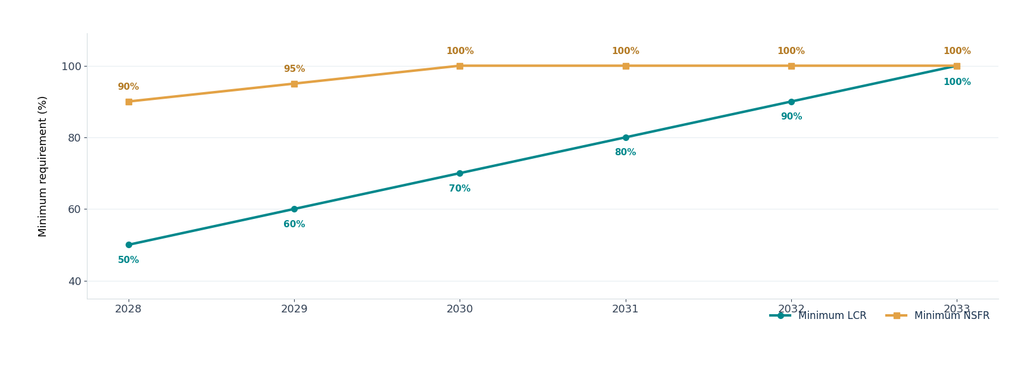
Figure 2. Circular 50/2026 roadmap: phased LCR and NSFR minimums, 2028–2033
Under the general roadmap, LCR reaches 100% on 1 October 2033, while NSFR reaches 100% on 1 October 2030. Separate dates may apply to early adopters or banks approved to use the internal ratings-based (IRB) approach. Sources: Articles 13, 16 and 22 of Circular 50 [1].
Article 8 also introduces a leverage ratio (LEV) framework, calculated as Tier 1 capital divided by the total exposure measure. However, the circular does not immediately impose a single minimum on all banks: the SBV Governor may determine the minimum and applicable date for each period where necessary [1].
02 How Circular 50/2026 affects the role of credit risk models
Article 4: risk quantification remains important, but is not a wholly new requirement
Point (b), Clause 1, Article 4 requires banks to establish principles and indicators for assessing credit risk in customer groups and sectors to which credit is encouraged or restricted. Credit scoring and rating systems may help apply these criteria consistently. Point (a) of the same clause, together with Article 9, also addresses the monitoring of customers and related parties, including exposures that meet specified thresholds and the calculation of total credit exposure [1].
This creates opportunities for corporate relationship analytics (graph/network models) to identify firms sharing owners, legal representatives or addresses and flag cases for further review. Such model-detected links do not, however, establish a legally defined “related party” relationship on their own. Formal verification and authoritative data remain necessary.
Point (dd)(iii), Clause 1, Article 4 requires an early-warning system for risk indicators that could cause deterioration in capital adequacy. Customer-level credit deterioration models may supply inputs to that system, but bank-wide capital adequacy early warning is a broader problem. Crucially, risk management and early-warning requirements were already present in Circular 22. It would therefore be inaccurate to say that Circular 50 created the need for credit scoring [1], [2].
Article 13(3): the most significant link to IRB
Where the SBV approves a bank’s use of the internal ratings-based (IRB) approach under Circular 14/2025 before 1 July 2033, the bank must meet a minimum of 100% for both LCR and NSFR within 90 days of approval. This explicitly links the adoption of a credit-risk measurement approach to the new liquidity framework [1], [3].
Still, not every credit scoring model is an IRB model. IRB comes with its own measurement and validation requirements, including, where applicable, probability of default (PD), loss given default (LGD) and exposure at default (EAD). A business-closure predictor, delinquency model or composite credit score does not automatically qualify as an approved PD estimate for regulatory capital purposes.
Articles 14–24: which models stand to gain the most?
LCR and NSFR require calculations covering HQLA, cash inflows and outflows, asset and liability maturities, ASF/RSF factors and stress conditions. Article 14 also addresses intraday liquidity management and projected cash shortfalls at different time horizons. Consequently, the most direct beneficiaries are cash-flow forecasting, withdrawal-behavior models, stress-testing systems and asset–liability management (ALM) models [1].
This does not make credit scoring obsolete. However, a firm may receive a low credit-risk score and still be denied additional credit if the bank faces LCR, NSFR or concentration constraints. A customer risk score is one input among several decision constraints—not an automatic green light for a loan.
Where influence may decline: tools built around legacy ratios
Clause 5, Article 13 sets out how compliance and reporting obligations change during the transition. Once a bank adopts LCR/NSFR, it is no longer required to comply with the old liquidity reserve, 30-day payment-capacity and short-term-funding-for-medium/long-term-lending thresholds under Circular 22; reporting continues until it meets both new ratios at 100%. Once both reach 100%, the bank no longer has to comply with or report those specified legacy ratios [1].
As a result, tools designed solely to test compliance against one legacy threshold lose some regulatory importance for banks that have completed the transition. Certain rule-based systems may be redesigned or replaced with LCR/NSFR monitoring rather than continuously expanding the number of models. This is a genuine reduction in the role of particular tools—not a broad decline in the importance of credit risk models.
Explainability, validation and decision traceability become more valuable
Article 27 of Circular 50/2026 requires public disclosure of liquidity information at least every six months. Article 1(5) allows supervisors to impose tighter factors or prudential limits in specified circumstances. These provisions increase the practical value of reconcilable data, reproducible calculations and auditable governance [1].
Model governance obligations are more explicit in Circular 83/2025: defining model purpose and scope, controlling data quality, documenting overrides and adjustments, monitoring performance, and conducting pre-deployment as well as at-least-annual validation for models within its scope [4]. Those AI/ML model-validation obligations should not be attributed directly to Circular 50.
03 The future of risk models under Circular 50/2026: shifting roles, not universal growth
| Model / tool | Likely effect | Practical implication |
| Liquidity / ALM / cash-flow models | STRONGEST INCREASE | Support LCR, NSFR, intraday liquidity and stress scenarios |
| Credit scoring / rating | STABLE; POTENTIAL TO EXPAND | Support customer grades and credit policy; AI is not mandated |
| Credit early-warning models | MAY INCREASE | Provide credit deterioration indicators for capital and portfolio oversight |
| Graph / corporate relationship models | OPPORTUNITY | Identify relationships for verification and concentration analysis |
| IRB and risk parameters | HIGHER REQUIREMENTS IF USED | Distinguish approved IRB models from ordinary scoring |
| Legacy Circular 22 ratio-checking tools | MAY DECLINE | Reduced mandatory compliance role after transition; may remain useful internally |
For corporate risk models, the best path forward is not necessarily to make algorithms more complex. More useful advances may include incorporating non-financial information, tracking changes in company registrations over time, analyzing corporate relationships and making scores explainable across historical periods.
A model using business-registration histories and ownership changes may provide valuable additional early-warning signals. Yet those signals must be tested to determine whether they predict non-performing loans or credit defaults, rather than merely dissolution, suspension or loss of contact. These outcomes are not interchangeable. A “closure score” should not be presented as PD without appropriate credit outcome labels and calibration.
Conclusion
Circular 50 should not be viewed simply as either loosening or tightening credit. It changes the prudential toolkit: a phased move from traditional limits toward LCR/NSFR, a separate mechanism for LEV, and an explicit connection between IRB approval and higher liquidity requirements. For analytics, its most direct implication is stronger demand for liquidity, cash-flow and portfolio-level risk capabilities.
For credit scoring, the balanced conclusion is that its core role remains intact and may expand into early warning and relationship analytics—but it does not automatically become more important. Meanwhile, tools created only to meet older ratio requirements may lose part of their compliance role. The future belongs to models that solve specific business problems, use reliable data, are properly validated and fit into banks’ governance and decision processes.
Sources and scope of interpretation
[1] Circular 50/2026/TT-NHNN (issued 30 September 2026; generally effective 1 December 2026), Articles 1, 4, 8, 9, 12–16, 22–24, 27 and 37.
https://congbao.chinhphu.vn/van-ban/thong-tu-so-50-2026-tt-nhnn-470632/69577.htm
[2] Circular 22/2019/TT-NHNN and related amending instruments; see the transition provisions in Article 13(4) of Circular 50.
https://vanban.chinhphu.vn/?pageid=27160&docid=198130
[2a] Circular 25/2026/TT-NHNN amending Circular 22 (effective 1 July 2026); increases the limit on short-term funding used for medium- and long-term lending to 40%.
https://congbao.chinhphu.vn/van-ban/thong-tu-so-25-2026-tt-nhnn-469825.htm
[3] Circular 14/2025/TT-NHNN on capital adequacy and the internal ratings-based approach.
https://chinhphu.vn/?classid=1&docid=214640&pageid=27160&typegroupid=6
[4] Circular 83/2025/TT-NHNN on internal controls and model risk management.
https://congbao.chinhphu.vn/van-ban/thong-tu-so-83-2025-tt-nhnn-468920/62369.htm
[5] Vietnam Banks Association, announcement of Circular 50 (5 October 2026).






Để lại một bình luận
You must be logged in to post a comment.