
"Speed and uncertainty are the new stability." - Reid Hoffman and Chris Yeh, Blitzscaling (2018)
That line from Blitzscaling is not a slogan, it is a description of the world we now live in. Markets are shifting faster than planning cycles, artificial intelligence is redefining entire industries in years instead of decades, and the distance between a prototype and a global product is shrinking.
In this world, companies that win are not simply those with the best ideas. They are the ones that can scale faster than their competitors, even when everything feels unclear.
That is the essence of blitzscaling.
And in Vietnam today, the opportunity and the risk are that many teams are trying to blitzscale on top of infrastructure that was never designed for this kind of speed. Data is scattered, computing is scarce or overpriced, and every ambitious team is reinventing the same plumbing from scratch.
DataCore exists to change that.
This essay explains blitzscaling in plain terms, looks at how the game has shifted in the age of data and AI, and then brings it home to Vietnam: what it would mean for Vietnam to have its own "operating system" for hypergrowth, and why DataCore is deliberately building exactly that.
What Blitzscaling Really Is, Without The Buzzwords
Blitzscaling is not just "growing fast". It is the deliberate choice to prioritize speed over efficiency in an environment of massive opportunity and massive uncertainty.
A few key points:
- You accept inefficiency in the short run
You hire ahead of revenue, you overbuild capacity, you launch before everything is perfectly optimized. The goal is to capture the market before the window closes. - You navigate uncertainty rather than waiting for clarity
There is no stable equilibrium to analyze. New technologies, shifting regulations, changing user behavior, and uncertain business models are the norm, not the exception. - You play for a winner-take-most outcome
Blitzscaling only makes sense in markets where, once a company wins, it can lock in a large, defensible position: through network effects, switching costs, data advantages, or ecosystem control. - You accept that some bets will fail
In exchange for speed, you take more product risk, operational risk, and sometimes reputational risk. The discipline is not eliminating risk; it is choosing the right risks.
Blitzscaling is a scaling strategy, not a religion. It is powerful when the conditions are right, and dangerous when they are not.
The World Has Changed: Blitzscaling Now Runs On Data And Compute
The original wave of blitzscaling stories centered on social networks, marketplaces, and consumer apps: Facebook, Uber, Airbnb, LinkedIn, and so on.
Today, the frontier is different:
- AI-native products and platforms
- Data infrastructure and analytics platforms
- Vertical software that is deeply integrated with industry data
- Ecosystems where APIs and models become the new building blocks
Blitzscaling in this environment depends on three things far more than before:
- Data gravity
Whoever can aggregate, clean, and leverage high-value data fastest, wins. Models are important, but without differentiated data, they become commodities. - Access to serious compute
Training, fine-tuning, evaluating, and deploying modern models is computationally intensive. Startups and even large enterprises can waste years and millions of dollars building, maintaining, and scaling their own infrastructure. - Reliable, repeatable production pipelines
It is no longer enough to demo a model. You need a pipeline that turns raw data into production-grade AI services, with monitoring, governance, and evaluation built in.
In other words, the bottleneck has moved. It is not just "move fast and break things". It is "move fast on a foundation that can handle the scale and the uncertainty".
The companies that have blitzscaled successfully in this environment, from cloud providers to data platforms and AI infrastructure players, all understood this early. They did not just build products, they built the rails for growth.
Vietnam: A Young Market With A Scaling Problem
Vietnam is one of the most promising digital markets in the world:
- A young, highly online population
- Rapid adoption of digital payments, e-commerce, and social media
- A government that understands the strategic importance of data and AI
- Increasing interest from global investors and partners
However, there is a quiet, structural problem that every founder, data leader, and university lab feels daily:
- Data is fragmented and locked in silos across banks, telcos, retailers, public agencies, and platforms.
- High-performance computing is scarce, expensive, or underutilized, split across isolated clusters and proprietary stacks.
- Every serious AI or analytics team is rebuilding the same infrastructure: pipelines, storage, governance, MLOps, monitoring, and evaluation frameworks.
- Collaboration is hard: moving data across institutions is risky, slow, and often impossible without manual work and legal friction.
So, Vietnamese teams are trying to play a global blitzscaling game while starting every project by laying their own railroad tracks.
That is not a recipe for speed, and it is certainly not a recipe for "speed and uncertainty as the new stability".
The Missing Layer: A Data And Compute Operating System For Vietnam
Blitzscaling in Vietnam will not look like copying Silicon Valley playbooks line by line. It will look like building local strengths on top of shared, world-class infrastructure.
This is the role DataCore is choosing to play.

At its core, DataCore is building a national-scale data intelligence and high-performance computing hub that gives Vietnamese organizations, from startups to state-owned enterprises, the foundation they need to scale at global speed.
Think of it as an operating system for hypergrowth in Vietnam and the surrounding region.
1. High Performance Computing as A Shared Utility
Instead of each university, bank, or tech firm struggling to justify its own cluster, DataCore provides:
- Elastic high-performance compute suitable for large-scale analytics, simulation, and AI workloads
- A managed environment where performance, security, and reliability are handled by an expert team
- A bridge between academic workloads, enterprise use cases, and startups, so utilization is high and costs are sane
When computing is a shared utility instead of a private luxury, more teams can experiment, iterate, and scale.
2. Secure Data Collaboration, Not Data Hoarding
Vietnam cannot create global-class AI products if every dataset is locked inside one institution.
DataCore focuses on:
- Secure data collaboration environments where organizations can analyze combined data without reckless sharing
- Privacy-preserving analytics and governance that respect legal and ethical constraints
- Standardized schemas and connectors that make it easier to join, enrich, and analyze data across industries
This is how Vietnam builds real data network effects, rather than just parallel silos.
3. Production-Grade AI and MLOps Pipelines
A one-off model demo is not blitzscaling. A repeatable, auditable pipeline is.
DataCore provides, or integrates:
- Tools to move from notebook experiments to robust services
- Monitoring, retraining, and evaluation frameworks that keep models reliable in production
- Support for modern AI patterns: retrieval augmented generation, graph based learning, recommender systems, fraud detection, and more
For Vietnamese organizations, this means they can focus on what they are building, not constantly rebuild how to get it into production.
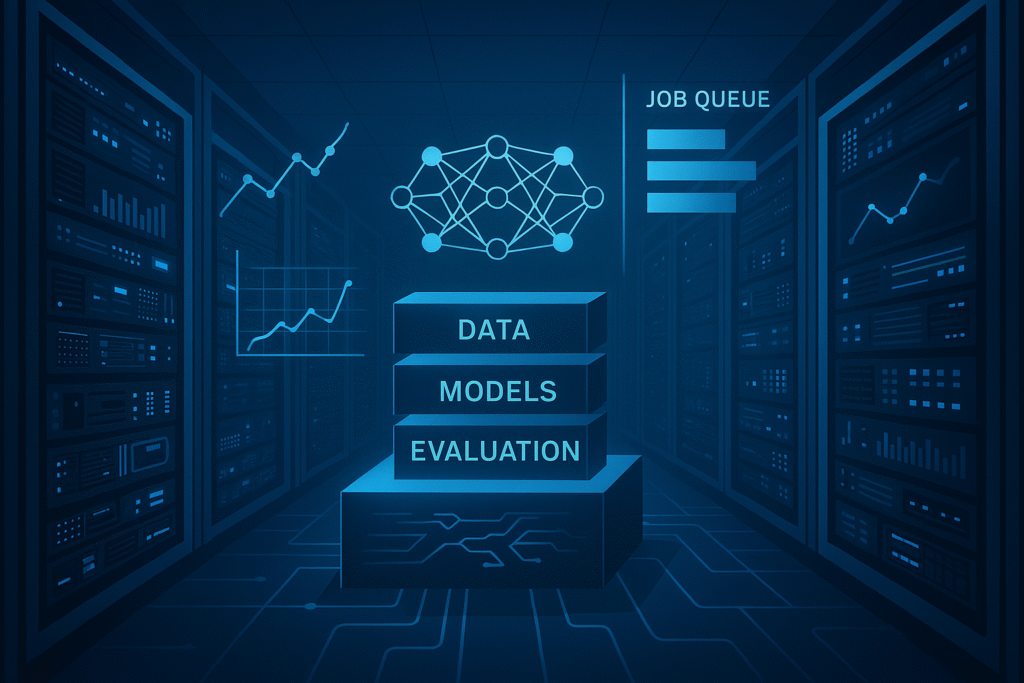
4. Evaluation And Benchmarking As Public Infrastructure
In a noisy AI market, trust is scarce.
DataCore is working toward:
- Shared evaluation datasets for key Vietnamese use cases: language, finance, telco, retail, logistics, education, and others
- Public or semi-public leaderboards that allow models and systems to be compared on real tasks, not marketing slides
- A culture of measurement and transparency that rewards real performance
This is exactly what an ecosystem needs if it wants to avoid hype and invest in what actually works.
How DataCore Changes The Blitzscaling Playbook For Vietnam
If you are a founder or data leader in Vietnam today, you have probably faced some version of the following dilemma:
- Either you move quickly, hack things together, and risk breaking under scale,
- Or you move slowly, build your own stack from scratch, and risk missing the market entirely.
A mature shared infrastructure layer changes that calculus.
With DataCore in the picture, blitzscaling in Vietnam starts to look different.
From Capex Heavy To Pay As You Grow
Instead of buying servers, negotiating complex cloud contracts, and hiring a large infrastructure team, you can tap into shared high-performance compute and data infrastructure as a service.
Capital and talent can go to your product and go-to-market, not to yet another cluster.
From Building Everything To Standing On The Shoulders Of A Platform
You do not need to design your own job scheduler, cluster topology, security policies, monitoring stack, and MLOps framework. You plug into a platform that already handles these concerns at scale.
Your risk shifts from "can we build and run this ourselves" to "can we create value on top of this faster than anyone else".
From Local MVPs To Regional Network Effects
With data collaboration and shared infrastructure:
- A fintech startup can work with multiple banks and data sources securely instead of integrating one by one,
- A telco can expose anonymized insights and APIs to a whole ecosystem of partners,
- A logistics player can combine data with ports, customs, and partners without losing control.
Network effects become easier to create because the rails are already there.
From Copycat Features To Original Data Products
When the hard work of data integration, compute, and pipelines is handled by a specialist, Vietnamese teams can:
- Build AI models that truly understand local behavior, language, and context
- Innovate in verticals where Vietnam has unique data: manufacturing, agriculture, export, tourism, supply chains, and more
- Move past basic "me too" features toward defensible, data-driven products
Concrete Blitzscaling Scenarios Enabled By DataCore
To make this less abstract, consider a few realistic scenarios.
Scenario 1: A Fintech Blending Credit, Behavior, And Graph Data
A Vietnamese fintech wants to build a superior credit scoring and fraud detection engine:
- They need to combine bank transaction data, telco behavioral signals, alternative data, and graph relationships across millions of entities.
- They need to train and evaluate graph-based models, monitor drift, and retrain regularly.
- They need to prove to partners and regulators that their models are robust and fair.
Without a platform, building the infrastructure alone could take years.
With DataCore:
- Graph construction and large-scale training jobs run on shared high-performance compute.
- Secure data clean rooms allow banks and partners to collaborate without exposing raw data.
- Evaluation and monitoring pipelines are part of the core infrastructure.
The fintech's edge is no longer "we can operate servers". It is "we can design and iterate on better models and user experiences faster than anyone else".
Scenario 2: A Telco Turning Its Network Into An AI Platform
A telco in Vietnam wants to move beyond connectivity and become a platform for AI innovation.
- It sits on rich data that could power personalization, risk scoring, location intelligence, and more.
- It wants to expose anonymized signals and AI services to banks, retailers, developers, and the public sector.
With DataCore:
- The telco can host its heavy workloads on shared HPC while keeping strict governance.
- It can collaborate with universities and startups on joint models and products, without compromising security.
- It can showcase its capabilities via shared evaluation and benchmarks, building credibility in the ecosystem.
Blitzscaling here is not about adding subscribers; it is about becoming the default AI infrastructure partner in the market.
Scenario 3: University Labs Turning Research Into Companies
Vietnamese universities are full of talented researchers and students who:
- Build promising models in isolation,
- Lack access to realistic data and scalable infrastructure,
- Struggle to turn prototypes into products trusted by industry.
With DataCore as a partner:
- Labs can run serious experiments on real infrastructure, not just on laptops.
- They can collaborate directly with industry partners through shared data environments.
- Spin-offs can inherit production-grade pipelines from day one.
Instead of watching their best students leave for foreign ecosystems, universities can anchor high-impact AI ventures locally.
Blitzscaling, But With Discipline
It is important to say this clearly: blitzscaling is not an excuse to ignore unit economics, compliance, or ethics.
If anything, the AI and data age raises the bar.
A company that blitzscales without a solid infrastructure foundation will not just burn cash, it will create technical debt and trust deficits that are hard to repair.
This is exactly why a platform like DataCore matters. It lets teams move faster, but on rails that are:
- Auditable
- Secure
- Performance tested
- Designed with long-term sustainability in mind
You still need to decide whether blitzscaling is the right strategy for your market, stage, and team. Not every company should, or can, blitzscale.
But if you have a genuine winner-take-most opportunity, you should not lose it because you were stuck rebuilding commodity infrastructure.
"Speed And Uncertainty Are The New Stability" In Vietnam
When Blitzscaling says, "Speed and uncertainty are the new stability", it captures the uncomfortable truth of modern business.
Stability now comes from your ability to:
- Learn faster than others
- Execute faster than others
- Adapt your systems faster than others
In Vietnam, that ability should not be limited to companies that can afford their own data centers and deep infrastructure teams.
The next generation of Vietnamese champions in finance, telecom, manufacturing, logistics, and public services should be able to blitzscale on top of a shared, national-grade base layer.
That is the vision DataCore is working toward:
A data and compute operating system that lets Vietnamese organizations, of all sizes, play the global game at global speed.
A Call To Builders, Institutions, And Partners
If you are:
- A founder or product leader who believes your company can win your market if you had the right data and compute foundation,
- A bank, telco, retailer, or industrial firm that knows you are sitting on underused data,
- A university lab or research group that wants to turn serious AI and analytics work into impact,
- A public sector leader who understands that digital infrastructure is now economic infrastructure,
Then the question is simple:
What could you build, and how fast could you build it, if you did not have to fight the infrastructure battle alone?
DataCore is already working with forward-looking teams to answer that question in practice, not in theory.
If you want to explore concrete ways to plug into this emerging operating system for blitzscaling in Vietnam, the next step is to talk to us, bring your hardest scaling problems, and see what becomes possible when speed and uncertainty are treated not as threats, but as the new environment we are designed to operate in.
Related reading: Vietnam Bank Executive Turnover Data: What Eximbank's CEO Exit Signals for 2026 and Vietnam Margin Trading Restrictions: 57 Stocks Cut in August Even as Foreign Capital Surges.
Want to see how DataCore's data services can support your business? Explore DataCore Services.






One response to “Blitzscaling In A World Of AI, And Why Vietnam Needs Its Own DataCore”
[…] A paper published that month on arXiv, "Regurgitative Training: The Value of Real Data in Training Large Language Models" by Zhang, Qiao, Yang and Wei, set out to test whether synthetic AI training data actually works. The findings are sobering for anyone betting their roadmap on synthetic shortcuts, and they have particular weight for an emerging market like Vietnam. (Related: see our take in Blitzscaling in a world of AI.) […]