
Data is becoming a strategic national platform. This article analyzes why Vietnam needs to build a data-centric foundation - from national data architecture and computational sovereignty to the role of DataCore in driving digital economic development.
1. The Global Shift: From Digital to Data Infrastructure
In the past decade, the world has moved beyond digitalization into an era defined by data infrastructure.
Governments and corporations alike are re-engineering their economies around data flows, computational capacity, and analytical intelligence.
- The OECD Digital Economy Outlook 2024 defines national data infrastructure as “a strategic asset underpinning innovation, governance, and competitiveness.1”
- The European Union’s Data Governance Act (2022) establishes frameworks for secure, interoperable data exchange, treating data as “a shared resource of public and private value.”2
These developments underscore a simple truth: nations that control and coordinate their data infrastructure control their digital futures.
2. Vietnam’s Digital Paradox: Growth Without Cohesion
Vietnam has become one of Southeast Asia’s fastest-growing digital economies.
According to Google-Temasek’s e-Conomy SEA 2024 Report, the country’s digital sector is valued at US$36 billion, driven by e-commerce, online travel, and online media3.
Yet behind this growth lies a structural gap: data fragmentation.
The Symptoms:
- Siloed Data Repositories:
Public data is distributed across ministries and provinces, often in incompatible formats. Enterprise and academic datasets are rarely interoperable or standardized. - Limited Data Interoperability Standards:
Unlike Singapore’s National Data Architecture4 or the EU’s GAIA-X model5, Vietnam lacks consistent metadata, schema, and governance protocols to ensure reliable exchange. - Infrastructure Imbalance:
While data volume expands exponentially, computing resources for AI and large-scale analytics remain limited to a handful of institutions. - Data Governance Complexity:
The Law on Cyberinformation Security (2015) and Decree 53/2022/NĐ-CP address sovereignty and privacy, but lack a unified framework for responsible data sharing and reuse, which is a critical enabler for research and innovation.
The result is a paradox: data abundance without accessibility, digital expansion without analytical depth.
3. The Strategic Imperative: A National Data Core
Vietnam’s next digital transformation must go beyond connectivity and applications.
It requires a National Data Core - an integrated, sovereign infrastructure that consolidates datasets, provides high-performance computation, and enables secure, scalable intelligence.
Lõi này phải bao gồm ba khả năng:
| Capability | Description | International Benchmark |
|---|---|---|
| Data Fabric | Unified, standardized, discoverable datasets across government, finance, and research domains. | EU Data Spaces, Singapore’s National Data Architecture |
| Computational Sovereignty | Domestic HPC and cloud environments to process and analyze national-scale data securely. | India’s National Supercomputing Mission |
| Intelligent Access Layer | APIs, analytics tools, and visualization environments that bring data closer to end users. | UK’s Office for National Statistics Data API |
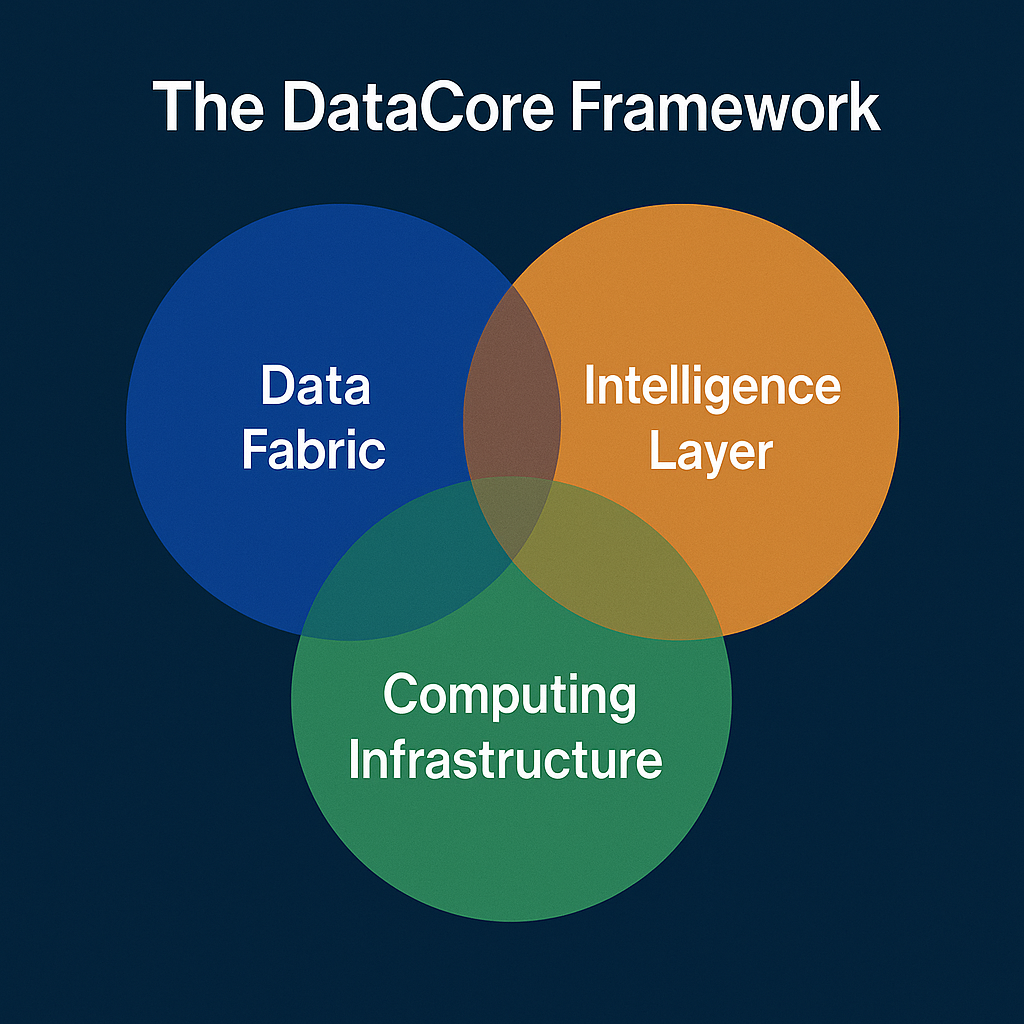
Without this triad, Vietnam risks losing competitiveness in AI development, financial analytics, and scientific research: all fields where data access and compute capacity are now prerequisites, not advantages.
4. The DataCore Model: Turning Data into Intelligence
Tại DataCore , chúng tôi đang xây dựng nền tảng này cho tương lai dựa trên dữ liệu của Việt Nam.
4.1. Tích hợp các tập dữ liệu
DataCore consolidates and standardizes public, financial, and enterprise datasets under common metadata and schema standards.
We align with open data protocols to ensure accessibility and interoperability.
4.2. Máy tính hiệu suất cao theo yêu cầu mở
Our HPC platform provides scalable compute resources for:
- AI model training and simulation
- Economic and policy analytics
- Scientific and industrial research
This supports both sovereign computation, ensuring data remains within Vietnam’s jurisdiction, and efficient collaboration across institutions.
4.3. Môi trường phân tích tích hợp
Rather than exporting data for processing, users can perform advanced analytics directly within DataCore’s environment, combining:
- Secure API access
- In-place computation
- Visualization and model deployment
This architecture minimizes latency, reduces compliance risk, and accelerates insight generation, enabling data-to-decision workflows.
5. Policy Alignment and Collaboration
DataCore’s mission aligns with national priorities outlined in:
- The National Digital Transformation Program to 2025, Orientation to 2030 (Decision No. 749/QĐ-TTg)6
- The National Strategy on Research, Development, and Application of Artificial Intelligence to 2030 (Decision No. 127/QĐ-TTg)7
- Vietnam’s Digital Infrastructure Strategy8
By providing a neutral, standards-driven platform, DataCore complements government initiatives while supporting private-sector innovation and academic research.
We are actively collaborating with:
- Universities developing AI models using financial and socioeconomic datasets.
- Corporations optimizing market and supply chain analytics through on-platform computation.
- Public agencies piloting secure data-sharing mechanisms across ministries.
6. The Vision Forward

The next decade will be defined not by who collects the most data, but by who can analyze, govern, and apply it most effectively.
By combining data integration with scalable compute and intelligent access, DataCore aims to serve as the infrastructure backbone for Vietnam’s digital economy, a foundation upon which AI, analytics, and innovation can thrive.
[ datacore.vn/services ] | [LinkedIn: DataCore Vietnam ] | [Liên hệ: support@datacore.vn ]
References
- OECD (2024). Digital Economy Outlook 2024. ↩︎
- European Commission (2022). Data Governance Act. ↩︎
- https://services.google.com/fh/files/misc/e_conomy_sea_2024_report.pdf ↩︎
- Smart Nation and Digital Government Office (Singapore). National Data Architecture Overview. https://www.smartnation.gov.sg/ ↩︎
- https://gaia-x.eu/gaia-x-framework/ ↩︎
- https://english.luatvietnam.vn/decision-no-749-qd-ttg-on-approving-the-national-digital-transformation-program-until-2025-with-a-vision-184241-doc1.html ↩︎
- https://english.luatvietnam.vn/decision-no-127-qd-ttg-dated-january-26-2021-of-the-prime-minister-on-the-promulgation-of-the-national-strategy-on-research-development-and-applica-197755-doc1.html ↩︎
- https://en.baochinhphu.vn/govt-approves-digital-infrastructure-strategy-11124101010505598.htm ↩︎
Related reading: Vietnam Bank Executive Turnover Data: What Eximbank's CEO Exit Signals for 2026 and Vietnam Margin Trading Restrictions: 57 Stocks Cut in August Even as Foreign Capital Surges.






One response to “Data as National Infrastructure: Why Vietnam Must Build Its Core”
[…] Chương trình Chuyển đổi số quốc gia đến năm 2025, định hướng đến năm 2030 (Quyết định số 749/QĐ-TTg) 6 […]