
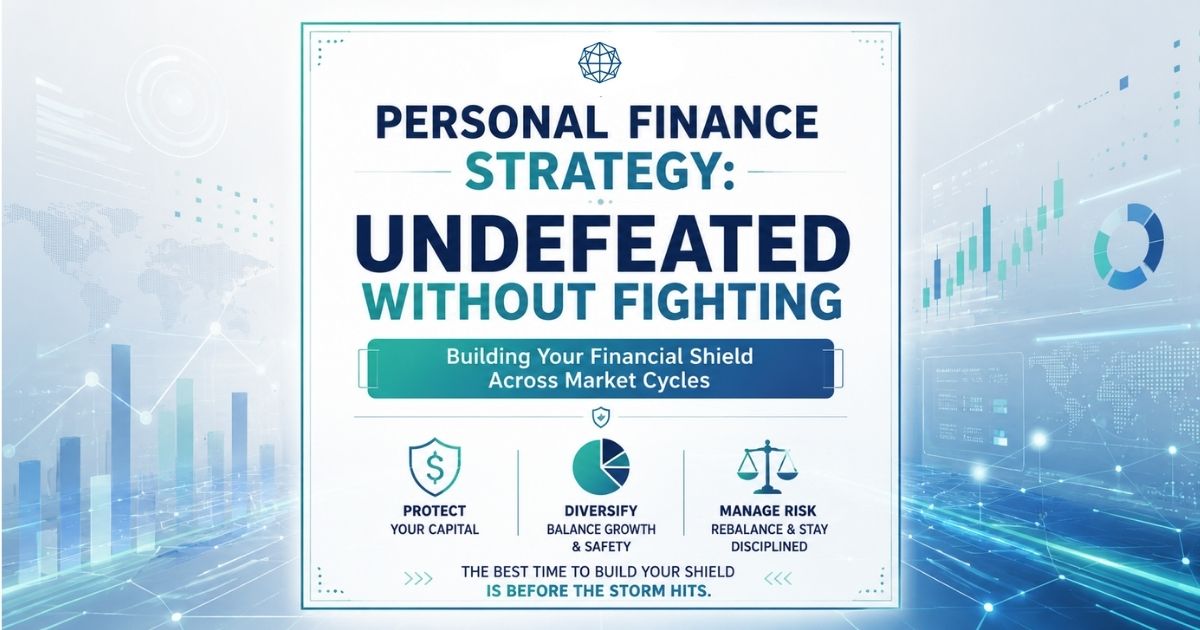
In the world of investing, we often get swept up in the race for returns during bull markets, forgetting that the greatest risk is not making less, but losing hard-earned capital when the cycle turns.
A resilient personal defensive finance strategy should therefore be about more than maximizing returns. Applying the philosophy of “winning without fighting” to personal defensive finance strategy means proactively building a robust defensive system during peaceful times, ensuring that no matter what storms arrive, your assets and peace of mind can stand firm against market volatility.
The objective is not to predict every market crash or economic downturn. It is to build a financial position strong enough that you do not need to predict them perfectly in the first place.
The Cycle Curse and the Fallacy of the Crowd
In personal finance, our own psychology can often be our biggest enemy. During a bull market, rising prices and growing optimism can create the illusion that the good times will never end. FOMO kicks in, everyone starts chasing the rally, and we become increasingly confident that nothing can go wrong. Meanwhile, we enjoy the gains on paper while overlooking the risks quietly building inside our portfolios.

This becomes particularly dangerous when headline market performance begins to influence investment decisions more than the underlying strength of individual holdings. As discussed in DataCore's analysis, VN-Index Trap: 3 Tools to Read the Market Correctly, an index can sometimes create a misleading impression of overall market strength when gains are concentrated in only a small number of large-cap stocks.
The idea of “winning without fighting” offers a different way to think about personal defensive finance strategy. Instead of waiting for a crash and then trying to react, real financial resilience is built while markets are still calm. Preserving capital is often far easier than trying to recover from a major loss.
Rather than constantly chasing returns, a disciplined personal defensive finance strategy focuses on protecting what you already have. By managing risk, avoiding unnecessary speculation, and remaining patient, you can build a financial buffer that helps you weather market volatility before it becomes a serious threat.
Identifying Portfolio Fractures Before the Storm Hits
Before a macroeconomic storm hits, vulnerabilities in a market rarely appear all at once. They usually begin as small cracks hidden deep within a portfolio's structure.

When asset prices are still rising, investors can easily overlook these early warning signs. That is why it is important to look beyond headline returns and pay attention to the underlying strength of your holdings.
These cracks can come from:
- Over-reliance on financial leverage;
- A complete lack of defensive, liquid assets;
- Heavy exposure to speculative assets without solid fundamentals;
- Excessive concentration in a single asset, sector, or market theme.
Once liquidity starts drying up across the broader market, these weaknesses can quickly turn into serious failures.
Leverage deserves particular attention. Borrowing can amplify returns when markets rise, but it can also magnify losses when prices move in the opposite direction. In extreme circumstances, investors may be forced to liquidate assets during a downturn rather than being able to wait for markets to recover.
For investors in Vietnam, DataCore's analysis of Vietnam Margin Trading Restrictions provides a practical example of how leverage and stock-level risk can become important even when the broader market narrative remains optimistic.
The key is to identify and address these vulnerabilities while markets are still stable. By regularly reviewing your portfolio and strengthening its weak points, you can better prepare it to withstand external shocks when they eventually arrive.
A sound personal defensive finance strategy therefore asks more than: "How much can this portfolio make?”. It should also ask: “What happens to this portfolio if market conditions suddenly turn against me?”
Building a Multi-Tiered Financial Firewall
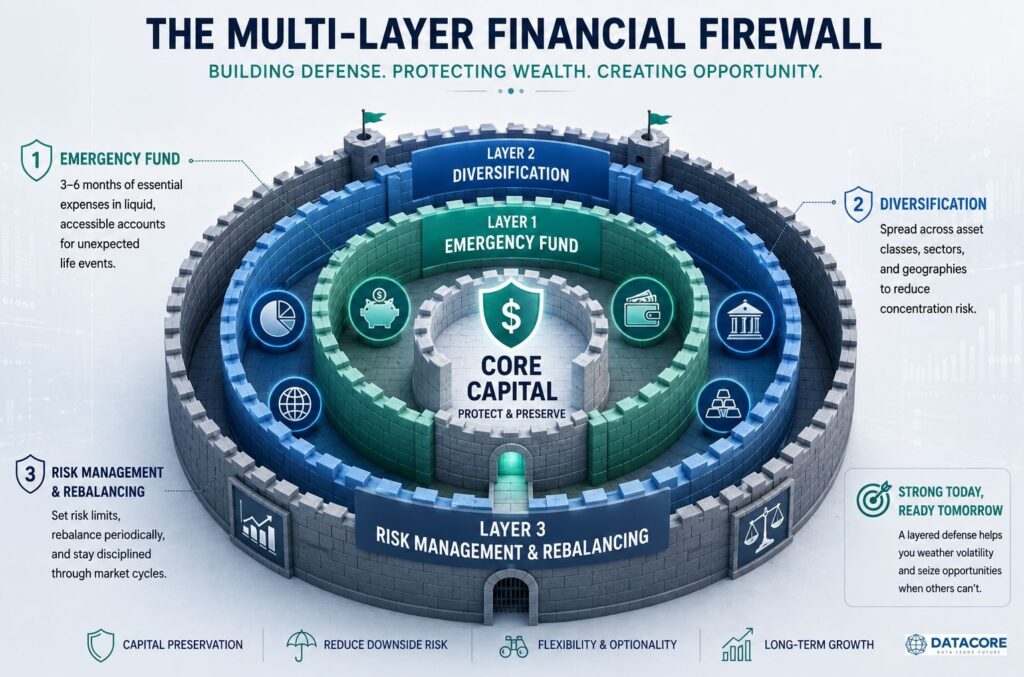
Building a strong financial defense takes more than good intentions. It requires a clear system with several layers of protection. Like a fortress with multiple walls, a resilient personal defensive finance strategy should have different buffers capable of absorbing unexpected shocks.
Layer One: Build an Accessible Emergency Fund
The first layer is an accessible emergency fund, ideally capable of covering several months of essential expenses and kept separate from volatile investments.
An emergency fund serves a fundamentally different purpose from an investment portfolio. Its job is not to generate maximum returns. Its purpose is to provide liquidity when unexpected expenses, income disruptions, or financial emergencies occur.
The U.S. Consumer Financial Protection Bureau describes an emergency fund as a dedicated cash reserve for unplanned expenses or financial emergencies and notes that savings can reduce the need to rely on debt when a financial shock occurs.
Learn more about building an emergency fund from the Consumer Financial Protection Bureau.
Layer Two: Diversify Across Different Types of Assets
The next layer is diversification - balancing higher-growth assets with safer options such as government bonds, cash, or cash equivalents. Diversification does not eliminate investment risk. Instead, it reduces dependence on the performance of any single investment or asset class.
The U.S. Securities and Exchange Commission's Investor.gov explains that diversification involves spreading money across different investments to reduce risk and that appropriate asset allocation depends on factors such as an investor's time horizon and risk tolerance.
Read the SEC's guide to asset allocation and diversification.
This principle becomes particularly important when market indexes themselves are concentrated. DataCore's recent analysis of a sharp VN-Index decline driven heavily by a small group of large-cap stocks illustrates why headline index movements do not always represent the experience of a properly diversified portfolio.
Layer Three: Rebalance Instead of Reacting Emotionally
Finally, good risk management means regularly reviewing and rebalancing your portfolio instead of making emotional decisions when markets turn.
As some investments outperform others, the original structure of a portfolio can gradually change. A portfolio that started with a moderate risk profile may eventually become much more aggressive simply because its highest-risk assets appreciated the fastest.
Rebalancing brings the portfolio back toward its intended asset allocation. Investor.gov specifically identifies rebalancing as a way to restore a portfolio's original asset mix when holdings have drifted away from an investor's goals.
Learn more about portfolio rebalancing from Investor.gov.
By setting clear limits and understanding your risk tolerance in advance, you can protect your core capital while staying calm and focused through market volatility.
The Courage to Stand Aside When the Storm Rages
True financial mastery is reflected not just in active maneuvers, but sometimes in the profound discipline of doing nothing.
When a market panic or macroeconomic storm finally hits, the crowd typically fractures into despair - selling assets out of fear, sometimes near the bottom of the cycle. In contrast, an investor protected by a solid financial shield views volatility through an entirely different lens.

Standing aside and letting the chaos clear requires emotional fortitude.
It means recognizing that cash is not necessarily a dead asset, but can also function as a strategic reserve waiting for the right moment. This does not mean attempting to predict the exact market bottom. Market timing is extraordinarily difficult, and holding excessive cash indefinitely also carries opportunity costs and inflation risk.
Rather, the defensive advantage comes from maintaining enough liquidity that you are not forced into decisions by short-term market conditions.
When asset prices collapse indiscriminately, genuine value can sometimes emerge. Investors who maintain their composure may be in a stronger position to evaluate and gradually accumulate high-quality assets at significantly lower valuations.
This is particularly relevant when macroeconomic forces such as interest rates, exchange rates, liquidity conditions, and capital flows are driving market-wide volatility. For an example of how these forces interact in Vietnam, see DataCore's analysis of the Fed interest rate decision and its impact on Vietnam.
By maintaining your composure while others panic, you position yourself to act from strength rather than necessity. This ability to remain patient and detached can transform market crashes from terrifying threats into potential long-term opportunities.
Personal Defensive Finance Strategy: Build the Defense Before You Need It
The central principle behind a defensive personal defensive finance strategy is not predicting exactly when the next bull market will end or when the next financial crisis will begin. It is building your financial position so that you do not need to make those predictions correctly in order to survive.
Market cycles are unavoidable. Interest rates change. Liquidity expands and contracts. Investor sentiment moves between optimism and fear. Assets that appear unstoppable during one part of the cycle can suddenly become vulnerable when conditions change.
A strong personal financial defense cannot eliminate these forces. But it can change how they affect you.
- An emergency fund can prevent an unexpected expense from forcing you to liquidate investments.
- Diversification can reduce dependence on a single source of returns.
- Controlled leverage can reduce the risk of forced selling.
- Rebalancing can keep portfolio risk aligned with your original objectives.
- And sufficient liquidity can give you the freedom to wait rather than react.
During a powerful bull market, this approach may appear conservative. Investors taking greater risks may temporarily achieve much higher returns.
But the true test of a personal defensive finance strategy does not come only during periods of prosperity. It comes when the cycle turns.
If your financial structure allows you to preserve capital, maintain liquidity, control your emotions, and continue making rational decisions when others are forced to react, you have achieved something more valuable than simply outperforming during the good times.
That is the financial meaning of “winning without fighting.” Build the defense before the storm arrives, so that when it finally does, you are not fighting for survival.Instead, you are calmly deciding what to do next.
Disclaimer: This article about personal defensive finance strategy is for educational and informational purposes only and should not be considered personalized financial or investment advice.






Để lại một bình luận
You must be logged in to post a comment.