
In this article
- How big was foreign net selling in May 2026?
- Which stocks led the foreign net selling?
- Is this a one-week blip or a structural trend?
- Why composition matters more than the total
- What is driving the foreign net selling?
- What should investors watch next?
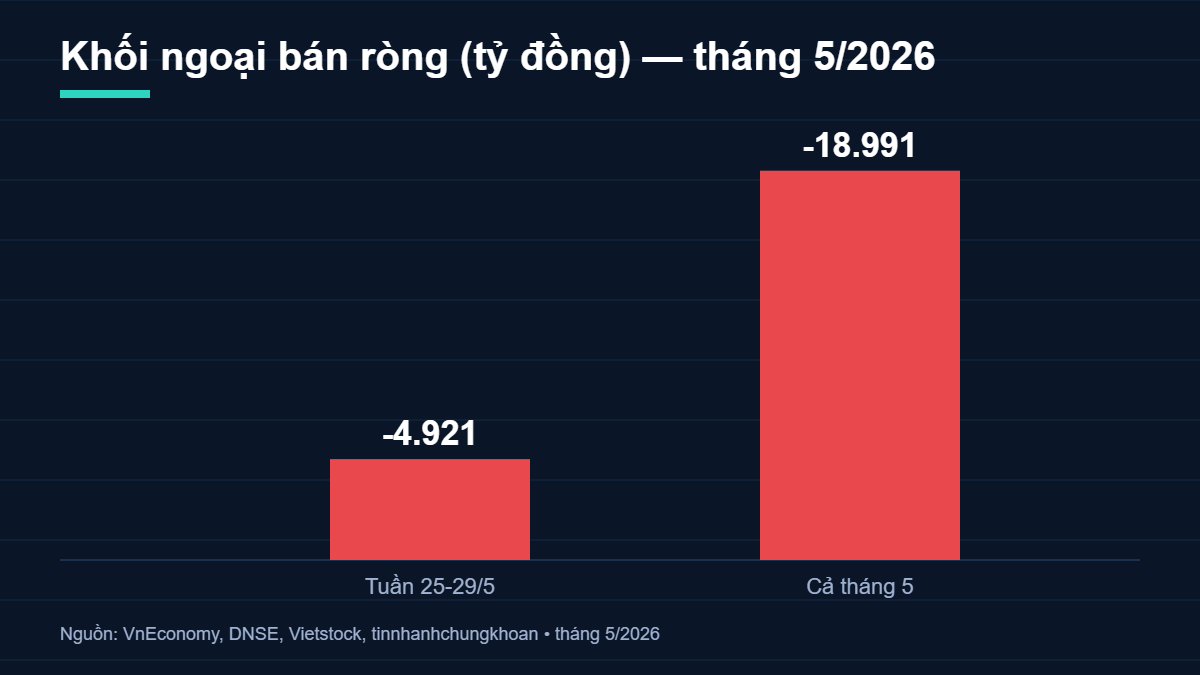
TL;DR. Foreign net selling dominated Vietnam's market in May 2026: foreign investors net-sold about VND 18,991 billion across Vietnam's three exchanges (HOSE, HNX, UPCOM), pushing year-to-date net selling to roughly VND 62,361 billion and extending the streak to 12 consecutive sessions of net selling. The week of 25-29 May 2026 alone accounted for about VND 4,921 billion of outflows, led by MSB (Maritime Commercial Joint Stock Bank), HPG (Hoa Phat Group) and VHM (Vinhomes JSC). The headline total matters less than the composition - which sectors and tickers the money is leaving. (Figures as of end-May 2026.)
How big was foreign net selling in May 2026?
Foreign net selling reached about VND 18,991 billion in May 2026 - close to VND 20,000 billion - according to VnEconomy (May 2026). Cumulative net selling since the start of the year stood at roughly VND 62,361 billion (tinnhanhchungkhoan, May 2026). Total foreign turnover for the month was over VND 111,713 billion, about 11.5% of whole-market value, so this was heavy two-way activity tilted decisively to the sell side.
Which stocks led the foreign net selling?
In the final week (25-29 May 2026), foreign net selling reached about VND 4,921 billion (DNSE, May 2026). The concentration is the story: MSB was the single largest target, with net selling of roughly VND 1,756 billion over the week (Vietstock, May 2026), alongside HPG and VHM. On the other side, VCB, LPB and MSN saw stronger net buying - so this was rotation, not a blanket exit.
Is this a one-week blip or a structural trend?
It is a streak, not a blip. Foreign investors net-sold for 12 consecutive sessions into late May (TTXVN, end-May 2026), and the year-to-date figure (~VND 62,361 billion) shows the pressure has been building for months, not days. Net-selling figures move daily, so treat any single number as a snapshot with an as-of date attached.
Why does the composition matter more than the total?
A headline like "foreigners sold VND 19,000 billion" is a number anyone can repeat. The decision-useful question is where the money went: which sectors, which tickers, which ownership cohorts. A market total cannot tell a bank-IR team whether their own free-float headroom is tightening, or tell a fund manager whether the selling is concentrated in names they hold. That requires ticker-level, point-in-time flow data - not a single aggregate.
What this means if you hold Vietnamese equities
Don't trade on a rumor or a single headline. Look at the breakdown - which names are absorbing the outflows and which are being bought against the trend - and pair it with the as-of date. DataCore tracks Vietnam’s margin trading restrictions amid foreign capital surges at ticker level, point-in-time, across HOSE, HNX and UPCOM, so you can see the composition rather than guess from the aggregate.
What is driving the foreign net selling in Vietnam?
Several forces sit behind the foreign net selling. A stronger US dollar and higher-for-longer global interest rates keep emerging-market equities under pressure, and Vietnam's foreign net selling has tracked that backdrop through 2026. Profit-taking after a strong run, index-rebalancing flows, and caution ahead of potential market-status changes all add to the net selling by foreign investors across HOSE, HNX and UPCOM.
Crucially, this foreign net selling is concentrated, not uniform. When a single name like MSB absorbs more than a thousand billion dong of outflows in one week while VCB and LPB are bought, the aggregate figure hides a rotation between sectors. That is why reading the composition - by ticker, sector and ownership cohort - matters far more than the headline number.
For analysts, the practical takeaway is to monitor foreign net selling daily and at the security level, not react to a single monthly print. Point-in-time data shows whether the foreign net selling is broadening or narrowing, and which groups are most exposed to the next wave of outflows.
This is also why a market-wide total can mislead. Two months can show the same headline foreign net selling while the underlying tickers, sectors and reasons differ entirely - and only granular flow data reveals that difference.
Which sectors are bearing the brunt of the foreign net selling?
The leaders of the foreign net selling map onto three different parts of the market. MSB sits in banking, HPG in steel and industrials, and VHM in real estate - so the outflows are not a single-sector story but a broad de-risking across Vietnam’s largest, most liquid names. These are exactly the stocks foreign funds hold for index exposure, which is why passive and benchmark-driven selling shows up here first.
At the same time, VCB, LPB and MSN drew net buying, showing capital is rotating within the market rather than simply leaving it. For a portfolio manager, the question is whether your holdings sit on the sold side or the bought side of this rotation - something the aggregate foreign net selling figure cannot answer alone.
How does May 2026 compare with recent months?
May’s ~VND 18,991 billion lifted year-to-date foreign net selling to roughly VND 62,361 billion, so a large share of the year’s outflows landed in one month. That concentration tells you the selling is event- and flow-driven rather than a slow drip, and that sentiment can turn quickly if the cross-border backdrop shifts.
Context also guards against overreaction: foreign investors still traded over VND 111,713 billion in May, so the market kept its liquidity even as the net balance tilted to selling. Reading gross turnover and the net figure together gives a truer picture than the net number alone.
How is foreign net selling measured?
Foreign net selling is simply the value foreign investors sell minus the value they buy over a period, reported daily by the three exchanges - HOSE, HNX and UPCOM - and aggregated by data providers. A positive number is net buying; a negative number, like May’s, is net selling. Because it nets two large flows, the headline can stay modest even when gross foreign trading is huge, which is exactly what happened in May 2026 with over VND 111,713 billion in total foreign turnover.
Two refinements make the figure decision-useful. First, look at it per session, not just per month: daily foreign net selling reveals momentum that a monthly total smooths away. Second, decompose it by ticker and sector, because a market-level figure can be dominated by one or two large caps while the rest of the market is flat or even net-bought.
Why do foreign flows matter for the VN-Index?
Foreign investors are a smaller share of daily turnover than domestic retail, but their flows carry outsized signalling weight. Sustained foreign net selling pressures the large-cap, high-weight names that move the VN-Index, and it often coincides with currency and global-rate stress. When foreign net selling concentrates in index heavyweights such as banks and real-estate leaders, the index can fall even on days when most tickers are flat.
That is why analysts treat persistent foreign net selling as a risk indicator rather than a timing tool. It rarely calls the exact bottom, but a long streak - twelve consecutive sessions into late May 2026 - signals that external conditions, not just local sentiment, are driving the tape.
How DataCore tracks foreign net selling
DataCore captures foreign net selling at the security level, point-in-time, across HOSE, HNX and UPCOM, with history back to 2005 and no survivorship bias. That means you can reconstruct exactly what the foreign net selling looked like on any given day, for any ticker or sector, and pair every figure with its as-of date - the discipline this whole episode demands.
For desks building dashboards or research, the same data powers alerts: flag when daily foreign net selling crosses a threshold, when a single name absorbs an outsized share, or when buying quietly broadens beneath a negative headline.
Key terms
- Foreign net selling - foreign sell value minus buy value; negative means net outflow.
- VN-Index - the main capitalization-weighted index on the Ho Chi Minh Stock Exchange (HOSE).
- Year-to-date (YTD) - cumulative total since 1 January; here, ~VND 62,361 billion of net selling.
- Point-in-time data - values as they stood on a past date, without later revisions - essential for honest backtests.
What should investors watch next?
Three signals tell you whether the foreign net selling is easing or accelerating. First, the daily net-flow value: a shrinking daily figure suggests pressure is fading, while fresh record sessions signal more to come. Second, breadth - how many tickers are sold versus bought; a narrow list of large caps doing the damage is very different from broad-based selling. Third, the cross-border backdrop: dollar strength, US yields and any change in Vietnam’s market-status outlook can flip foreign flows quickly.
Watch the names that have led the outflows - MSB, HPG and VHM - alongside the stocks bought against the trend such as VCB, LPB and MSN. If buying broadens and the daily foreign net selling shrinks for several sessions, the rotation may be maturing. If not, the streak can extend, as it already has for twelve sessions.
For a desk, the discipline is the same either way: track flows at ticker level, point-in-time, and pair every figure with its as-of date rather than trading on a single headline.
FAQ
How much did foreign investors net-sell in May 2026?
About VND 18,991 billion across HOSE, HNX and UPCOM (VnEconomy, May 2026), with year-to-date net selling near VND 62,361 billion (tinnhanhchungkhoan).
Which stock was sold the most?
MSB led, with roughly VND 1,756 billion in net selling over the week of 25-29 May 2026 (Vietstock), followed by HPG and VHM.
How long has the net selling lasted?
Twelve consecutive sessions into late May 2026 (TTXVN).
Were foreigners selling everything?
No. VCB, LPB and MSN were net-bought in the same period - the flow was a rotation, not an indiscriminate exit.
Where can I see live foreign flows?
At datacore.vn, which provides ticker-level, point-in-time foreign-flow data across all three exchanges.
Which sectors saw the most foreign net selling?
Banking (MSB), steel (HPG) and real estate (VHM) led the outflows, while VCB, LPB and MSN were bought - a rotation across sectors, not a uniform exit.
How does May compare with the year so far?
May’s ~VND 18,991 billion is a large slice of the ~VND 62,361 billion net sold year-to-date, showing the selling was concentrated rather than gradual.
Is foreign net selling always bearish?
Not necessarily. It signals risk-off pressure on index heavyweights, but domestic flows, valuations and the rotation into bought names all matter. Read it alongside breadth and the as-of date.
Where does DataCore get the data?
From the official HOSE, HNX and UPCOM daily records, normalised to ticker level and point-in-time, cross-checked against outlet reporting.
Sources
- VnEconomy, "Khối ngoại bán ròng gần 20.000 tỷ trong tháng 5," May 2026.
- tinnhanhchungkhoan, "Khối ngoại bán ròng hơn 62.000 tỷ đồng từ đầu năm," May 2026.
- DNSE, "Giao dịch kém sôi động, khối ngoại vẫn bán ròng hơn 5.000 tỷ đồng trong tuần 25-29/5," May 2026.
- Vietstock, "Cổ phiếu ngân hàng tháng 5/2026: Khối ngoại nối dài chuỗi bán ròng" and "Theo dấu dòng tiền cá mập 26/05: MSB tiếp tục bị khối ngoại rút ròng mạnh," May 2026.
- TTXVN / Báo Tin Tức, "VN-Index suy yếu trong tuần cuối tháng 5, khối ngoại bán ròng 12 phiên liên tiếp," end-May 2026.
Figures as of end-May 2026. Net-selling values change daily; verify the latest before acting. DataCore publishes financial data for Vietnam - sources cited, methodology documented.
What Foreign Net Selling Signals for Vietnamese Markets
Foreign net selling on this scale is rarely random. It tends to reflect a mix of global risk repositioning, currency expectations, and sector-specific profit-taking rather than a single domestic trigger. Reading it well means separating the structural flows from the noise, and that is only possible with clean, timely data on who is selling what and when.
For domestic investors, sustained foreign net selling is a signal to watch rather than to panic over. Liquidity, valuation, and the pace of selling matter more than the headline number. The episodes that move markets are the ones where foreign net selling concentrates in a handful of large-cap names over a short window, which is exactly the pattern this data lets you detect early.
Frequently Asked Questions
What does foreign net selling mean?
Foreign net selling is the amount by which foreign investors sell more than they buy over a period. A large figure indicates net capital outflow from those investors, though it must be read alongside liquidity and valuation context.
Does foreign net selling always push prices down?
Not always. Strong domestic demand can absorb foreign net selling with little price impact. The effect depends on how concentrated and how fast the selling is relative to a stock's normal turnover.
How to Track Foreign Net Selling With Reliable Data
The hardest part of analysing foreign net selling is not the concept but the data plumbing. Figures are reported per exchange, per session, and per security, and they are revised. Without a consistent, timestamped source, a team ends up comparing numbers that were captured on different bases, which quietly distorts every conclusion drawn from them.
A robust workflow pulls foreign net selling data through an API with stable security identifiers, stores each snapshot with its as-of date, and reconciles against the official exchange totals. That discipline turns a noisy daily figure into a series you can actually trust for research, reporting, and risk monitoring, and it is the same point-in-time approach that underpins every dataset DataCore publishes.
For analysts, the payoff is the ability to answer the question that matters: not just how much foreign net selling happened, but where it concentrated, how fast it moved, and whether domestic buyers stepped in to absorb it.
Need to verify an address or land parcel in Vietnam? DataCore's Cadastral Service gives you fast, reliable lookups across the country.






Để lại một bình luận
You must be logged in to post a comment.