EXECUTIVE SUMMARY
The journey to build "Digital Levees" cannot be completed by a single individual, a corporation, or even a solitary government agency.
- Episodes 1-3 solved the engineering challenges (Resilient Networks, AI Processing, Data Fusion).
- Episode 4 addresses the hardest challenge of all: Collaboration.
We propose an "Open Ecosystem" Model, where:
- The Government acts as the Platform Provider (Infrastructure & Trust).
- The Tech Community acts as the Solution Builder (Innovation).
- Citizens participate as both Sensors and Protected Subjects.
- AI Agents join the workforce via the Model Context Protocol (MCP).
Datacore.vn humbly steps forward as a technical contributor, offering Open Source code and a Sandbox environment to jumpstart this engine.
PART 1: ARCHITECTURAL MINDSET - FROM "CLOSED" TO "OPEN"
We often fall into the trap of trying to build a single "Super App" to solve every disaster problem. History shows that monolithic state-run apps struggle to maintain the UX/UI agility required to keep up with user needs.
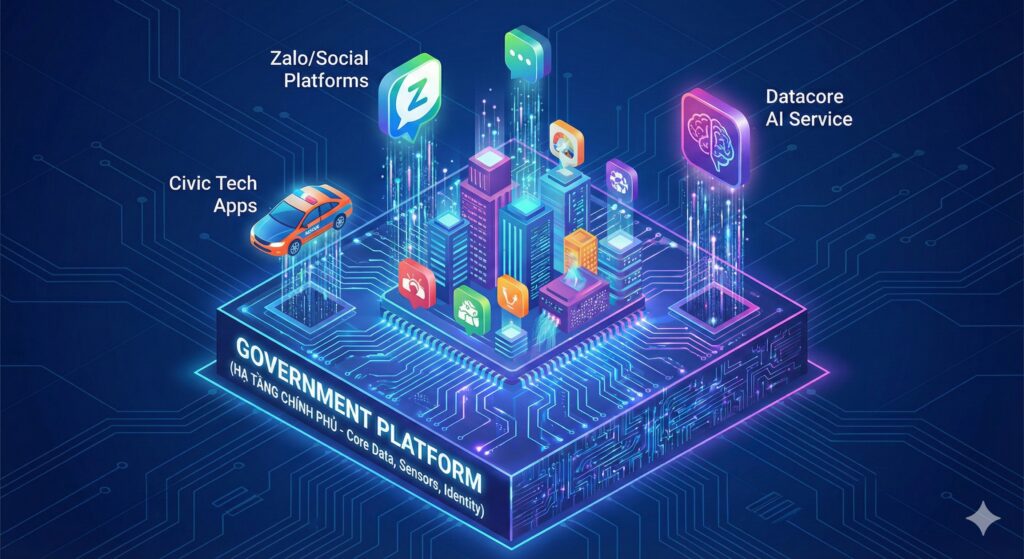
The solution is a fundamental shift in governance architecture:
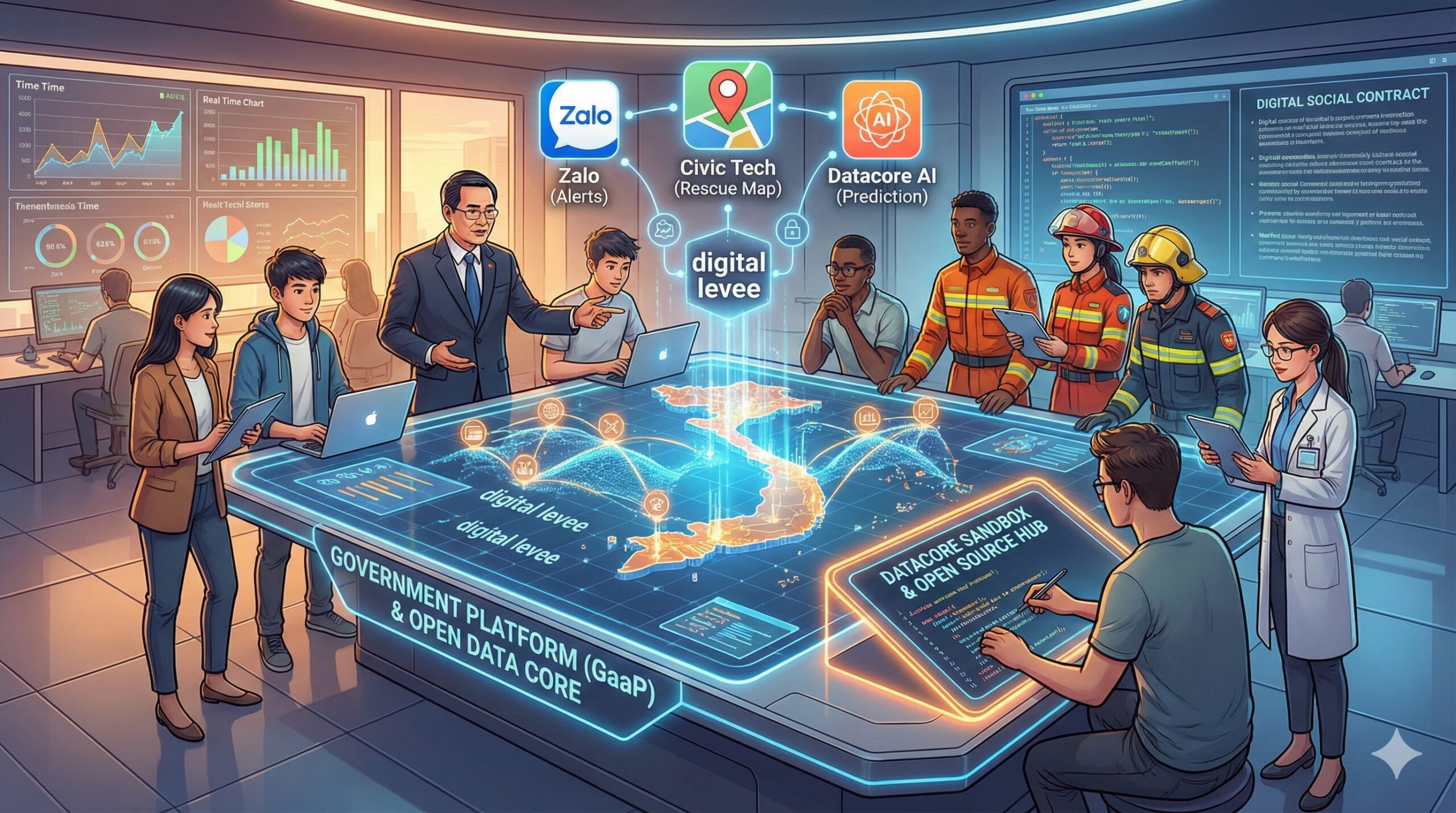
The "Government as a Platform" (GaaP) Model
Imagine the National Disaster Defense System operating like an App Store:
- The Platform Layer (Government): Provides the "Digital Roads and Power Grid." This includes: National Rain Gauge Networks, Weather Radars, Identity Authentication APIs, and the National Open Data Portal. The core mission here is Reliability and Security.
- The Application Layer (Society): Tech companies (e.g., Zalo, Grab, Datacore) and volunteer groups (Civic Tech) build specific solutions on top of this infrastructure.
- Zalo integrates a "Safety Check" feature.
- Grab organizes "Volunteer Rescue Fleets."
- DataCore deploys "AI Flood Mapping."
- Student Groups code bots for "Medicine Supply Finding."
The Benefit: Innovation is unleashed. When a new need arises (e.g., finding charging stations), the community can deploy a solution in 24 hours without waiting for lengthy budget approval cycles.
PART 2: TECHNICAL SOLUTIONS - STANDARDIZATION FOR INTEROPERABILITY
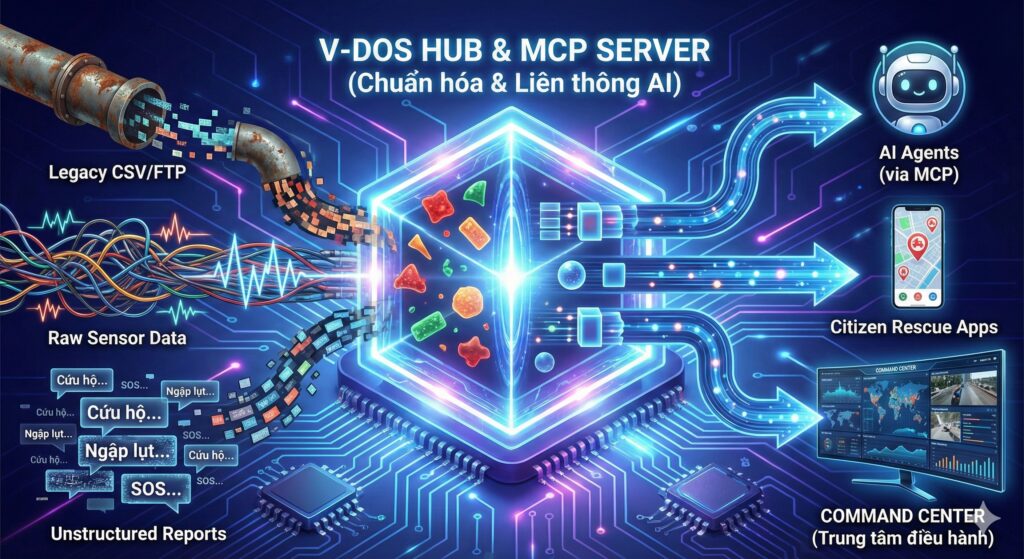
For the GaaP model to work, independent systems must speak a common language. We propose a 3-Layer Technical Framework to solve the "Tower of Babel" problem.
1. Data Layer: V-DOS & Offline-First Design
We need a V-DOS (Vietnam Disaster Open Schema) that defines not just what the data is, but how it behaves.
- Standardized Schemas (JSON):
RescueRequest: Beyond coordinates, we standardize medical triage tags (Red/Yellow/Green) for AI prioritization.ResourceAvailability: Standard definitions for rescue fleets, medicine stockpiles, and charging hubs.
- Offline Reconciliation (CRDTs):
- The Challenge: In a storm, connectivity is intermittent. If two rescuers update a victim's status differently while offline, who is right when they reconnect?
- The Solution: Implement CRDTs (Conflict-free Replicated Data Types). This allows Mesh Nodes (from Episode 2) to automatically merge data upon reconnection without conflicts, ensuring Eventual Consistency.
2. Connectivity Layer: Federated API Strategy
Instead of a giant Monolithic Server, we move towards a Federated Model:
- GraphQL Federation: Allows client apps to query data from multiple sources (Gov Ministry, Social Platform, IoT Network) via a single Gateway endpoint. This saves bandwidth for end-users.
- Event-Driven Architecture (Kafka/MQTT): Moving from "Polling" to "Push." When a sensor detects water crossing a threshold, it publishes an Event. Instantly, 100 different apps subscribe to that event and trigger their specific workflows (SMS alerts, pump activation, etc.).
3. Intelligence Layer: AI-Ready & MCP (Model Context Protocol)
The future interface is not a website; it is an AI Agent. We must make our data "AI-Ready."
- Deploying MCP Servers:
- MCP (Model Context Protocol) is the new standard allowing LLMs (like Claude, Gemini, ChatGPT) to connect safely to real-time data.
- Datacore will build the
v-floodnet-mcp-server. This wraps complex APIs into AI-readable "Tools" and "Resources." - Scenario: A citizen asks a Chatbot: "Is my house safe?" The AI doesn't hallucinate. Via MCP, it calls the tool
check_flood_level(lat, long), retrieves the exact sensor reading, and generates a grounded answer.
- RAG-Optimized Vectors: converting disaster manuals and flood maps into Vector Embeddings for Semantic Search (e.g., searching for "stomach ache" finds pharmacies with digestive medicine).
PART 3: SOCIAL SOLUTIONS - AVOIDING THE "GHOST TOWN" EFFECT
Technology is useless without users. We must address the human and psychological barriers.
1. Peacetime Utility (Incentives)
Don't ask citizens to install an App used only 2 days a year. Make the sensor network useful every day:
- Hyper-local Weather: Provide street-level rain forecasts using the Mesh network.
- Air Quality & Traffic: Mesh Nodes can monitor fine dust and traffic density.
- "Digital Knights" Gamification: Users earn "Reputation Points" for sharing bandwidth or data, redeemable for social utilities.
2. Privacy & Trust Contract
The biggest fear is surveillance. The system must commit to:
- Ephemeral Data: Precise location data in rescue messages is automatically hard-deleted after 72 hours post-event.
- Anonymous Mode: Allowing SOS reporting without identity disclosure (unless medical evacuation is required).
3. Inclusive Design (The "Grandmother Test")
Technology must not leave the vulnerable behind.
- Voice-First Interfaces: For those unable to type under stress.
- Low-Tech Fallback: Support for Feature Phones via SMS/USSD to trigger Mesh Nodes.
PART 4: DATACORE'S ROLE - THE TECHNICAL ENABLER
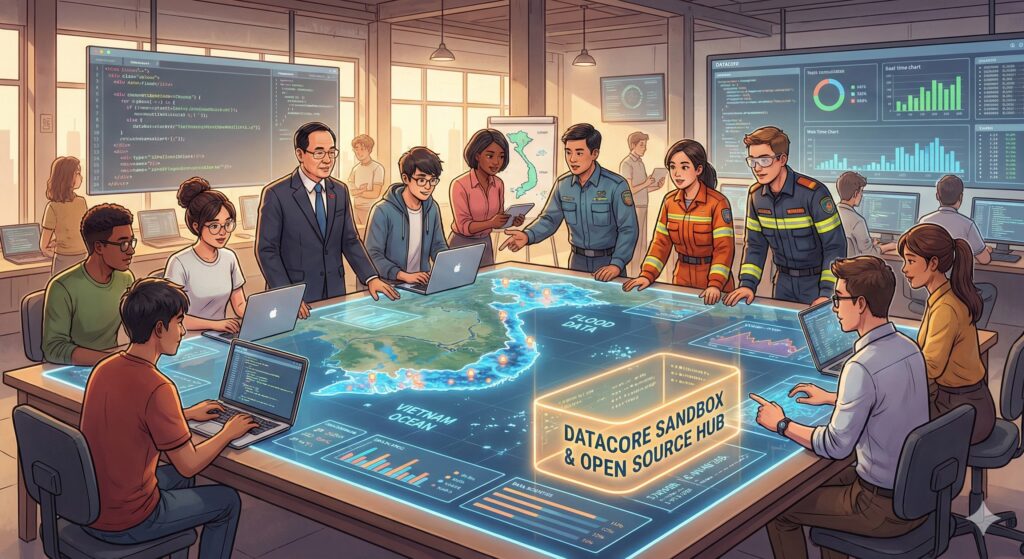
We recognize our limits. DataCore is a data technology company, not a government agency nor a rescue NGO.
We step forward as a Tool Builder and Sandbox Provider:
1. Open Source Initiative
- DataCore will publish core libraries for processing Vietnamese rescue messages, AI spam filters, and low-cost Mesh Node blueprints.
- Goal: Saving startups and student groups 6 months of R&D time.
2. V-FloodNet Sandbox (The Simulation)
- We will host a Sandbox Server broadcasting simulated storm data (virtual water levels, virtual SOS messages) 24/7.
- Goal: Developers can test their apps against "live" disaster data anytime, without waiting for a real typhoon.
3. Reference MCP Server
- Developing and maintaining
v-floodnet-mcp, bridging Vietnamese disaster data with global AI platforms.
CONCLUSION: FROM VISION TO ACTION
"Digital Levees" is not a project to be "finished." It is a persistent journey to enhance our nation's Resilience.
In the past, our ancestors built levees with earth, stone, and village solidarity.
Today, we build levees with Data, Algorithms, and Digital Collaboration.
CALL TO ACTION:
- To the Government: Please open the Data APIs. This is the keystone.
- To Tech Experts: Contribute to the V-DOS schema and Open Source repos.
- To Businesses: Integrate rescue modules into your existing Super Apps instead of building silos.
DataCore has laid the first technical bricks. We place them down not to build a wall around us, but to build a foundation for everyone.
ACT NOW WITH DATACORE:
- Review the V-DOS Draft on [GitHub Link - Update soon].
- Register for the Sandbox Environment [Link - Update soon].
- Join the "Civic Tech Vietnam" Discord Community [Link - Update soon].
Thank you for following the "Digital Levees" Deep Dive Series. Code for Vietnam. Code for Resilience.
Related reading: Alibaba's AI Tool Ban: What Enterprise AI Governance Means for Data Companies in Vietnam and Vietnam Data Laws 2026: Why Foreign SaaS and Cloud Email Are Now a Legal Risk.
Want to see how DataCore's data services can support your business? Explore DataCore Services.