
Too Long; Didn't Read
- The Problem: The total information blackout during Typhoon Yagi (2024) and the 2025 floods was not an accident, but an inevitable consequence of a Centralized network architecture suffering from a Single Point of Failure (SPOF).
- The Data: We are facing a crisis of Unstructured Data fragmented across "Data Silos" (e.g., private messaging groups, spreadsheets), resulting in decision-making latency of up to 12 hours.
- The Solution: A fundamental Architectural Shift is required, moving from "Online-First" to "Offline-First" principles, drawing on proven models like Project Owl (Puerto Rico) and PetaBencana (Indonesia).
1. The Paradox: High Tech, Zero Connectivity
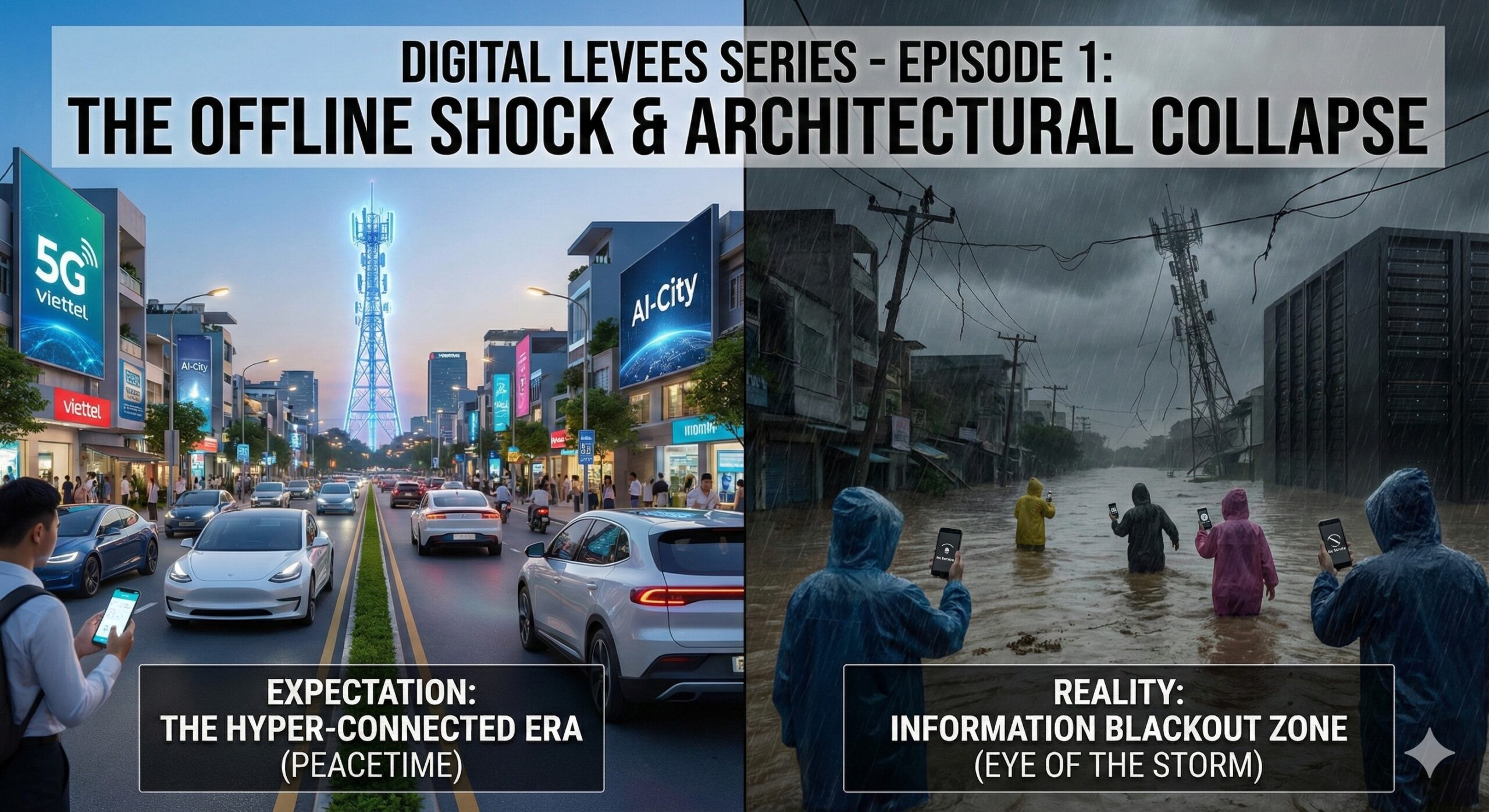
Vietnam boasts leading 4G/5G coverage in the region and a smartphone penetration rate exceeding 80%. Theoretically, we live in an era of hyper-connectivity.
However, empirical data from the 2024-2025 disaster seasons paints a starkly different picture: Complete connectivity breakdown in critical Hotspots.
A bitter paradox emerges: Citizens hold devices carrying exponentially more computing power than the Apollo 11 guidance computer, yet they are rendered powerless to transmit a GPS data packet consisting of merely a few bytes. Why?
2. Post-Mortem Analysis: The Physical Layer
The Root Cause lies in the network topology. The current civil telecommunications infrastructure is optimized for peacetime economic efficiency, relying heavily on a Hub-and-Spoke model.
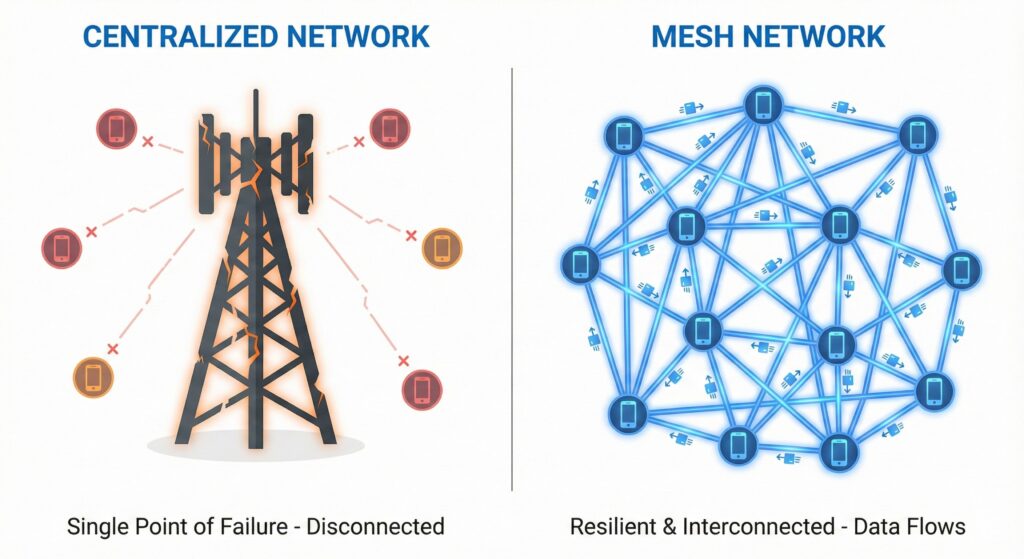
Architectural Flaw: Single Point of Failure (SPOF)
In this model, thousands of user devices (Edge Nodes) depend entirely on a central Base Transceiver Station (the Hub).
- Failure Mode: When a typhoon snaps antenna towers or widespread flooding disables backup generators, the "Hub" goes offline.
- Cascading Effect: The entire cluster of "Spokes" (citizen smartphones) is instantly isolated, even if the individual devices have power and are functional. In systems engineering, this is a fundamental design flaw: betting entire system availability on a single point.
3. Data Analysis: The Collapse of the Logical Layer
As physical connectivity intermittently recovers, we face a second disaster: Data Fragmentation.
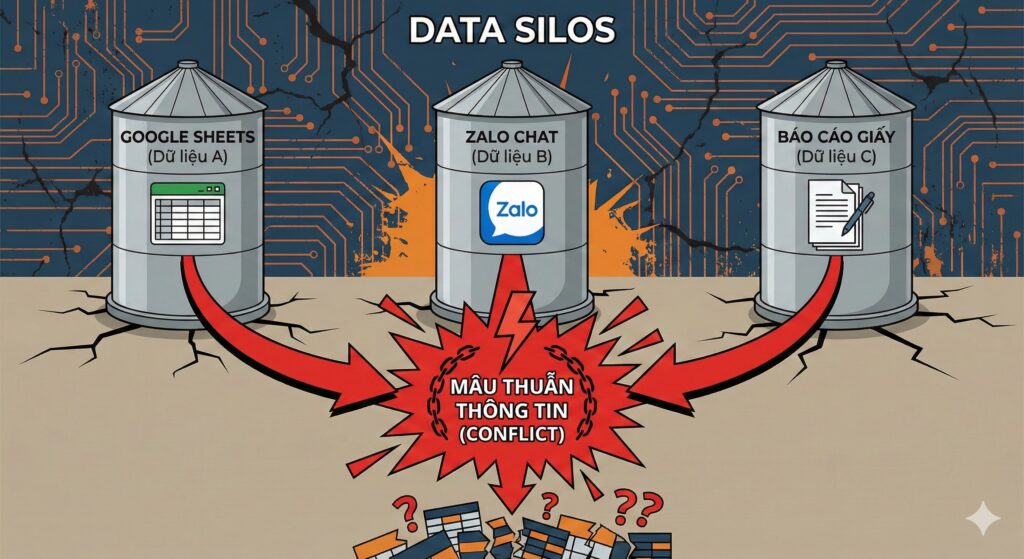
The Issue: Unstructured Data & Silos
In the chaos, the community spontaneously created numerous ad-hoc information channels. From a Data Architecture perspective, this is a nightmare:
- Unstructured Formats: Data exists as text statuses, images, Excel files, and scattered map markers. There is no standardized Schema (JSON/XML) for machine automated parsing.
- Data Silos:
- Silo A: Relief Group X's Google Sheet.
- Silo B: Residential Community Y's Zalo Chat Group.
- Silo C: Local government paper reports.
Blockquote: "There is no State Synchronization mechanism between these Silos. The result is Data Conflict: Team A deploys boats to rescue a village that Team B already evacuated four hours prior."
Consequence: Latency
Manual Processing-relying on humans to read, verify, and aggregate messages-creates an information latency of 6 to 12 hours. In emergency rescue operations, this latency effectively renders logistical efforts obsolete.

4. Gap Analysis: Global Benchmarks
We do not need to reinvent the wheel. Other nations have addressed these challenges with distinct architectural approaches.
Case Study 1: Infrastructure Resilience
- Context: Hurricane Maria (2017) destroyed 100% of Puerto Rico's power and telecommunications grid.
- Solution: Project Owl (IBM Call for Code Winner).
- Technology: Deployed a Mesh Network using low-cost, buoyant IoT devices ("DuckLinks").
- Mechanism: Devices use Auto-discovery to form a network and Packet Forwarding to hop data to a satellite-connected gateway.
- Key Lesson: Offline-First Architecture.
Case Study 2: Data Processing
- Context: Jakarta (Indonesia) faces widespread urban flooding and social media misinformation (Twitter/X).
- Solution: PetaBencana.id.
- Technology: Replacing human operators with AI Chatbots.
- Mechanism:
- AI scans for keywords like "flood".
- AI automatically DMs the poster: "Can you verify the depth with a photo?".
- Verified data is pushed directly to a Real-time Map.
- Key Lesson: Automated Verification.
5. The Paradigm Shift: Proposed Architecture
To avoid repeating the 2025 scenario, we require a Design Thinking Shift based on three pillars:
V-FloodBrain High-Level Architecture Proposal
- Shift 1: Online to Offline-First:
- Systems must function within a Local Mesh when the internet is severed.
- Utilize Store-and-Forward protocols: Cache messages at the device level and transmit only when a network node is discovered.
- Shift 2: App-Centric to Data-Centric:
- Cease developing isolated apps. Focus on building standardized APIs (OpenAPI Standard) for disaster data.
- Treat data as a Public Good, accessible by any authorized application.
- Shift 3: Reactive to Predictive:
- Move from post-event reaction to AI-driven Impact-based Forecasting.
6. Conclusion & Next Steps
The "Offline Shock" is a wake-up call for the Vietnamese tech community. Our current infrastructure isn't "wrong," but it lacks the necessary Resilience for extreme weather events.
In the following episodes, we will dive deep into the Technical Design for each layer of this new architecture.
COMING UP:
👉 Episode 2: Deep Dive into Hardware. Technical analysis of Mesh Networks, LoRaWAN protocols, and transforming smartphones into ad-hoc network nodes.
(Follow Datacore for the latest updates)
Related reading: JadePuffer: The First AI Agent Ransomware and What It Means for Vietnam Fintech Security and AWS Local Zone Hanoi 2026 - Powerful Essential Guide for Data-Driven Businesses in Vietnam.
Want to see how DataCore's data services can support your business? Explore DataCore Services.






One response to “DIGITAL LEVEES - EPISODE 1: System failure analysis - Why does multi-billion dollar infrastructure still "GO DARK" in the eye of the storm?”
[…] Episode 1: System Failure Analysis, we conducted a “post-mortem” on the information infrastructure during the 2024-2025 […]