
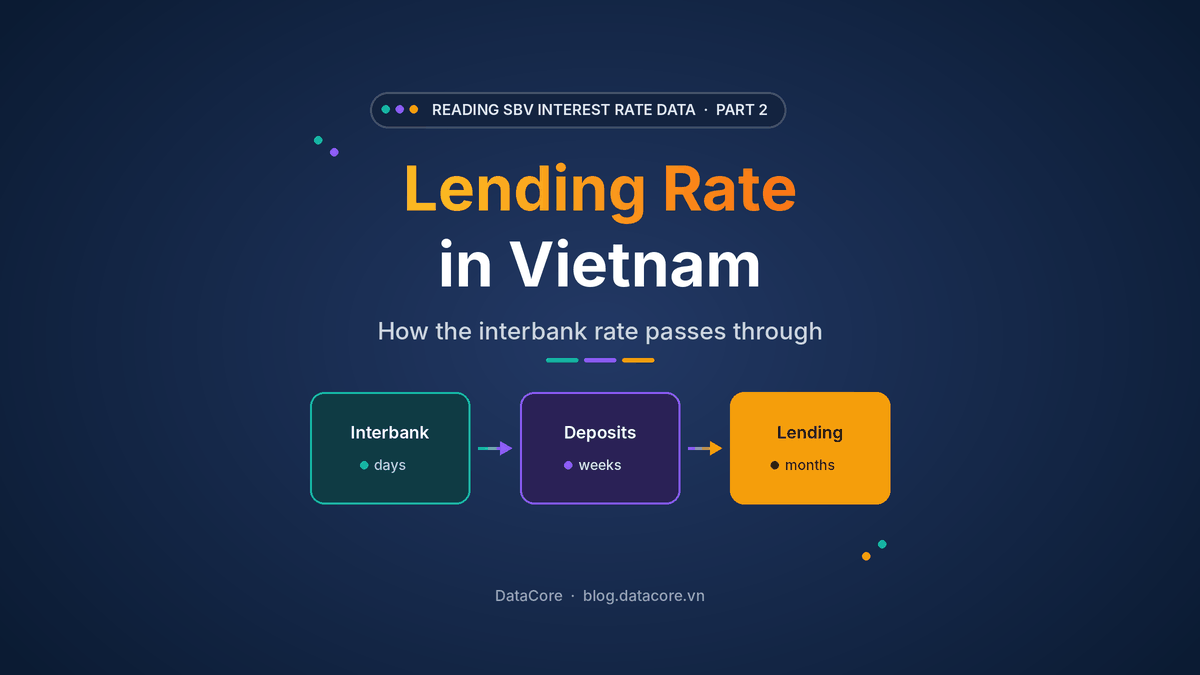
TL;DR: The lending rate is the last link in a chain that starts in the interbank market. When the State Bank of Vietnam (SBV) adds or drains liquidity, the interbank rate reacts within days, deposit rates within weeks, and lending rates usually take months.
2026 shows the lag clearly. The average deposit rate on new transactions rose to 6.38% a year on 20 September 2026, 1.15 points above the end of 2025, even though the SBV had asked banks to cut rates in April. Only in October, when surplus liquidity (overnight briefly fell to 0.72%) met firm guidance, did all 46 commercial banks cut their posted rates. The average lending rate on new loans then fell by about 0.2–0.5 points.
Borrowers care about one question: when will my lending rate come down? Savers ask the opposite: when will my deposit rate fall? The answer is in data the SBV publishes, if you read it in the right order.
Part 1 of the Reading SBV Interest Rate Data series explained the interbank rate and open market operations (OMO). Part 2 goes one step further: what deposit and lending rates are, how pass-through works, five signals for reading it, how it played out in 2026, and who can use these signals.
What Are Deposit Rates and the Lending Rate?
The deposit rate is what a bank pays to take your savings; the lending rate is what it charges businesses and households to borrow. Unlike the interbank rate, both are transactions between banks and the real economy, not between banks.
Three different numbers for the same kind of rate
When reading rate news, separate three kinds of data:
| Type of data | What it means | Who publishes it | Frequency |
|---|---|---|---|
| Posted rates | The rate schedule a bank publishes for each tenor | Each bank | When it changes |
| Average rate on new transactions | The actual rate on new deposits or new loans in the period, system-wide | SBV | Periodically, in press conferences and reports |
| Bank-level average lending rate | Each bank's average rate on new loans, with its spread over the deposit rate | Each bank, as required by the SBV | Monthly |
Posted rates are the easiest to see and the least accurate: large deposits are often negotiated above the schedule, and subsidised loans sit below it. The SBV's average rate on new transactions is the most reliable measure of pass-through.
Why is the lending rate always higher than the deposit rate?
Lending rate = cost of funds + operating cost + credit risk cost + profit. The cost of funds is mostly interest paid to depositors, with the rest borrowed in the interbank market or from the SBV. To cut the lending rate sustainably, a bank must first cut its cost of funds, or accept a thinner margin. That is why the SBV asked banks to “cut costs and share profits” in the October 2026 rate-cut push.
How Does the Interbank Rate Pass Through to the Lending Rate?
Pass-through moves in four steps, each slower than the one before:
- The SBV adjusts liquidity through OMO, treasury bills, FX swaps and guidance to banks. The effect is same-day.
- The interbank rate reacts within a few sessions, especially the overnight tenor.
- Deposit rates adjust after a few weeks. Banks short of cash in the interbank market raise deposit rates to attract savings; banks with surplus cut them.
- The lending rate changes after several months. New loans move first; existing loans change only at their next repricing date, usually every 3, 6 or 12 months.
Why is there a lag?
- Deposits have fixed terms. A 12-month deposit at the old rate stays in the bank's cost of funds until it matures, so the average cost of funds moves more slowly than posted rates.
- Medium- and long-term loans carry a large weight. By 21 October 2026, medium- and long-term credit had grown 15.26%, almost twice as fast as short-term credit (+8.47%) since the end of 2025 (SBV). These loans reprice on a schedule, not with the daily market.
- Deposit competition. When credit grows faster than deposits, banks must keep deposit rates high to hold on to funding, even after the interbank rate has fallen.
- Margins. If net interest margins are already thin, banks tend to cut deposit rates first and the lending rate later.
In short, the interbank rate shows the direction, deposit rates show whether the cost of funds has really changed, and the lending rate is where policy finally reaches the economy.
What Are the 5 Signals That a Lending Rate Cut Is Coming?
All five measures below can be built from data the SBV publishes. Each answers a different question, and they are most useful when they point the same way.
1. The deposit- interbank spread: do banks still need to compete for deposits?
Compare the 6 - 12-month deposit rate with the 1- 3-month interbank rate. When interbank funding is much cheaper than deposits, banks have a reason to cut deposit rates. When the gap narrows or flips, pressure to raise deposit rates returns.
October 2026 is the clearest example: the overnight rate briefly fell to 0.72% while the average new deposit rate was still around 6.38%. That wide gap is what allowed the late-October cut in deposit rates to happen so fast.
2. The average deposit rate on new transactions: is the real cost of funds falling?
Posted rates can fall on paper while large deposits are still paid more. The SBV's average for new transactions removes that gap. That is why the SBV, in Official Letter 9736/NHNN-CSTT of 21 October 2026, asked banks to cut the average rate on new deposits of 6 months or longer by at least 0.5 points, not just their posted rates.
3. The gap between credit and deposit growth: will funding pressure last?
When credit grows faster than deposits, banks compete to keep savings and deposit rates are hard to cut deeply. According to the SBV, the credit-to-deposit ratio stood at 106.2% in September 2026, up from 105.3% a year earlier. By 26 October 2026, outstanding credit had reached about 20.81 quadrillion dong (+11.94% since the end of 2025), while deposits stood at almost 19.73 quadrillion dong (+11.7%).
The gap of almost 1.1 quadrillion dong between credit and deposits has to be funded from elsewhere: valuable papers, interbank borrowing or the SBV. If the ratio keeps rising, room for a lasting lending rate cut narrows.
4. New loans versus existing loans: who benefits first?
A lower lending rate on new loans helps only new borrowers. Most borrowers pay interest on existing loans. That is why the October 2026 push stands out: the Governor asked banks to consider cutting rates on existing loans as well, not just new ones. Tracking how much existing credit banks have repriced shows how far pass-through has really reached the economy.
5. Dispersion across bank groups: is pass-through even?
State-owned commercial banks usually cut first and further, thanks to cheaper deposit bases and direct guidance. Smaller banks rely more on high-rate deposits and move more slowly. A widening gap between the two groups means pass-through has not spread; a narrowing gap means the whole rate level is really moving.
The Lending Rate in 2026: Why Did the October Cut Work Better Than April?
The SBV asked banks to cut rates twice in 2026, with very different results. The difference was liquidity: in April, guidance pushed against a system short of cash; in October, it pushed in the same direction as a system flush with cash.
April: a short-lived cut, then a rebound. After Official Letter 2342/NHNN-CSTT of 30 March 2026 and a meeting with banks on 9 April 2026, the average deposit rate on new transactions fell to 6.01% a year on 20 April 2026. By 20 September 2026 it had risen to 6.38%. In between, the overnight rate broke above the 5% ceiling several times (close to 7% in late May and 7% in late September), and banks had to keep paying up to hold deposits.
October: a broad cut. In early October the system had surplus liquidity and the overnight rate fell to 0.72%. On that footing, two official letters within three days and the Governor's meeting with bank leaders produced a system-wide rate cut in just two weeks.
| Date | What happened | Pass-through signal |
|---|---|---|
| 4 Nov 2026 | Deputy Governor says all 46 commercial banks cut posted rates for 6 months or longer by at least 0.5 points; new deposit rates fell about 0.4 points from mid-October; new lending rates fell 0.2–0.5 points | Pass-through has reached deposit rates; the lending rate on new loans is falling, but more slowly than the 1.5–2-point target |
| 31 Oct 2026 | Governor tells the National Assembly credit growth is about 12.27% | Year-end funding demand rising, limiting room for further cuts |
| 21 Oct 2026 | Official Letter 9736/NHNN-CSTT: cut the average rate on new deposits of 6 months or longer by at least 0.5 points | Focus shifts from posted rates to the real cost of funds |
| 19 Oct 2026 | Governor meets bank leaders; asks banks to consider cutting rates on existing loans too | Pass-through extended to existing loans |
| 18 Oct 2026 | Official Letter 9608/NHNN-CSTT: cut posted rates for 6 months or longer by at least 0.5 points; cut lending rates by 1.5–2 points for production, business and priority sectors | Direct guidance, aligned with surplus liquidity |
| 7 Oct 2026 | SBV reports the average new deposit rate at 6.38% (20 September), up 1.15 points on end-2025; overnight rate falls to 0.72% the same day | Widest deposit–interbank gap of the year |
| 20 Apr 2026 | Average new deposit rate 6.01%, down 0.21 points on the previous period | Cut by guidance, without liquidity support |
| 9 Apr 2026 | SBV meets commercial banks on lowering rates | First guidance push of the year |
| 30 Mar 2026 | Official Letter 2342/NHNN-CSTT asks banks to stabilise rates | Start of deposit rate control |
Source: SBV official letters, Q1 and Q3 2026 press conferences, the government's regular press conference for October 2026, and daily interbank rate data.
The lesson: guidance to cut rates lasts best when signal 1, the deposit–interbank spread, is already wide. When the interbank market is stressed, banks can lower their posted schedules, but the real cost of funds soon climbs back.
How Do the Interbank Rate, Deposit Rates and the Lending Rate Compare as Data?
The three rates answer three different questions. The table compares them as data sources; it does not contain measured results.
| Dimension | Interbank rate | Deposit rate | Lending rate |
|---|---|---|---|
| Transaction between | Banks | Banks and savers | Banks and borrowers |
| Speed of response | A few days | A few weeks | A few months (longer for existing loans) |
| Publication | Daily | Posted rates when changed; new-transaction average periodically | Bank-level averages monthly; system average periodically |
| What it tells you | Direction of liquidity and SBV intent | Banks' real cost of funds | The economy's cost of borrowing |
| Noise | High around Tet, tax deadlines and quarter-ends | Medium; posted rates differ from actual deals | Low, but varies widely by bank and loan type |
| Best use | Spotting turns early | Confirming pass-through is real | Judging the impact on businesses and households |
Takeaway: the interbank rate signals, the deposit rate confirms and the lending rate is the final result. To forecast the lending rate, read the first two first.
Worked Example: How Long Does a Rate Move Take to Reach a Loan?
Illustrative only: the bank and figures below are hypothetical, used to explain the mechanism. They are not reported data.
Suppose Bank A has 100 units of deposits, maturing evenly over 12 months, at an average rate of 6.4%. In month 1 the interbank rate falls sharply and the bank cuts its new deposit rate to 5.9%, a cut of 0.5 points.
- Month 1: only about 8 units of deposits mature and roll over at the new rate. The average cost of funds falls by about 0.04 points.
- Month 6: about half the deposits have rolled over. The cost of funds is down about 0.25 points.
- Month 12: all deposits have rolled over. Only now is the cost of funds down the full 0.5 points.
If the bank keeps its margin, the lending rate on new loans can only fall as fast as its cost of funds: about 0.25 points after six months. A business whose existing loan reprices every six months may wait until month 6 to see the first change.
To cut the lending rate by 1.5–2 points at once, as the SBV targeted in October 2026, banks must accept thinner margins or use cheaper funding. That is why the actual lending rate on new loans fell only 0.2–0.5 points in the second half of October, and why this round of cuts will keep playing out for months.
Who Can Use Lending Rate Signals, and for What?
- Corporate borrowers: when the deposit–interbank spread is wide and new deposit rates start falling, it is time to renegotiate or pick a shorter repricing period. When the signals turn, locking in a rate early pays off.
- Savers: deposit rates usually fall before the lending rate. When the interbank rate drops sharply and the SBV issues guidance to cut, locking in a longer term before banks reprice keeps a higher rate.
- Bank analysts: how fast the cost of funds falls relative to the lending rate decides the net interest margin. A request to cut rates on existing loans, as in October 2026, is a direct risk to margins over the next few quarters, especially at banks with a large share of medium- and long-term loans.
- Equity investors: a falling lending rate supports rate-sensitive sectors such as real estate, construction and consumer goods, but can weigh on bank profits. The five signals help tell a lasting cut from a short-lived one like April 2026.
- Economists and policy researchers: the lag and depth of pass-through show which SBV tools work: OMO liquidity, administrative guidance, or both. 2026 suggests the combination works far better than either alone.
- Data and analytics teams: rate data is scattered across official letters, press conferences, posted schedules of more than 40 banks and monthly average lending rate reports. Standardising it into time series with consistent tenors and units is the first step that makes every analysis above possible.
What Are the Pitfalls When Reading Lending Rate Data?
- Confusing posted rates with actual rates. A lower posted schedule does not mean a lower cost of funds. Check it against the SBV's average for new transactions.
- Ignoring subsidised programmes. Preferential lending programmes are limited in size and eligibility. Their low rates do not represent the general level.
- Comparing bank-level average lending rates naively. The average depends on loan mix: a bank with more consumer lending will show a higher average than one lending mainly to large companies, even at the same pricing.
- Forgetting existing loans. News that the lending rate is falling usually refers to new loans. Existing borrowers benefit only when the bank cuts proactively or at the next repricing date.
- Expecting instant pass-through. As the example shows, the cost of funds falls fully only once all old deposits have matured. Judging a rate cut after a few weeks is too early.
- Using unverified secondary figures. Summaries often round numbers or mix posted and transaction rates. Store the series from the SBV's own announcements and press conferences.
Where Is the Lending Rate Heading?
The lending rate is where monetary policy reaches the economy, and also where it arrives last. 2026 showed that a rate cut lasts only when interbank liquidity is already ample and banks' real cost of funds has actually fallen.
The five signals track that process: the deposit–interbank spread shows the incentive, the new-transaction deposit rate shows the real cost of funds, the credit–deposit gap shows funding pressure, existing loans show how far pass-through reaches, and dispersion across bank groups shows how widely it spreads.
At the end of November 2026, four of the five signals support a further fall in the lending rate. Signal 3 is the brake: credit is still growing faster than deposits, and year-end funding demand is rising. If the credit-to-deposit ratio keeps climbing, room for lending rate cuts in 2027 will narrow.
Part 3 of the series turns to another link in the chain: the government bond yield curve and what it says about growth and inflation expectations.
Frequently Asked Questions About the Lending Rate in Vietnam
What is the current lending rate in Vietnam?
According to the SBV, the average lending rate on new loans fell by about 0.2–0.5 points in the second half of October 2026, after the SBV asked banks to cut rates by 1.5–2 points for production, business and priority sectors. Exact rates vary by bank, term and purpose; each bank publishes its average lending rate monthly on its website.
Why do deposit rates fall faster than the lending rate?
Banks must cut their cost of funds first to protect margins when they lower the lending rate. Many existing loans also reprice only on a schedule, usually every 3–12 months.
Will rates on existing loans come down?
They can. At the meeting on 19 October 2026, the SBV Governor asked banks to consider cutting rates on existing loans as well. The size and timing of cuts are decided by each bank.
How long does the interbank rate take to affect the lending rate?
Deposit rates usually react within a few weeks, the lending rate on new loans within one to a few months, and existing loans can take 6–12 months depending on the repricing period.
Where can I get lending rate data?
The SBV publishes average rates on new transactions in its press conferences and periodic reports, and daily interbank rates on its website. Each bank publishes its monthly average lending rate as required by the SBV.
References
- State Bank of Vietnam, Official Letter No. 9608/NHNN-CSTT on lowering interest rates, 18 October 2026. sbv.gov.vn
- State Bank of Vietnam, Official Letter No. 9736/NHNN-CSTT on lowering average deposit rates on new transactions, 21 October 2026. sbv.gov.vn
- State Bank of Vietnam, Official Letter No. 2342/NHNN-CSTT on stabilising interest rates, 30 March 2026. sbv.gov.vn
- State Bank of Vietnam, press conference on Q1 2026 monetary policy results, 14 April 2026. sbv.gov.vn
- State Bank of Vietnam, press conference on Q3 2026 banking results, 7 October 2026. sbv.gov.vn
- State Bank of Vietnam, Deputy Governor's remarks at the government's regular press conference for October 2026, 4 November 2026. sbv.gov.vn
- State Bank of Vietnam, credit and deposit growth data to 21 and 26 October 2026. sbv.gov.vn
- State Bank of Vietnam, daily average interbank rates, 2026. sbv.gov.vn






Để lại một bình luận
You must be logged in to post a comment.