
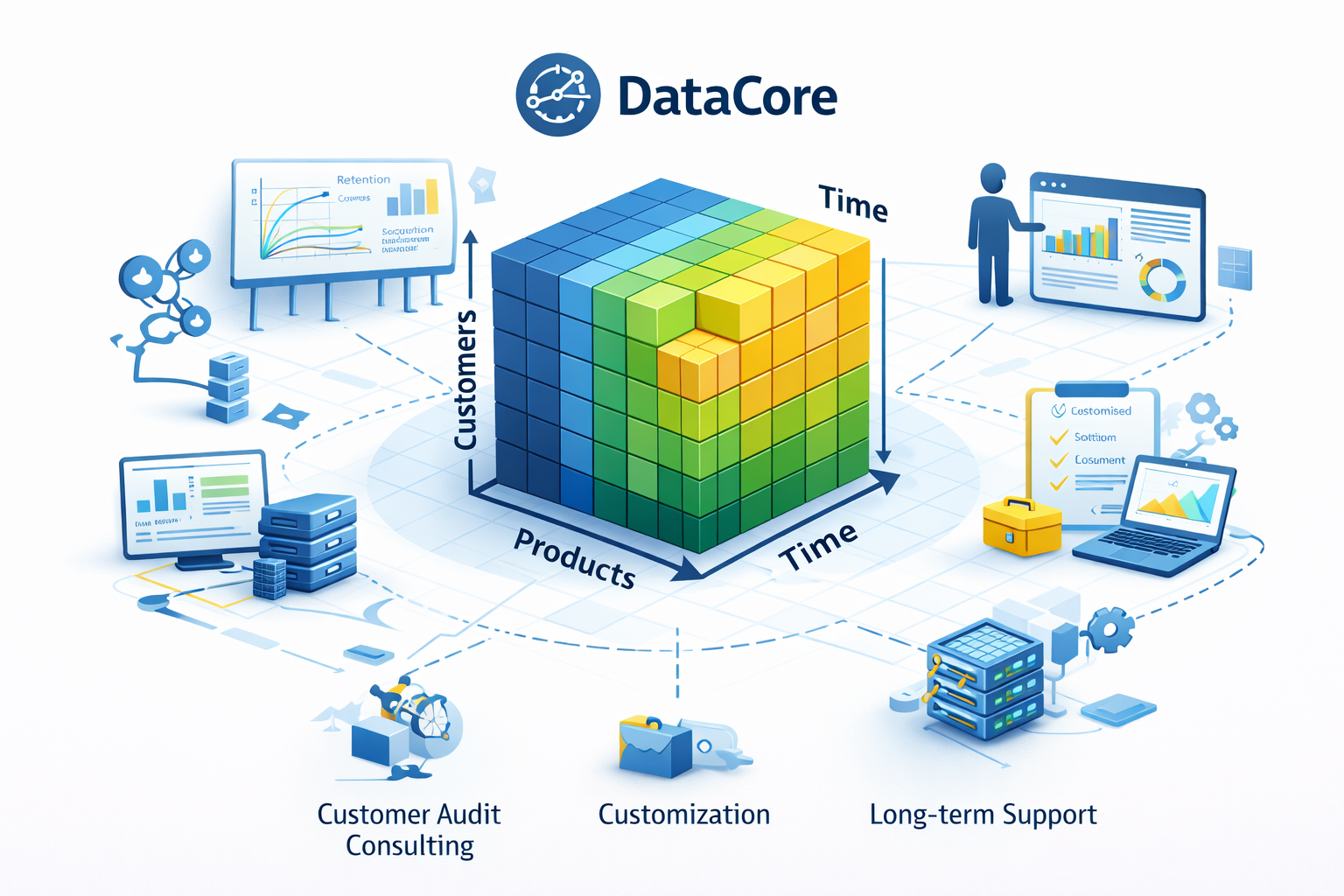
1. What Is a Customer Base Audit?
A customer base audit is a systematic, quantitative assessment of the health and value of a firm’s customer portfolio. It answers questions such as:
- How many customers do we really have
- How are they distributed by value, tenure, and behavior
- How fast are we acquiring, losing, and developing customers
- What is the forward-looking value of our current customer base
This is not a one-time dashboard. It is an ongoing measurement system that treats customers as financial assets. Just as finance teams track a portfolio of investments, marketing and growth teams should track a portfolio of customers.
2. The Foundational Structure: The Customer, Product, Time Data Cube
At the heart of any serious customer audit is a three-dimensional data structure, often conceptualized as a cube with three axes:
- Customer,
- Product,
- Time
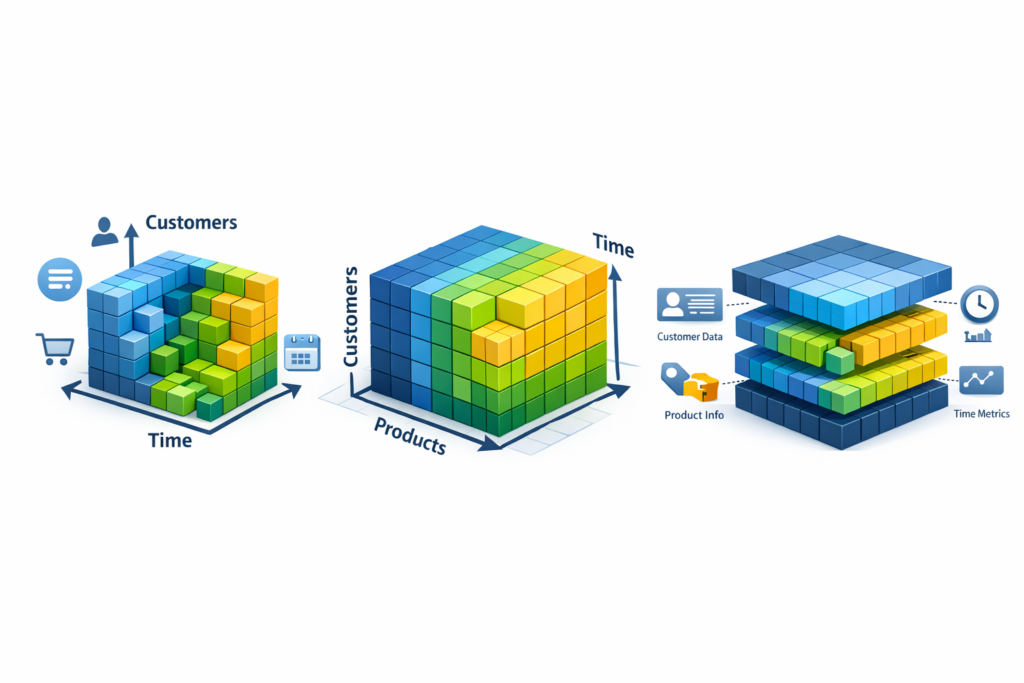
Customer dimension
Each unique customer is an individual, a household, or a business account. This dimension holds identifiers and attributes such as acquisition channel, geography, segment tags, risk scores, and lifecycle stage.
Product dimension
Every product, service, plan, or SKU the firm offers. This includes pricing, category, margin structure, and product hierarchy.
Time dimension
A consistent calendar structure, often at daily, weekly, or monthly frequency. This allows us to observe behavior longitudinally, which is essential for retention, churn, and lifetime value analysis.
Every transaction, interaction, or contract event should be mapped into this cube. Once this structure exists, almost every important customer metric becomes a structured aggregation over these three dimensions.
Without this cube, companies are stuck with disconnected reports by channel, by campaign, or by product line, none of which reveal the true dynamics of the customer base.
3. Core Metrics in a Customer Audit
Once the data cube is in place, the audit focuses on forward-looking, customer-centric metrics, not just historical sales.
3.1 Customer Acquisition
- Number of new customers per period
- Acquisition cost by channel and cohort
- Early behavior of new cohorts
Instead of asking “How did the campaign perform?” the audit asks “What kind of customers did this campaign bring, and how valuable are they likely to be?”
3.2 Retention and Churn
- Retention rates by cohort and segment
- Time to churn distributions
- Behavioral signals before churn
Retention is not just a percentage. It is a dynamic process that varies across customer types. High-value customers often have very different retention patterns from low-value ones.
3.3 Customer Lifetime Value
Customer lifetime value, or CLV, is the discounted value of expected future contribution from a customer. In a proper audit:
- CLV is estimated at the individual or segment level
- It is updated regularly as behavior evolves
- It is used in decision-making, not just reported
CLV connects marketing, finance, and operations. It turns customer management into capital allocation.
3.4 Customer Equity
Customer equity is the total lifetime value of the entire customer base. This becomes a strategic asset measure. Firms can track whether their customer equity is growing because they are acquiring better customers, retaining them longer, or increasing their value through cross-sell and upsell.
4. From Reporting to Decision Making
A customer audit is not just descriptive. It must inform concrete decisions:
- How much to spend on acquiring different types of customers
- Which segments deserve premium service levels
- Where to focus retention investments
- Which products attract high-value versus low-value customers
This shifts the mindset from short-term revenue to long-term customer asset growth. It also exposes uncomfortable truths, such as channels that generate volume but destroy long-term value.
5. Why Most Firms Struggle to Do This
Despite the conceptual clarity, most companies fail to implement a true customer base audit for three main reasons:
Fragmented data
Customer data sits in CRM, billing, product logs, marketing platforms, and support systems, with inconsistent identifiers.
Lack of longitudinal structure
Data is stored as snapshots or reports, not as event-level, time-stamped histories needed for cohort and lifetime modeling.
Weak data observability
Even when pipelines exist, companies do not systematically monitor data quality, schema drift, or metric consistency. Over time, trust erodes.
This is where infrastructure and process matter as much as modeling.
6. How DataCore Enables Customer Audits at Scale
DataCore is built specifically to solve the infrastructure problem behind advanced analytics like customer base audits.
6.1 Unified Customer, Product, Time Modeling
DataCore helps organizations design and implement the core data cube:
- A clean, persistent customer ID layer
- A standardized product and offering taxonomy
- A robust time-based event model
We integrate transactional systems, digital logs, and operational databases into a single analytical foundation where every event can be traced by customer, product, and time.
6.2 Data Observability and Reliability
A customer audit is only as good as the data feeding it. DataCore embeds observability directly into the data pipelines:
- Automated checks for missing data, anomalies, and schema changes
- Monitoring of key business metrics for unexpected shifts
- Lineage tracking from raw source to executive dashboard
This ensures that when leadership makes decisions based on CLV or retention metrics, they can trust the numbers.
6.3 Advanced Modeling Layer
On top of the data foundation, DataCore supports:
- Cohort analysis and retention modeling
- Predictive churn and lifetime value models
- Segmentation based on behavior and value, not just demographics
We do not deliver static dashboards. We deliver a modeling environment that continuously updates as new data arrives.
6.4 Customization by Industry
Different industries require different interpretations of customer value:
- In fintech, value depends on balances, transactions, risk, and product mix
- In telecom, it depends on plan type, usage, and contract tenure
- In retail and e-commerce, it depends on frequency, basket size, and category breadth
DataCore works with each client to define the right customer value framework, while keeping the same underlying cube structure and audit principles.
7. From Project to Long-Term Capability
A proper customer base audit is not a one-off consulting report. It is an organizational capability.
DataCore partners with companies in a long-term model:
- Foundation phase: Build the customer, product, time data cube and core pipelines.
- Audit phase: Implement the first full customer base audit, including acquisition, retention, CLV, and customer equity.
- Operational phase: Embed these metrics into marketing, product, and finance decision processes.
- Optimization phase: Use experimentation and advanced modeling to actively grow customer equity.
Because DataCore owns and operates the infrastructure layer, we can continuously evolve the system as the business grows, new products are launched, and new data sources become available.
8. Why This Matters for Vietnamese Businesses
Many fast-growing firms in Vietnam are rich in transactions but poor in structured customer analytics. Growth has often been driven by expansion and promotion, not by disciplined customer portfolio management.
DataCore brings a global, academically grounded framework, inspired by the work of scholars like Peter Fader, and combines it with production-grade data engineering and observability. This allows Vietnamese firms to move from:
- Campaign-driven marketing to asset-driven customer management
- Short-term revenue focus to long-term customer equity growth
- Fragmented reporting to an integrated, forward-looking customer audit
In short, a customer base audit turns customers from anonymous transactions into measurable, manageable assets. With the right data cube, the right metrics, and the right infrastructure, this becomes a repeatable discipline, not a buzzword. DataCore exists to make that discipline real, scalable, and sustainable.
Related reading: Vietnam Bank Executive Turnover Data: What Eximbank's CEO Exit Signals for 2026 and Vietnam Margin Trading Restrictions: 57 Stocks Cut in August Even as Foreign Capital Surges.
Want reliable Vietnam business data to power decisions like this? Try DataCore's Company Intelligence.