
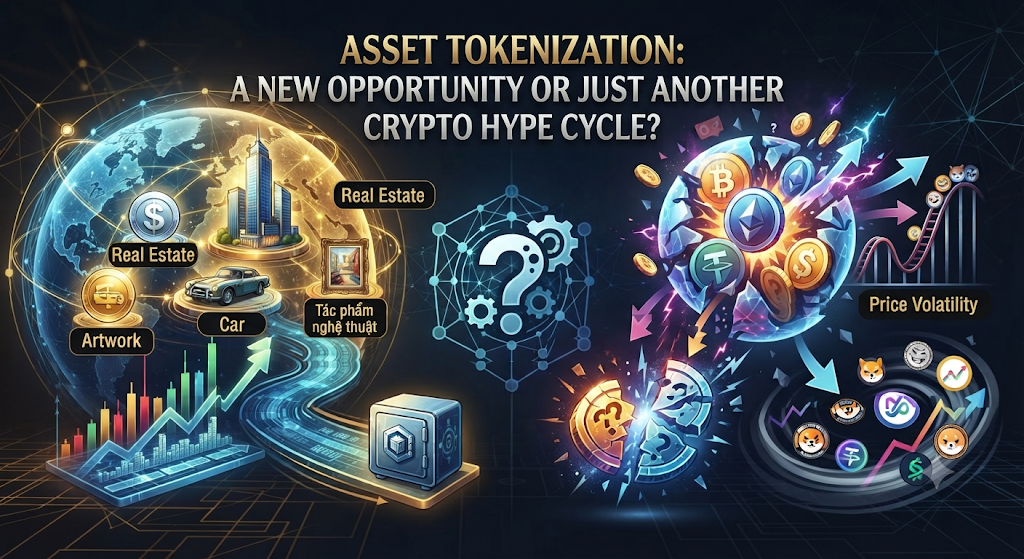
For many investors, the term “token” has long been associated with the volatility of cryptocurrency markets. In recent years, however, the concept has increasingly appeared in policy documents and strategic initiatives from major securities firms, this time in the form of asset tokenization.
The proposition is compelling: enabling individuals to gain fractional ownership of assets such as real estate or bonds with relatively modest amounts of capital. Yet an important question remains: does asset tokenization represent a meaningful advancement in financial markets, or is it simply another crypto-driven speculative trend?
This article explores the potential of asset tokenization and examines whether it could mark a substantive shift in the financial landscape or merely prove to be another passing market craze.
What Is Asset Tokenization?
Put simply, tokenization is the process of converting ownership rights in a real-world asset into digital units known as tokens, which are recorded on a blockchain-based platform. Each token represents a portion of the underlying asset’s value, with the holder entitled to the corresponding share of that value.
For those familiar with equity investing, the easiest way to understand the concept of asset tokenization is to draw a comparison with shares.
A share represents a portion of ownership in a company. Tokenization applies a similar principle to virtually any type of asset, including an office building, a bond portfolio, a quantity of vaulted gold, or even a work of art. The larger the underlying asset, the greater the potential value of fractionalization, as it can open access to investors who may previously have lacked sufficient capital to participate.
Blockchain serves as a shared ledger, recording transactions and transfers in a manner that is difficult to alter and can be independently verified. This distinguishes tokenized ownership from traditional ownership structures, which often rely heavily on physical documentation and intermediaries.
How Is Tokenization Different from Speculative Cryptocurrencies?
This is perhaps the most important distinction, and one that is easily overlooked. From a technological perspective, both operate on blockchain networks. However, they differ fundamentally in what underpins the value of the token.
Most speculative cryptocurrencies are not backed by any tangible underlying asset. Their prices are driven largely by market expectations and investor sentiment, meaning they can multiply in value or lose most of their value within a short period.
By contrast, tokenized real-world assets, commonly referred to as RWAs (Real-World Assets), are backed by a specific underlying asset. In principle, the value of such a token is therefore linked to the value of the building, bonds, gold, or other asset it represents.
The phrase “in principle,” however, is particularly important. A token can only be considered reliable if the underlying asset genuinely exists, is valued transparently, and the associated ownership rights are legally protected. Without these conditions, the distinction between tokenization and speculation can quickly become blurred. This is precisely why the question posed in the title is not an easy one to answer, and why the issue needs to be examined from both sides.
Why Is the Financial Industry Paying Attention to Tokenization?
If tokenization were merely a short-lived technological trend, it would unlikely have attracted the attention of financial institutions known for their cautious approach.
In reality, BlackRock, the world’s largest asset manager, launched a tokenized fund investing in U.S. government bonds in 2024. Franklin Templeton had also been experimenting with a similar model several years earlier. The involvement of such major institutions suggests that tokenization is increasingly being viewed as a serious financial development rather than simply another arena for speculation.
So, what makes it so attractive? Its potential can broadly be summarized in four key benefits.
Lowering barriers to entry
Many high-value assets, such as commercial real estate, corporate bonds, and private equity funds, typically require substantial minimum investments. By fractionalizing these assets into tokens, individual investors can participate with amounts that better match their financial capacity. This could represent a significant step toward broadening access to investment opportunities.
Enhancing liquidity
Selling a property can take months, while transferring fractional ownership of that property is virtually impossible through traditional mechanisms. Tokenization could enable smaller portions of an asset to be traded on secondary markets, making traditionally illiquid assets more flexible and accessible.
Faster, continuous transactions
Stock markets operate within defined trading hours, while settlement typically takes one to two business days. On blockchain networks, transactions can take place around the clock and may be confirmed almost instantly. This could reduce operating costs and mitigate risks arising during the settlement period.
Greater transparency
Transactions are recorded on a shared ledger that can be traced and is difficult to alter. For investors, this can make ownership histories easier to verify. For regulators, it provides a potentially valuable tool for monitoring market activity.
Of course, these benefits remain largely potential at this stage. For them to materialize, clear regulatory frameworks and sufficiently robust market infrastructure will be essential. This is precisely the foundation that Vietnam is now beginning to develop.
Where Does Vietnam Stand in the Asset Tokenization Race?
For years, crypto assets in Vietnam existed in a legal “gray area”: they were not explicitly prohibited, but neither were they clearly recognized under the law. Domestic investors largely traded through overseas platforms and, when risks arose, were generally left to bear the consequences themselves.
That picture began to change in 2025, when Vietnam officially introduced a cautious and controlled pilot framework for the crypto-asset market. The requirements for operating an exchange are relatively stringent, meaning that participating institutions are expected to include major banks and securities firms - names already familiar to domestic investors.
So where does tokenization of real-world assets fit into this picture? Many experts believe that once the market becomes more established, the tokenization of bonds, real estate, and other assets could emerge as the next stage of development, potentially creating a new channel for capital mobilization across the economy.
Even so, the market remains at a very early stage. The regulatory framework is taking shape and prospective participants are lining up, but the official market has yet to fully open for business.
Don’t Rush to Invest: Key Risks to Consider
Significant potential does not necessarily mean limited risk. When it comes to tokenization, investors should consider at least four key issues.
First, whether the underlying asset actually exists and has been properly valued. A token can only have meaningful value if the asset backing it is genuine. If information about the underlying asset is not transparent, the token may be little more than a number on a screen.
Second, technological risks. While blockchain records are difficult to alter, trading platforms and digital wallets can still be vulnerable to cyberattacks. Globally, there have been numerous cases of digital assets being lost due to security vulnerabilities.
Third, liquidity may not be as strong as expected. Fractionalizing an asset can make it easier to purchase, but it does not guarantee that a buyer will be available when an investor wants to sell. This can be a particularly important concern in an emerging market.
Fourth, scams disguised as an emerging trend. Whenever a new concept gains attention, there will inevitably be attempts to exploit that interest. Investment offers on social media promising “real estate tokens with fixed monthly returns,” for example, should immediately raise red flags.
Read more: 15 crypto transaction red flags that Vietnam regulators now require monitoring for
Conclusion: An Opportunity or Another Market Craze?
Asset tokenization carries the potential to become either. On the one hand, it is backed by real-world assets, supported by major financial institutions, and increasingly being brought within formal regulatory frameworks. These factors distinguish it considerably from the speculative cryptocurrencies of the past. On the other hand, the market remains at an early stage, with significant questions surrounding transparency, technology, and liquidity yet to be fully addressed. There is also an ongoing risk that the concept could be used to inflate expectations and fuel speculative enthusiasm.
Whether tokenization ultimately becomes a meaningful step forward or simply another market craze will depend on several factors: how the regulatory framework evolves, how effectively the underlying market infrastructure operates, and how well investors understand the products they are investing in. In the early stages, thoroughly assessing the underlying asset and participating only through legitimate, regulated channels will be essential for approaching this emerging trend responsibly.
If one day you could own a fraction of a bond or a piece of real estate for just a few hundred thousand Vietnamese dong, how would you view that opportunity?






Để lại một bình luận
You must be logged in to post a comment.