
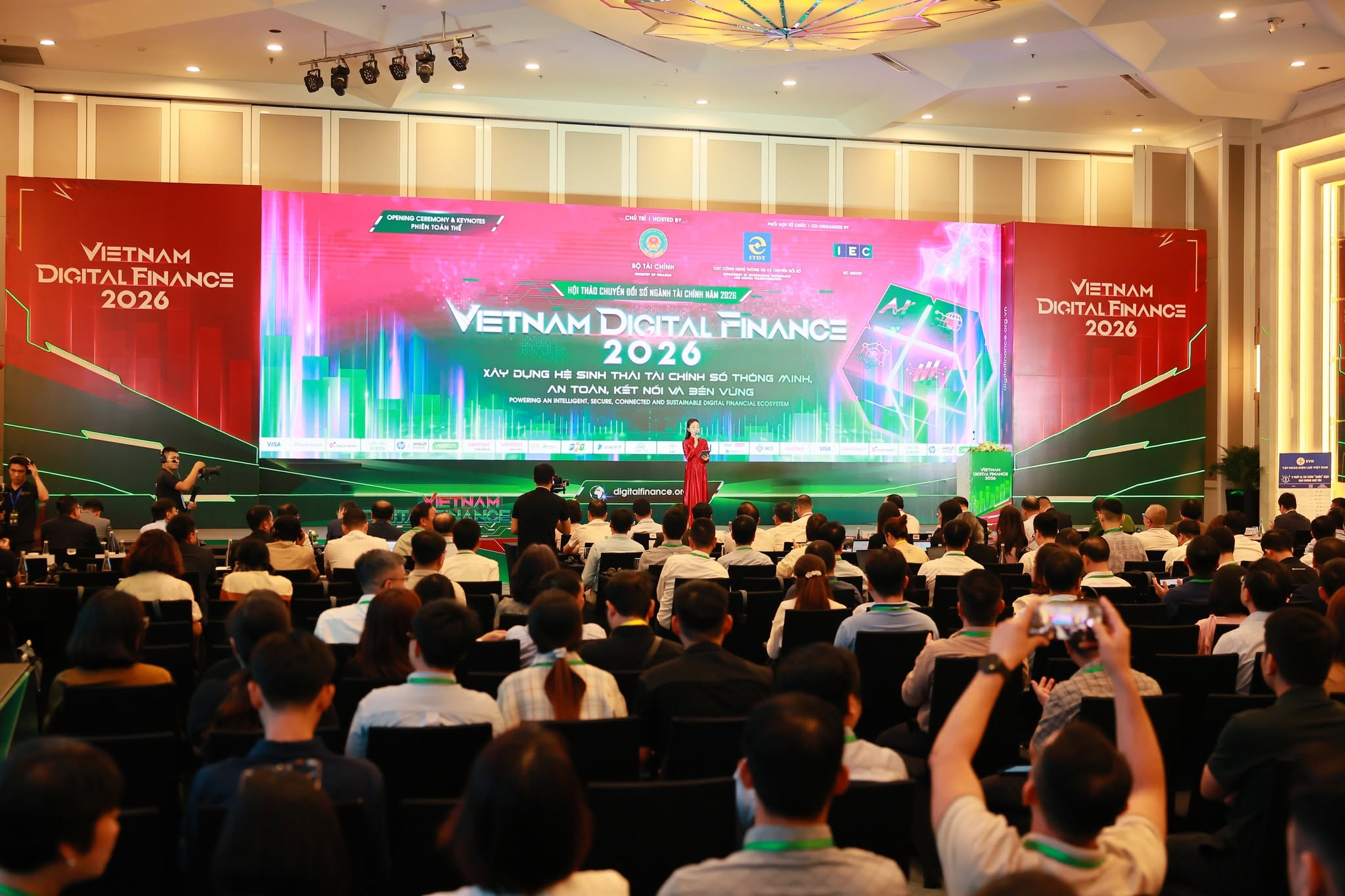
On September 24, 2026, DataCore attended Vietnam Digital Finance 2026 in Hanoi to hear the latest priorities from regulators, learn more about the challenges facing the financial sector, and connect with potential partners. One insight stayed with us throughout the day: AI offers significant opportunities, but its value depends on how organizations build, connect, govern, and protect their data.
The event featured a plenary session on building an intelligent, secure, connected, and sustainable digital financial ecosystem, followed by two parallel afternoon tracks on public finance and financial services in the AI era. The perspectives below bring together DataCore’s experience at the event and the published conference program; they are not a session-by-session account.

Trustworthy AI Starts with Trustworthy Data
A recurring theme in the plenary session was the gap between the ambition to use AI and the readiness of the data on which it relies.
- Mr. Nguyen Minh Ngoc, Deputy Director General of the Department of Information Technology and Digital Transformation at the Ministry of Finance, presented the Ministry’s digital transformation plan for 2026–2030.
- From a technology perspective, Mr. Nguyen Tuan Khang, Data & AI Leader for IBM Southeast Asia, explored how a Data Marketplace can provide a foundation for trustworthy AI. His session covered how organizations can discover, govern, and reuse data products through intelligent metadata, data quality controls, data lineage, and policy-driven governance.
For DataCore, this raises a practical question: Can a dataset be found, understood correctly, checked for quality, and used by the right people under the right conditions? These capabilities allow data to do more than sit in storage. They make it possible to reuse and combine data, then bring it into analytics and AI workflows with appropriate controls.
The stakes are particularly high in finance. When analytical outputs affect operations, risk management, or services for citizens and customers, organizations need to know where their data came from, how it was processed, and who is responsible for its use.
Further reading: Responsible AI Governance: Five Lessons for Vietnamese Businesses
The Distance Between an AI Pilot and Production
The conference also examined AI through the lens of implementation.
- Mr. Nguyen Hoang Minh, CEO of FPT IS, addressed the substantial gap between “having AI” and having the computing infrastructure and risk governance needed to make AI work in practice.
- Mr. Nguyen Van Quang, Strategic Accounts Director at VNPT AI, discussed rethinking financial services experiences in the era of data and AI agents.
As a company working in data and infrastructure, we believe this question belongs at the start of every AI project: A model that performs well in a pilot is not necessarily an application that can run reliably in production. Scaling it requires organizations to address data sources, computing capacity, access rights, performance monitoring, and emerging risks together.
The afternoon topics on data security, AI protection, and large-scale deployment reinforced that connection. Investment in AI must be accompanied by investment in the data foundations and operational capabilities that support it.
Further reading: Data as National Infrastructure: Why Vietnam Needs to Build a Core Foundation

Connecting Data Is a Business Challenge as Well as a Technical One
The track “Building Intelligent Public Finance Through Data and AI” brought the discussion closer to day-to-day operations. Its agenda covered connecting tax data with other agencies and using data to build a digital social insurance ecosystem. These topics featured Mr. Luu Nguyen Tri, Deputy Head of the Technology, Digital Transformation and Automation Division at the Tax Department, and Mr. Chu Manh Sinh, Deputy Director of Vietnam Social Security, respectively.
For DataCore, connecting systems is only part of the challenge. Data from different organizations becomes genuinely useful when those organizations share a consistent understanding of it, can verify information, keep it current, and apply it within a defined business process. Without those conditions, more data may flow between systems without a corresponding improvement in decisions or service experiences.
That is why standardization, quality control, and access governance should be considered when a cross-agency data system is designed. This is DataCore’s perspective on the challenges raised by the conference program, rather than a conclusion attributed to the participating agencies.
Digital Trust Must Be Protected Across the Data Journey
The parallel track, “Developing a Financial Services Ecosystem in the AI Era,” addressed risks involving customer data, financial fraud, and system security.
- Mr. Doan Huu Hau, Director of Strategy and Transformation at CMC Technology & Solution, examined financial services fraud in the AI era. Deepfakes, synthetic identities, voice cloning, AI-powered phishing, account takeovers, and fraud-as-a-service create new challenges as fraudulent activity becomes faster, more personalized, and easier to scale. Rule-based detection and fragmented monitoring systems face growing limitations.
- Mr. Tran Minh Quang, Director of the Cyber Threat Intelligence Analysis and Sharing Center at Viettel Cyber Security, focused on protecting customer data from software supply chain attacks. As outlined in the session, attackers are increasingly targeting developers, source code repositories, CI/CD platforms, and open-source packages - the channels through which organizations build and distribute software they rely on.
These topics are a reminder that data protection cannot be treated as a final security layer. Data moves across systems, operational teams, and technology partners; each connection needs to be managed. As AI accelerates processing and automation, access controls, usage monitoring, and the ability to review decisions become even more important.
Listening to the Market to Find the Right Opportunities to Collaborate
Beyond the conference sessions, DataCore had the opportunity to meet and speak with partners at the event. Those conversations helped us better understand the priorities financial institutions face when using data and deploying AI: finding suitable data sources, integrating with existing systems, meeting security requirements, and expanding processing capacity as demand grows.
Vietnam Digital Finance 2026 gave DataCore a clearer view of how data, AI, infrastructure, and digital trust fit together. We will continue listening to these needs, developing relevant data services and infrastructure capabilities, and staying connected with partners to identify opportunities to solve practical challenges together.






Để lại một bình luận
You must be logged in to post a comment.