

TL;DR: Vietnam is piloting a cost-sharing model that would make digital signature Vietnam adoption free for ordinary citizens, with businesses, hospitals, schools, and banks covering the cost instead. The plan builds on a digital signature Vietnam ecosystem that has already reached 45.62% adult adoption, according to the National Electronic Authentication Center (NEAC).
A new proposal could make digital signature Vietnam adoption free for millions of ordinary citizens. At a trust-services workshop in Can Tho hosted by the National Electronic Authentication Center (NEAC), digital-signature certification provider Mat Bao (branded MATBAO-CA) pitched a cost-sharing model: businesses, hospitals, schools, and banks would pay for the digital signature service so citizens, patients, and parents sign online transactions for free. A hospital could cover signature costs so a patient signs a treatment-consent form on a phone. A school could subsidize fees so parents sign enrollment paperwork. A bank could pay so customers sign loan contracts without a single printed page. It is a modest shift with real implications for eKYC and digital trust.
How Does the Digital Signature Vietnam Cost-Sharing Model Work?
The idea driving this round of digital signature Vietnam reform is simple: shift the cost from the individual signer to the institution that benefits from the transaction. Mat Bao, a digital-signature certification service provider, raised the proposal at the NEAC workshop in Can Tho, arguing that businesses, hospitals, schools, and banks are better positioned to absorb a small per-signature fee than individual citizens who sign only occasionally. Digital signatures already carry legal value equivalent to a handwritten signature in Vietnam, so removing the cost barrier does not require new legislation, only new payment arrangements.
A hospital could pay for digital signatures so patients sign treatment-consent forms directly on their phone before a procedure. A school could subsidize signature costs so parents sign enrollment paperwork without a trip to the office. A bank could cover the fee so customers sign loan contracts online instead of visiting a branch. Each example keeps the digital signature Vietnam transaction free at the point of use while the paying institution captures the efficiency gain of a fully digital, legally binding process.
How Is Digital Signature Vietnam Adoption Used Today?
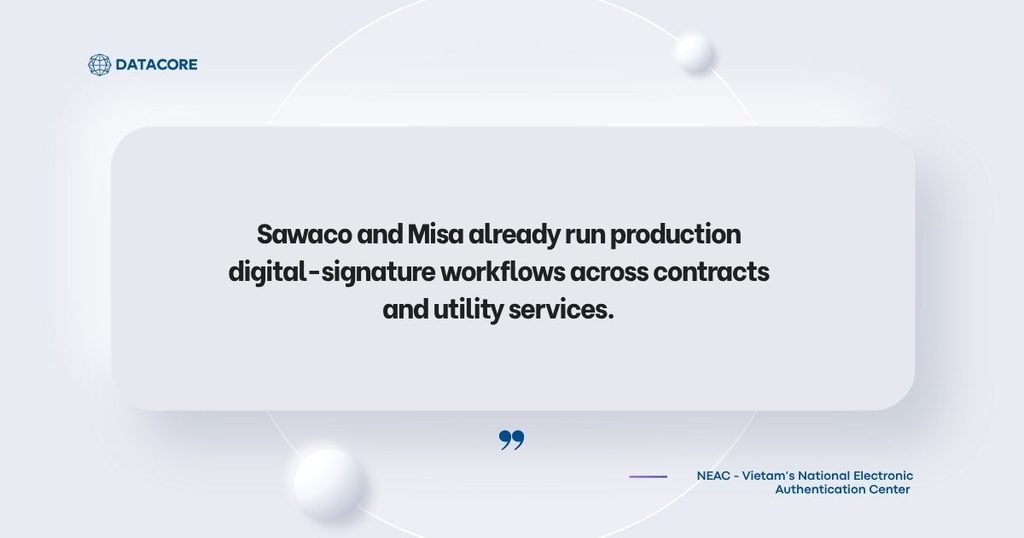
Digital signatures are not a future concept in Vietnam; they already sit inside everyday tax filing, contract signing, and online transaction workflows. Saigon Water Corporation (Sawaco) uses digital signatures for electronic water-supply contracts, ownership transfers, new meter installations, and usage-quota adjustments, Accounting software company Misa has integrated digital signatures into contract signing, e-invoices, documents, and internal approval workflows, showing the digital signature Vietnam model works for both business and citizen-facing services.
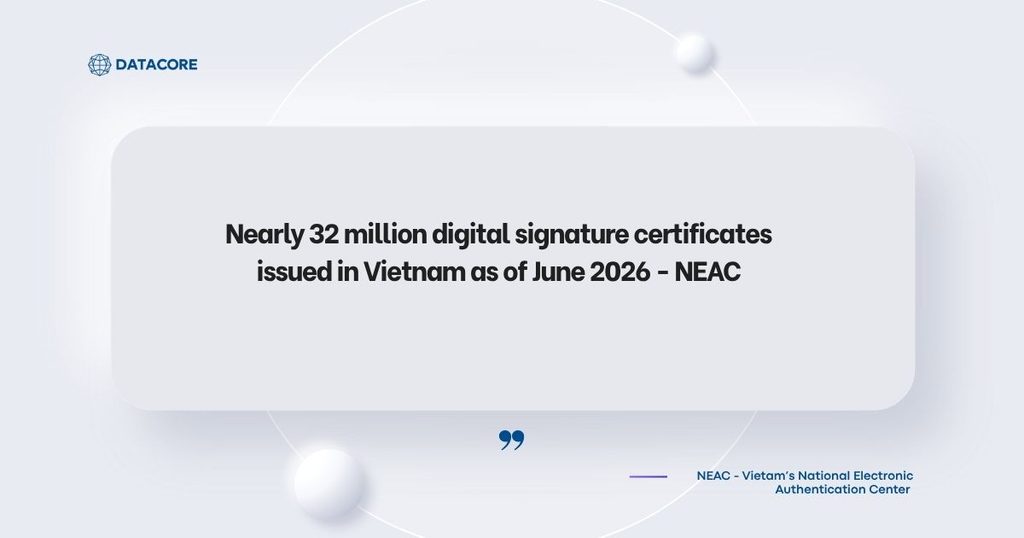
The national numbers back up how far the digital signature Vietnam ecosystem has already spread. As of end-June 2026, the National Electronic Authentication Center (NEAC) reports that Vietnam has issued nearly 32 million digital signature certificates, reaching 45.62% adoption among the adult population, with billions of electronic transactions completed using them. Vietnam's national digital-ID app, VNeID (Vietnam Electronic Identification), already includes a Digital Signature Certificate feature, putting the tool directly in citizens' pockets. DataCore has covered related trust challenges in its review of enterprise trust in Vietnam's digital transformation.
Why Does Certificate Count Miss Real Digital Signature Vietnam Adoption?
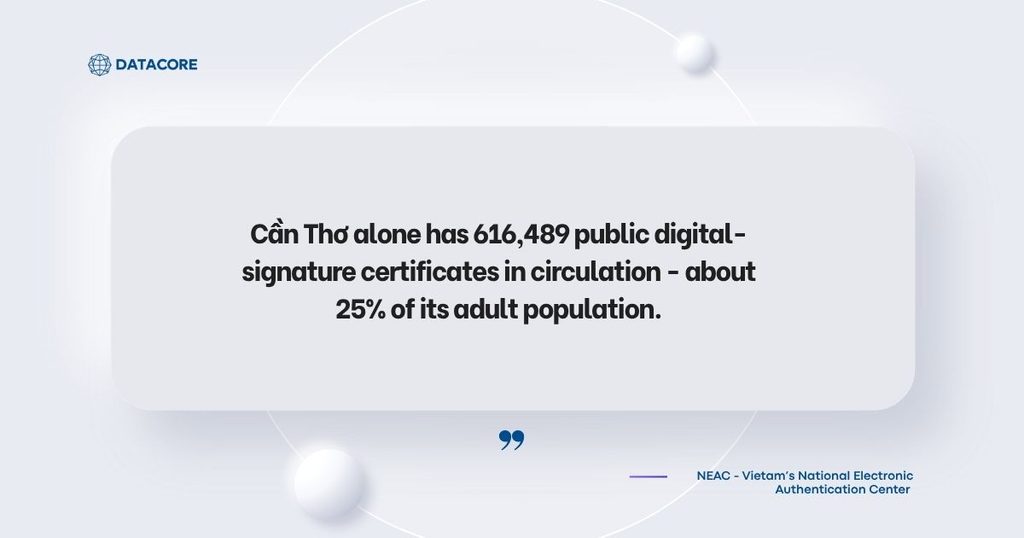
Issuing a certificate is not the same as using one, and officials at the workshop pushed back on counting the former as success rather than tracking real digital signature Vietnam usage. A Can Tho Department of Science and Technology official argued the city needs to shift its framing from certificates issued to certificates actually used, and from counting certificates to counting real transactions completed. Can Tho alone has 616,489 public digital-signature certificates in circulation, equivalent to about 25% of the local population aged 15 and older, and the city is working with the Ministry of Science and Technology toward 100% coverage of that population within five years.
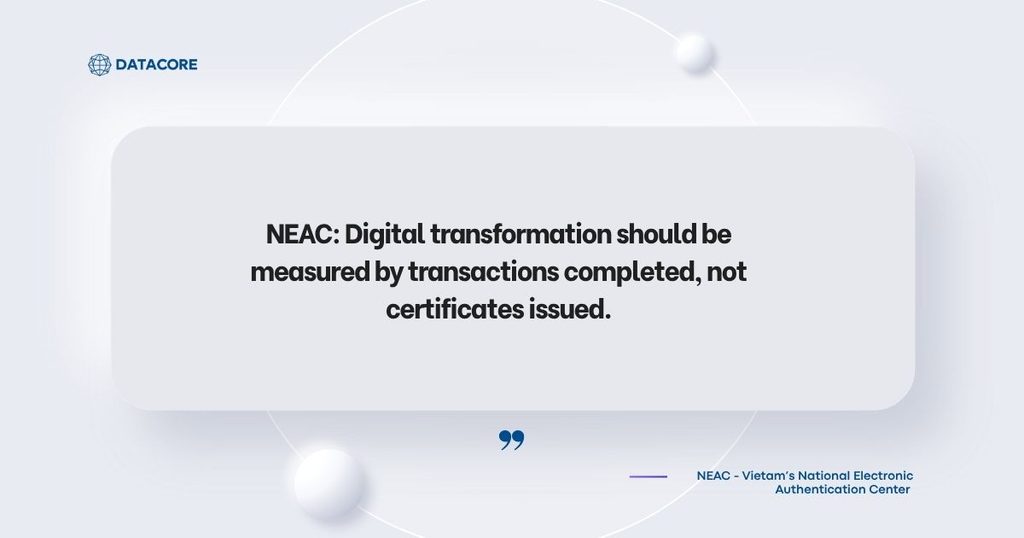
Pham Quoc Hoan, Deputy Director of NEAC, framed the same point at the national level: digital transformation should be measured by real transactions completed, paper processes replaced, and time and cost saved, not just the number of certificates issued. He said Vietnam needs a broader trusted-services ecosystem: electronic authentication, digital-signature certificates, electronic seals, and timestamping. That broader ecosystem is exactly where the digital signature Vietnam cost-sharing proposal could have its biggest multiplier effect, echoing themes DataCore explored in its analysis of open-source AI adoption trends for 2026.
Frequently Asked Questions
What is the digital signature Vietnam cost-sharing proposal?
It is a proposal, raised by digital-signature certification provider Mat Bao at a National Electronic Authentication Center (NEAC) workshop in Can Tho, for businesses, hospitals, schools, and banks to pay for the digital signature service so citizens can sign online transactions for free.
Are digital signatures legally valid in Vietnam?
Yes. Digital signatures carry legal value equivalent to a handwritten signature in Vietnam and are already used in tax filing, contract signing, and online transactions.
How many people in Vietnam use digital signatures?
As of end-June 2026, the National Electronic Authentication Center (NEAC) reports nearly 32 million digital signature certificates issued nationwide as part of the wider digital signature Vietnam rollout, reaching 45.62% adoption among the adult population.
What role does VNeID play in digital signatures?
VNeID (Vietnam Electronic Identification), the national digital-ID app, already includes a Digital Signature Certificate feature, giving citizens a built-in way to sign transactions from their phone.
Why does Can Tho track certificate usage instead of just issuance?
A local Can Tho official argued that counting certificates used, not issued, is the better gauge of digital signature Vietnam progress.
Free digital signatures only work if the paying institution can trust who is on the other end of the transaction, whether a patient, a parent, or a loan applicant. That trust question is an eKYC (electronic Know Your Customer) problem, exactly where DataCore focuses. Businesses weighing a cost-sharing digital signature Vietnam rollout can explore DataCore's eKYC Platform and other identity and data services, including DataCore's Company Intelligence Service for verifying counterparties, and can review DataCore's guide to building personal financial resilience as more transactions move online.
Sources
- VnExpress, Trong Dat (2026-08-26), "De xuat de nguoi dan dung chu ky so mien phi"
- Adoption statistics attributed to the National Electronic Authentication Center (NEAC), as cited in the VnExpress report, end-June 2026.






Để lại một bình luận
You must be logged in to post a comment.