
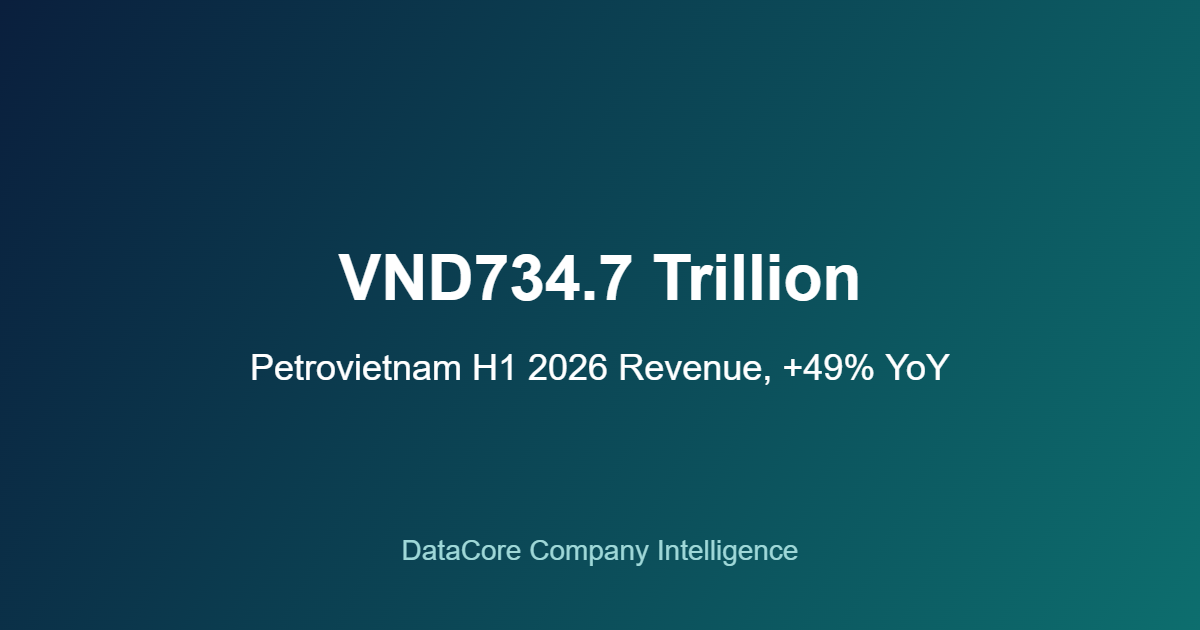
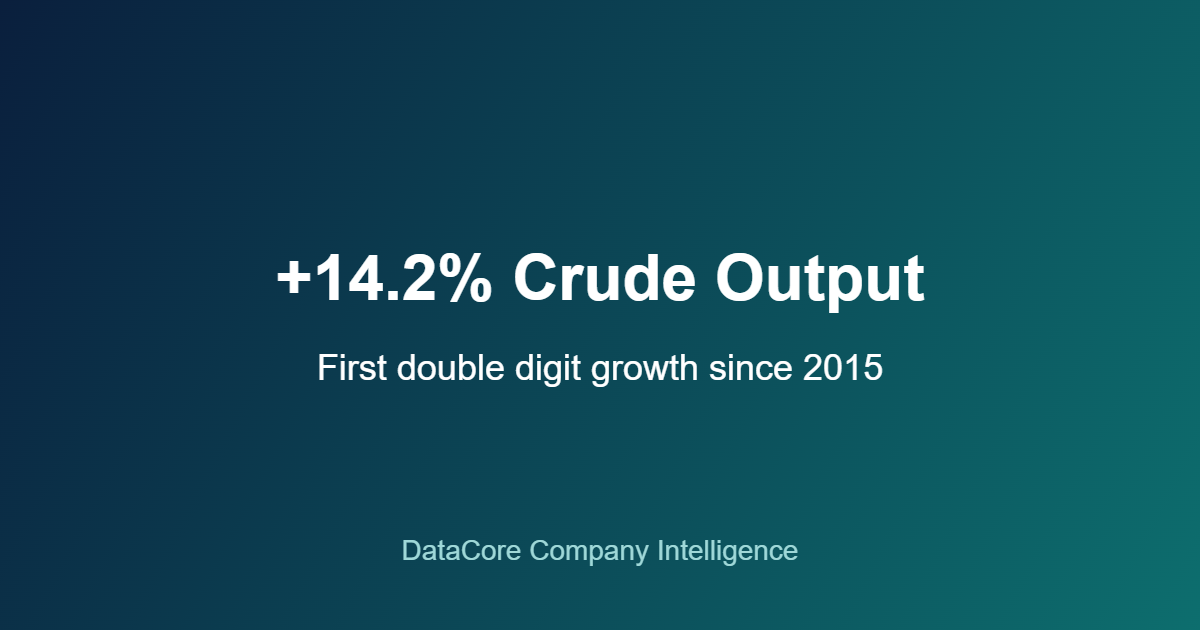
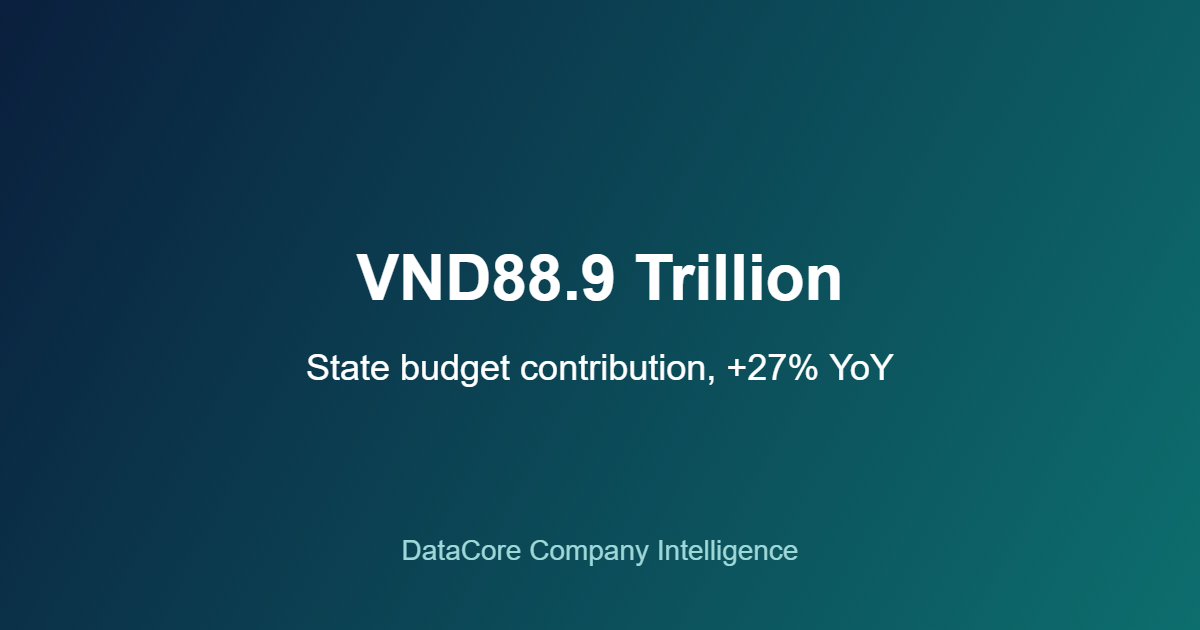
TL;DR: Petrovietnam revenue growth hit 49% year on year in H1 2026. The state energy group posted VND734.7 trillion in total group revenue and VND445.4 trillion in consolidated revenue, 22% above plan. Crude oil output rose 14.2% year on year, the first double-digit increase since 2015. State budget contributions reached VND88.9 trillion, up 27%. Sources: Bao Nhan Dan (10 July 2026) and Bao Cong Thuong (13 July 2026).
How much did Petrovietnam's revenue grow in H1 2026?
Petrovietnam (formally the Vietnam Industry-Energy Group, Tap doan Cong nghiep-Nang luong Quoc gia Viet Nam) is Vietnam's state-owned oil and gas conglomerate. In the first half of 2026, total group revenue across the Petrovietnam ecosystem reached an estimated VND734.7 trillion, up 49% compared with the same period in 2025. That single figure is the clearest read on Petrovietnam revenue growth this year: a jump this size, on a base this large, is unusual even for a state energy group with Petrovietnam's scale.
Consolidated revenue, the narrower measure covering the parent company and its core subsidiaries, came in at VND445.4 trillion, up 39% year on year and 22% above the group's own semi-annual plan. International business revenue added roughly VND97.8 trillion, equal to 65.5% of Petrovietnam's full-year international target. Petrovietnam revenue by segment was broad-based rather than concentrated in one business line: exploration and production revenue rose 66%, the gas-power-fertilizer segment rose 41%, refining and product distribution rose 46%, and technical services rose 24%.
Why did crude oil output rise for the first time in 11 years?
Underneath the Petrovietnam revenue growth headline sits an operational number that matters just as much: domestic crude oil extraction rose 14.2% year on year in H1 2026. According to Bao Cong Thuong, this is the first double-digit increase in domestic crude output since 2015, even as several mature fields continue their natural production decline.
Petrovietnam's leadership credited the reversal to signing three new petroleum contracts, adding 8.3 million tonnes of oil-equivalent reserves (55.3% of the annual target), and pushing three flagship projects forward: early gas from the Su Tu Trang field's ST-9P well, progress toward first oil at Lac Da Vang in October 2026, and continued work on the Block B - O Mon gas chain, a roughly $13 billion project expected to deliver first gas in 2027. Natural gas output still grew 6.8% even though downstream consumers have not yet fully absorbed Petrovietnam's supply capacity.
How much did Petrovietnam pay into the state budget?
State budget remittances from the group reached VND88.9 trillion in H1 2026, up 27% year on year. Combined with the H1 investment disbursement of VND27.5 trillion, up more than 70% year on year, the numbers show a group reinvesting aggressively while still handing more back to the state than a year earlier.
Petrovietnam's leadership has flagged that even a single percentage point of additional growth from a group this size moves the needle on Vietnam's overall state revenue, which is part of why the government has pushed so hard on the group's 2026 targets. It is a similar dynamic to Vingroup's outsized pull on the VN-Index: a handful of state-linked giants can move national-level numbers almost on their own, which is exactly why Petrovietnam revenue growth gets read as a signal for the wider economy, not just for one company's balance sheet.
What is driving Petrovietnam's push for double-digit growth in 2026?
2026 is the first year of Vietnam's 14th Party Congress resolution and the opening year of the 2026-2030 development phase, and the government has set a double-digit GDP growth ambition for the whole economy. Petrovietnam's leadership has been explicit that meeting a double-digit target is "a political task," not only a business one, given the group's scale. Deputy Prime Minister Pham Gia Tuc reinforced that message at the group's mid-year review, telling leadership not to be satisfied with H1 results and to track progress weekly rather than settle for a good six months.
The same growth push sits inside a broader national effort to attract capital and lift state-sector output, echoed in Vietnam's FDI strategy under Doi Moi 2.0, where foreign and state investment are both being leaned on to hit 2026 growth goals. Petrovietnam's own target for 2026 is VND105.8 trillion in investment, more than double what it actually deployed in 2025, aimed at the Lo B - O Mon gas chain, the Ca Voi Xanh field restart, and the Dung Quat refinery expansion.
How does Petrovietnam's growth compare with the rest of the state sector?
Petrovietnam is not the only state-owned giant chasing a double-digit target in 2026. Vietnam Electricity (EVN) and several other state groups reported similar growth pushes over the same period, part of a coordinated government campaign to lift the state sector's contribution to GDP. What sets the Petrovietnam revenue growth story apart is scale: at VND734.7 trillion in H1 revenue alone, Petrovietnam's six-month numbers are large enough that a single percentage point of extra Petrovietnam revenue growth shows up in national accounts, which is a big part of why the figures were still being cited in national media on 19 August 2026, more than a month after the original H1 report.
Reading Petrovietnam revenue growth in isolation misses that context. The number is as much a proxy for how the whole state sector is performing against the government's 2026 growth mandate as it is a scorecard for one company.
What does tracking a state giant like Petrovietnam mean for other businesses?
Petrovietnam revenue growth is one data point in a much larger pattern: Vietnam's state-owned enterprises are being pushed toward double-digit growth simultaneously, and each one reports revenue, tax contributions, and production metrics on its own schedule, in its own format, across dozens of individual disclosures. Building a reliable comparison across companies, or simply tracking one company's quarter-over-quarter Petrovietnam revenue figures against its peers, means someone has to pull every one of those numbers by hand from a different press release each time.
DataCore's Company Intelligence Service structures exactly this kind of company financial, tax, and production data for businesses operating in Vietnam, so revenue growth, budget contribution, and output figures like the Petrovietnam revenue numbers in this post are available in one structured, comparable, continuously updated dataset instead of scattered across dozens of press releases and PDF reports.
FAQ
What was Petrovietnam's total revenue in H1 2026?
Total group revenue reached an estimated VND734.7 trillion, up 49% year on year (Bao Nhan Dan, Bao Cong Thuong, July 2026).
How much of that was consolidated revenue?
Consolidated revenue was VND445.4 trillion, up 39% year on year and 22% above Petrovietnam's own H1 plan.
Why does an 11-year streak matter for crude oil output?
Domestic crude oil production had not posted a first-half, double-digit year-on-year increase since 2015; H1 2026's 14.2% growth breaks an 11-year run of flat or declining output.
How much did Petrovietnam contribute to Vietnam's state budget in H1 2026?
VND88.9 trillion, up 27% year on year, alongside VND27.5 trillion in investment disbursement, up more than 70%.
What is Petrovietnam's 2026 growth target?
Double-digit growth group-wide, in line with the Vietnamese government's broader push for state-owned enterprises to hit double-digit GDP contribution in 2026, backed by a planned VND105.8 trillion in 2026 investment.
Sources
- Bao Nhan Dan, "Petrovietnam dat doanh thu hon 734 nghin ty dong" (10 July 2026) - nhandan.vn
- Bao Cong Thuong, "Sau 11 nam, lan dau tien san luong khai thac dau tho tang truong hai con so" (13 July 2026) - congthuong.vn
- Sputnik Vietnam (Kevesko), "'Dau tau' kinh te Nha nuoc tang toc truoc muc tieu tang truong hai con so" (19 August 2026) - kevesko.vn






Để lại một bình luận
You must be logged in to post a comment.