
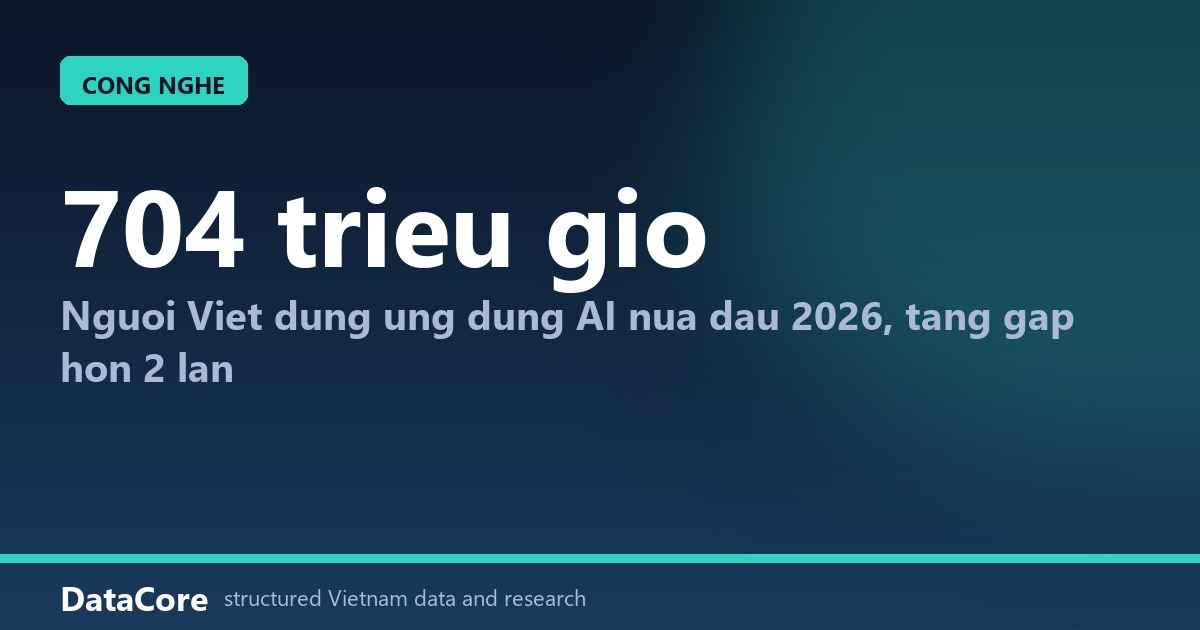
The Vietnam AI app boom just hit a milestone: users spent 704 million hours in AI apps in the first half of 2026, more than double the 283 million hours a year earlier. Spending and Vietnamese-language usage surged alongside it.
How big is the Vietnam AI app boom?
In the first half of 2026, users in Vietnam spent 704 million hours on mobile AI applications, according to a Sensor Tower market report cited by VnExpress on 2026-08-03. That is more than double the 283 million hours recorded in the first half of 2025.
| Metric (Vietnam) | H1 2025 | H1 2026 | Change |
|---|---|---|---|
| Time in AI apps | 283 million hours | 704 million hours | +149% |
| Sessions | 8.82 billion | 18.6 billion | +111% |
| In-app purchase revenue | 7.44 million USD | 14.4 million USD | +94% |
Takeaway on the Vietnam AI app boom: every dimension - time, frequency, and money - roughly doubled in a single year. Source: Sensor Tower via VnExpress, as of 2026-08-03.
Are users paying for AI apps?
Yes, increasingly. In-app purchase revenue nearly doubled year on year, from 7.44 million USD (H1 2025) to 14.4 million USD (H1 2026). Combined with 18.6 billion sessions, the pattern behind the Vietnam AI app boom is clear: users are not just trying AI once, they return daily and pay for advanced features.
This mirrors a wider regional race in model capability - see our breakdown of China AI model benchmarks in 2026 for how quickly the underlying models are improving.
Why does Vietnamese-language AI matter?
According to Google's Gemini report cited by VnExpress (2026-08-03), 89% of prompts sent to Gemini in Vietnam were written in Vietnamese - the highest share in Southeast Asia. High-quality native-language data is the foundation of the Vietnam AI app boom: models that understand Vietnamese well win Vietnamese users.
Rapid adoption also raises governance questions. Our piece on AI security auditing covers where automated systems still need human verification.
What does the Vietnam AI app boom mean for business?
Behind every digital trend are companies. The AI surge is reshaping which Vietnamese technology firms matter - who raises capital, who hires, who ships. Compute and connectivity underpin all of it; see Vietnam infrastructure investment data for the physical layer beneath the software boom.
To track those companies with structured, verified data - financials, ownership, and key people - DataCore offers the Company Intelligence Service (live, GA) via API, web dashboard, and CSV export. Explore it at datacore.vn/en/services.
FAQ
Q: Where do these Vietnam AI app boom figures come from?
A: A Sensor Tower market report on global AI apps for H1 2026, reported by VnExpress on 2026-08-03. The H1 2025 comparison (283 million hours) comes from VnExpress on 2026-10-21, citing the same source.
Q: Is 704 million hours mobile only?
A: Yes. It measures time in AI apps on smartphones (iOS and Android) and excludes web usage.
Q: Which AI apps are counted?
A: Consumer AI assistant and generative apps tracked by Sensor Tower; leading apps in the market include ChatGPT and Gemini.
Q: How can I track the companies behind the boom?
A: DataCore Company Intelligence Service provides structured company data via API and dashboard: datacore.vn/en/services.
Sources
- Sensor Tower, global AI market report H1 2026, via VnExpress: "Nguoi Viet danh 700 trieu gio cho ung dung AI trong nua nam" (2026-08-03), author Luu Quy.
- H1 2025 comparison (283 million hours): VnExpress, "Nguoi Viet danh gan 300 trieu gio cho ung dung AI trong nua nam" (2026-10-21), same Sensor Tower source.
- Vietnamese-language prompt share (89%): Google Gemini report, cited by VnExpress (2026-08-03).
This Vietnam AI app boom briefing was published 2026-08-09. All figures carry their source and as-of date. DataCore - structured Vietnam data and research.






Để lại một bình luận
You must be logged in to post a comment.