
TL;DR: The Bibica Q2 2020 results showed net revenue of about VND 171 billion (down 18.2 percent year over year) yet net profit after tax of roughly VND 49 billion, about 3.8 times the level of Q2 2019, according to CafeF (July 21, 2020). The jump did not come from selling more confectionery. A one-off transfer of land use rights at Bibica North added nearly VND 78 billion of other income, offsetting the first operating loss in the company's listed history (about VND 14.4 billion). This Bibica Q2 2020 case study walks through the income statement with a Sankey flow chart and draws the earnings-quality lessons that still apply to any Vietnamese stock today.
Who Is Bibica and Why Does BBC Matter on HOSE?
Bibica Corporation (Ho Chi Minh Stock Exchange ticker: BBC) is one of Vietnam's best known confectionery producers, making biscuits, candy, cakes, and nutritional products. The company grew out of Bien Hoa Confectionery and was among the earliest tickers listed on the Ho Chi Minh Stock Exchange (HOSE), joining the board in 2001. By 2020 it operated under the umbrella of PAN Group (HOSE: PAN), the Vietnamese agriculture and food holding company, after a long tug-of-war over ownership with South Korea's Lotte Confectionery.
That history matters for readers of the Bibica Q2 2020 report. BBC has never been a high-turnover speculative ticker; it is a small-cap consumer staple followed for its steady brand, its land assets, and its shareholder politics. When a company like this suddenly reports profit multiplying several times over in a pandemic quarter, the right instinct is not celebration. It is to ask where the money came from.

What Do the Bibica Q2 2020 Numbers Show?
The headline pairing of the Bibica Q2 2020 results, falling sales and surging profit, resolves quickly once the income statement is laid out line by line. All figures below are from the Q2 2020 financial statements as reported by CafeF on July 21, 2020, in VND billion, with year-over-year comparisons against Q2 2019.
| Income statement line | Q2 2020 (VND billion) | Change vs Q2 2019 |
|---|---|---|
| Net revenue | 171 | down 18.2 percent |
| Gross profit | 33.7 | down 46 percent |
| Selling expenses | 32 | elevated relative to shrunken sales |
| General and administrative expenses | 19.3 | elevated relative to shrunken sales |
| Operating profit | minus 14.4 | versus plus 12.3 in Q2 2019 |
| Other income (land use rights transfer) | about 78 | versus about 3 in Q2 2019 |
| Net profit after tax | 49 | about 3.8 times Q2 2019 |
Text takeaway: every operating line of the Bibica Q2 2020 statement deteriorated, and the entire net profit, plus the hole left by operations, was covered by a single non-recurring gain of nearly VND 78 billion.
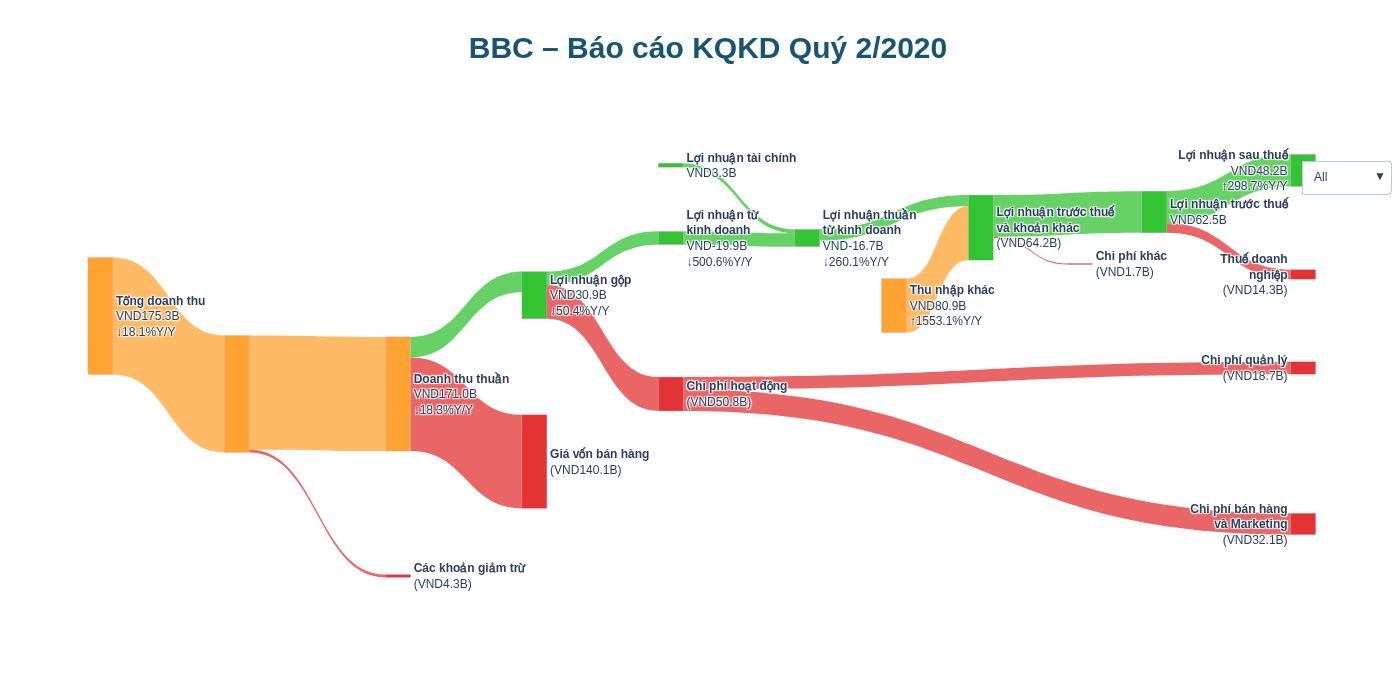
Text takeaway from the chart: in the Bibica Q2 2020 Sankey, the flow that reaches net profit barely touches the revenue side of the diagram; it enters from the separate other-income branch created by the land transfer.
Where Did the Bibica Q2 2020 Profit Actually Come From?
The answer is real estate, not candy. During the quarter Bibica transferred land use rights at its Bibica North site, booking a gain of nearly VND 78 billion in other income, against roughly VND 3 billion of other income in the same quarter of 2019, per CafeF (July 21, 2020) and Nhip cau Thuong hieu (July 22, 2020).
Strip that gain out and the Bibica Q2 2020 quarter shows a business under real pressure. Net revenue fell 18.2 percent to about VND 171 billion, but cost of goods sold fell only 6.5 percent, so gross profit was cut nearly in half to VND 33.7 billion. With selling expenses of about VND 32 billion and administrative expenses of VND 19.3 billion barely adjusting to the smaller revenue base, operations posted a loss of about VND 14.4 billion, versus a profit of VND 12.3 billion a year earlier.
CafeF flagged the deeper significance: it was the first time in Bibica's listed history that the core business recorded a loss. The Bibica Q2 2020 release is therefore a textbook example of a quarter in which the headline profit number and the health of the underlying business point in opposite directions.
How Does the Sankey View Expose Earnings Quality?
An income statement is a table of subtractions; a Sankey diagram turns it into flows whose width is proportional to money. That single design choice makes earnings quality visible at a glance. In the Bibica Q2 2020 chart above, the revenue flow narrows sharply at the gross profit junction, then disappears entirely into costs before reaching operating profit. Net profit is fed almost wholly by a separate flow entering from the side: the land gain.
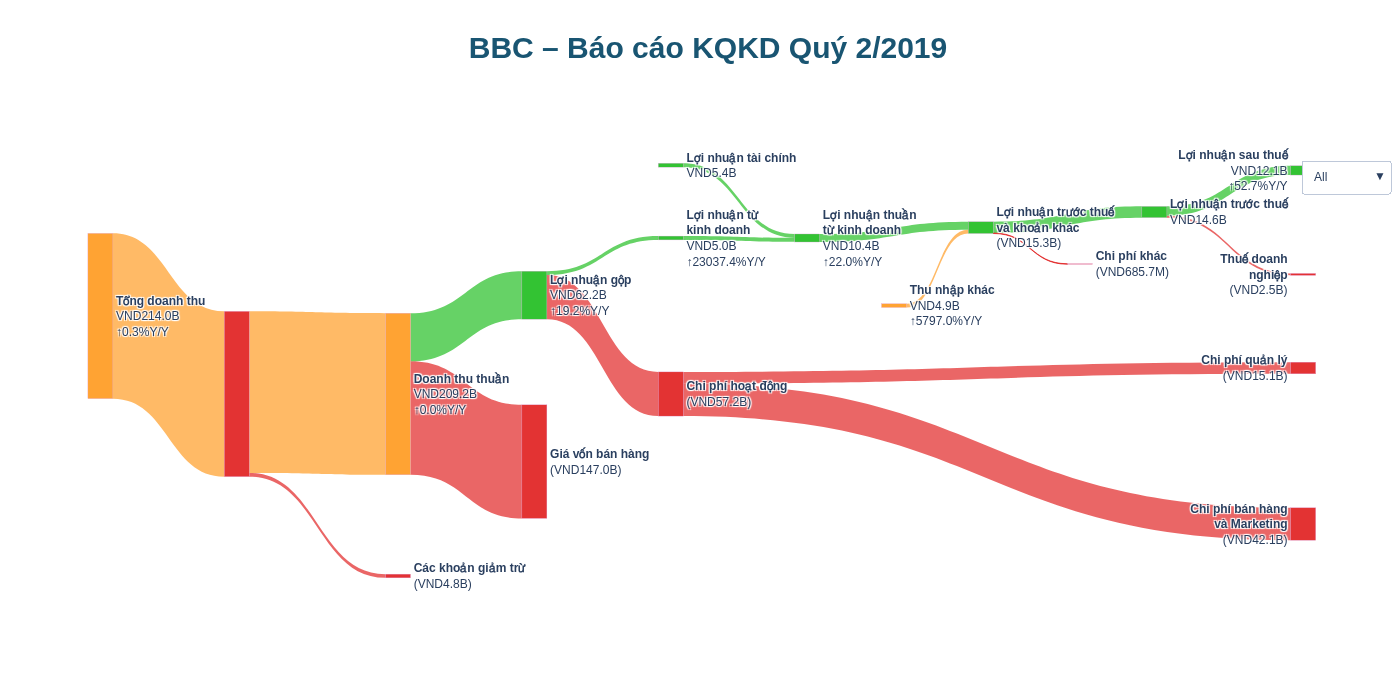
Text takeaway from the comparison: in Q2 2019 the profit flow originates inside operations; in the Bibica Q2 2020 diagram it originates outside them. Two pictures communicate what would otherwise take a paragraph of ratio analysis.
Analysts formalize this instinct as earnings quality: the share of reported profit that comes from recurring, cash-generating operations rather than one-off items. Land can be sold once. Candy is sold every quarter. A profit built on the first source deserves a lower multiple than the same profit built on the second, which is why experienced HOSE investors read the other-income line before they read the bottom line.
What Was the COVID-19 Context in Vietnam in Q2 2020?
The revenue decline in the Bibica Q2 2020 report did not happen in a vacuum. Vietnam entered nationwide social distancing in April 2020, closing schools, restricting gatherings, and emptying the wedding halls and festival seasons that drive gift-box confectionery demand. Supermarket traffic recovered only gradually through May and June 2020.
The half-year figures confirm the pressure: for the first six months of 2020 Bibica recorded net revenue of VND 377.4 billion, down 25 percent year over year, with net profit after tax of VND 50 billion, up 108 percent only because of the land gain booked in the second quarter, per CafeF. In other words, essentially all of the first-half profit growth in the Bibica Q2 2020 period traces back to a single transaction.
What Happened After the Bibica Q2 2020 Report?
The one-off gain did its job for the full year. Bibica closed 2020 with profit of VND 97.1 billion, 10.4 percent above its annual plan, as reported by Tin nhanh Chung khoan (January 2021). The core confectionery business recovered gradually as social distancing eased, and the company went on to declare substantial cash dividends in the following years, including a 36 percent cash dividend approved in 2021 (CafeF, August 2021).
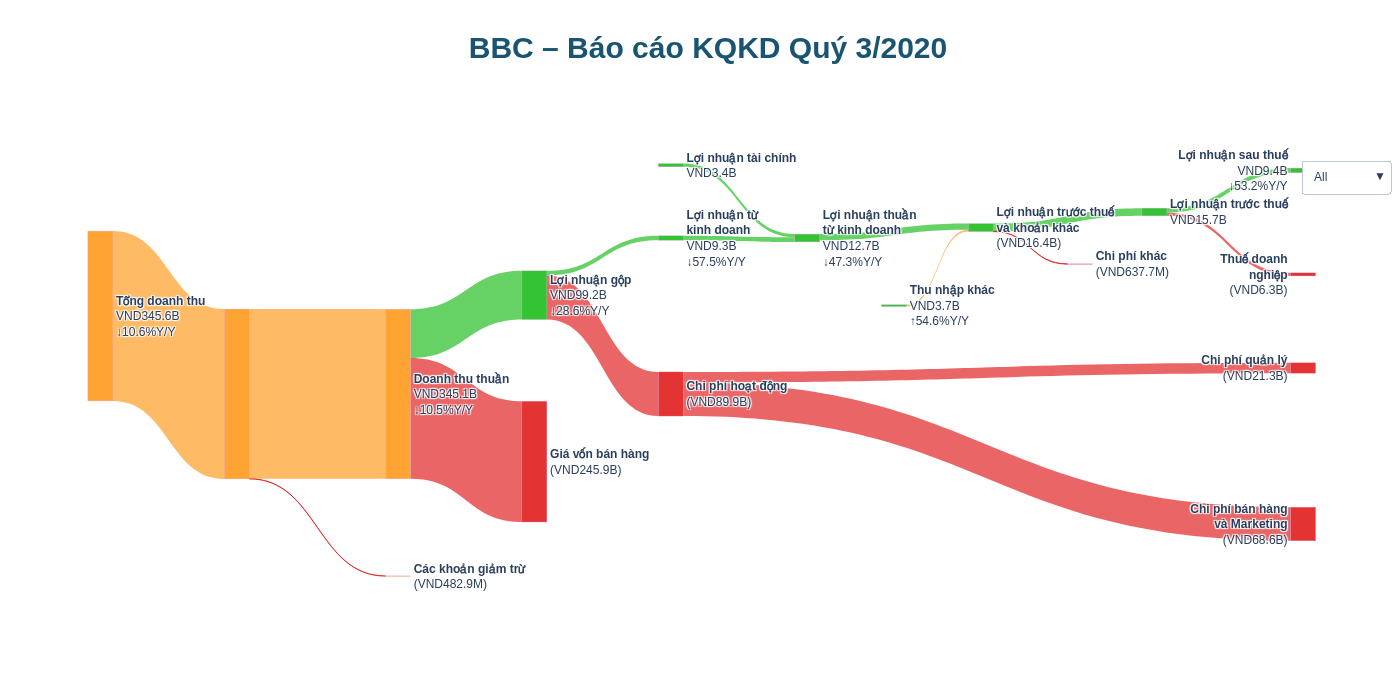
Text takeaway from the chart: the following quarter's Sankey shows profit once again fed from operations, confirming that the Bibica Q2 2020 structure was an exception rather than a new normal.
How Do You Read a Sankey Income Statement?
For readers new to the format, a Sankey income statement has three elements. Nodes are the line items of the statement: net revenue, gross profit, operating profit, net profit. Flows are the ribbons connecting them, drawn with width proportional to the amount of money moving between lines. Junctions are where flows split, and they encode the subtractions: the gap between the revenue ribbon and the gross profit ribbon is cost of goods sold, the gap after that is operating expense.
Vietnamese statements prepared under Circular 200 map cleanly onto this structure: doanh thu thuan (net revenue), gia von hang ban (cost of goods sold), chi phi ban hang (selling expenses), chi phi quan ly doanh nghiep (administrative expenses), and thu nhap khac (other income). It is that last line, thu nhap khac, that enters a Sankey as a side flow, and the Bibica Q2 2020 chart is a vivid example of how prominent that side flow can become.
Three reading habits pay off quickly. First, scan junction angles: a healthy quarter narrows gently from left to right, while margin compression shows up as an abrupt pinch at the gross profit node. Second, look for flows that enter from outside the main left-to-right stream; every one of them is non-operating by definition. Third, compare the same company across quarters, because flow shapes are far easier to remember than ratio tables, which is exactly why the Q2 2019, Bibica Q2 2020, and Q3 2020 charts in this article communicate the story in seconds.
Why Do Vietnamese Small Caps Sit on Valuable Land?
The transaction behind the Bibica Q2 2020 gain is part of a much broader pattern on Vietnamese exchanges. Manufacturers listed in the 2000s often hold factory sites acquired decades earlier, carried on the balance sheet at historical cost. As cities expanded, land that was industrial periphery in the 1990s became prime urban or logistics real estate, creating a silent gap between book value and market value.
Monetizing that gap is legitimate and common: factories relocate to industrial parks, and the vacated land use rights are transferred at market prices. For shareholders the important distinction is between the asset story and the earnings story. A land transfer converts a hidden balance-sheet asset into visible cash once. It says nothing about whether the company can sell more product next quarter, which is why the operating flow in the Bibica Q2 2020 Sankey, not the land flow, was the number to watch.
Investors who screen for this pattern typically watch two signals together: an other-income spike in the income statement and a matching disposal in the cash flow statement's investing section. When both appear, the next stop is the footnotes, then the question of what management intends to do with the proceeds: reinvest in capacity, pay it out as dividends, or cover an operating hole, as happened in the quarter examined here.
Which Ratios Complement the Sankey View?
Flow charts build intuition; ratios make it comparable across companies. Four simple calculations, all computable from the lines already discussed, complete the Bibica Q2 2020 picture.
- Gross margin: gross profit over net revenue. It fell from roughly 30 percent in Q2 2019 to about 19.7 percent in Q2 2020 (33.7 over 171), quantifying the pinch visible at the first Sankey junction.
- Operating margin: operating profit over net revenue, about minus 8.4 percent for the quarter. A negative sign here with a positive bottom line is the single fastest one-off detector in Vietnamese statements.
- Non-operating share of profit: other income over pre-tax profit. In the Bibica Q2 2020 quarter this exceeded 100 percent, meaning operations subtracted from, rather than added to, the reported result.
- Expense stickiness: the ratio of expense decline to revenue decline. Selling and administrative costs barely moved against an 18.2 percent revenue fall, showing a largely fixed cost base in the short run.
None of these calculations require anything beyond the published statement. What they require is the discipline to run them every quarter, on every holding, which is precisely the kind of repetitive work that structured data services exist to automate. A screening rule as simple as operating margin negative while net margin positive would have flagged the Bibica Q2 2020 filing within a day of publication.
The reverse screen is equally useful. Quarters where operating profit grows while net profit shrinks often mark the unwinding of past one-offs, and they tend to be mispriced in the opposite direction: the business is improving while the headline number deteriorates. Flow-based reading habits catch both cases, because the eye is drawn to where profit comes from rather than how large it is.
What Should Investors Learn from the Bibica Q2 2020 Case?
Six years on, the Bibica Q2 2020 quarter remains one of the cleanest teaching examples on HOSE because every distortion sits in one line item. The checklist it leaves behind applies to any earnings season.
- Read other income before the bottom line. Any quarter where the other-income line rivals gross profit deserves a footnote hunt. Land, subsidiary divestments, and revaluations are the usual suspects on Vietnamese statements.
- Watch the gross margin, not just revenue. Revenue fell 18.2 percent but cost of goods sold fell only 6.5 percent. Sticky input costs cut the margin in half, a signal about pricing power that survives the one-off noise.
- Compare operating profit with net profit over time. When the two series diverge sharply in one quarter, something non-recurring happened. A divergence that persists is a business-model question.
- Check what management does next. Bibica used the cushion to hold its full-year plan through a pandemic. That is a legitimate use of a one-off, but it is not organic growth and should not be projected forward.
How DataCore Turns Filings into Flow Charts
The Sankey diagrams in this Bibica Q2 2020 analysis are produced by DataCore CashStream, our income statement visualization service that converts every listed Vietnamese company's quarterly filing into a flow chart within days of publication. Paired with the structured fundamentals in DataCore's Company Intelligence Service and the datasets on our data domain catalog, analysts can screen an entire exchange for quarters where net profit and operating profit tell different stories.
For more current coverage of Vietnamese finance, see our analyses of the 40 percent short-term capital cap for banks and the AI data center investment wave, both of which apply the same source-verified approach used in this Bibica Q2 2020 retrospective.
Frequently Asked Questions About the Bibica Q2 2020 Results
What were the Bibica Q2 2020 results in one sentence?
Net revenue of about VND 171 billion, down 18.2 percent year over year, and net profit after tax of about VND 49 billion, roughly 3.8 times Q2 2019, driven by a one-off land gain, according to CafeF (July 21, 2020).
Why did profit rise while revenue fell?
Because of nearly VND 78 billion in other income from transferring land use rights at Bibica North. Without it, the Bibica Q2 2020 quarter would have shown a net loss, since operations lost about VND 14.4 billion.
Was this Bibica's first operating loss?
Yes. CafeF reported the Bibica Q2 2020 operating loss of about VND 14.4 billion as the first loss from the core business in the company's history as a listed firm.
Is a one-off land gain bad for shareholders?
Not inherently. Monetizing idle land is rational capital allocation. The risk is valuation: pricing the stock as if the Bibica Q2 2020 profit level were repeatable would overstate sustainable earnings several times over.
How did the rest of 2020 turn out for Bibica?
Full-year 2020 profit reached VND 97.1 billion, 10.4 percent above plan (Tin nhanh Chung khoan, January 2021), as operations recovered in the second half.
Sources
- CafeF: "Bibica (BBC): Quy 2 lai 49 ty dong gap 4 lan cung ky nho chuyen nhuong quyen su dung dat Bibica mien Bac", July 21, 2020.
- Nhip cau Thuong hieu: "Bibica (BBC) thoat lo nho chuyen nhuong quyen su dung dat Bibica mien Bac", July 22, 2020.
- Tin nhanh Chung khoan: "Nam 2020, Bibica (BBC) loi nhuan dat 97,1 ty dong, vuot 10,4% ke hoach nam", January 2021.
- CafeF: "Bibica (BBC) chot quyen nhan co tuc bang tien ty le 36%", August 2021.
- Bibica Corporation: Financial reports page (primary filings).
Curious how the latest AI models actually compare? Check DataCore's AI Leaderboard, a free, real time ranking of frontier AI models updated continuously.






Để lại một bình luận
You must be logged in to post a comment.